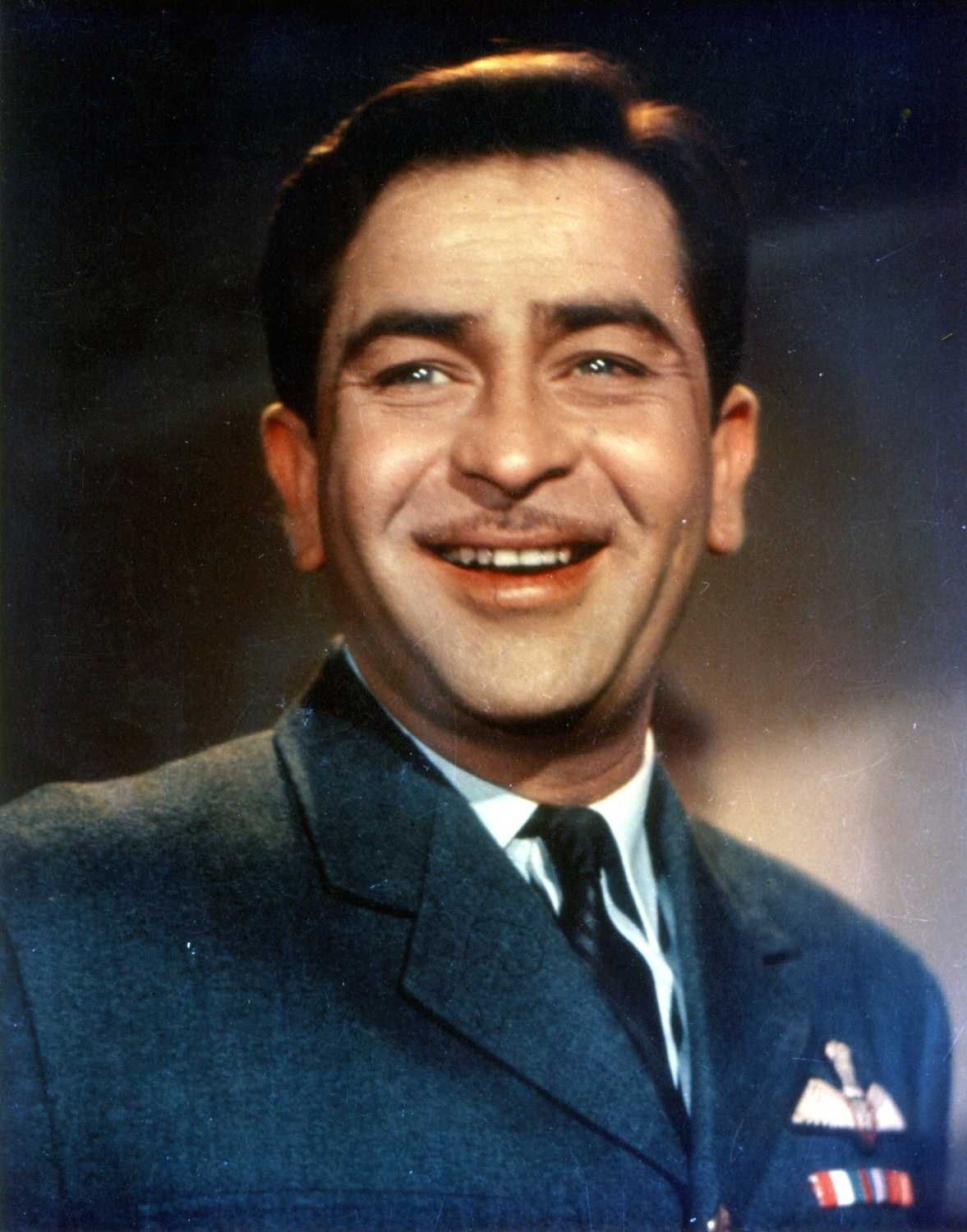
Raj Kapoor was an Indian actor, film producer and film director who worked in Hindi Cinema. He was inspired from silent film’s great actor Charlie Chaplin. Raj Kapoor was known as the Charlie Chaplin of Indian Cinema. His best known characters was based on Charlie Chaplin’s poor but honest Tramp.
At the age of ten, he appeared in a Hindi film for the first time, in 1935’s Inquilab. Raj Kapoor’s big break came with the lead role in Neel Kamal (1947) opposite Madhubala in her first role as a leading lady. In 1948, at the age of twenty-four, he established his own studio, R. K. Films, and became the youngest film director.
In 1948, Aag (Fire) film which is produced, directed by and stars Raj Kapoor. It was the first film produced by his R. K. banner. In 1949 he co-starred alongside Dilip Kumar and Nargis in Mehboob Khan’s hit film Andaz which was his first major success as an actor. Barsaat (Rain) is a 1949 Bollywood film directed by Raj Kapoor. Barsaat was one of the first major hit films directed by Kapoor. This success allowed Kapoor to buy R. K. Srudios in 1950. Barsaat became the highest grossing movie in Indian Cinema. The much-acclaimed poster and publicity for the movie were illustrated by the master artist Dr S. M. Pandit. One of the posters showing the heroine dangling on the arms of the hero would go on to inspire the R. K. Studios’ famous logo.
He went on to produce and star in several hit films made under his R. K. Banner including Awara (1951), Aah (1953), Shree 420 (1955), Jagte Raho (1956). Jis Desh Men Ganga Behti Hai (1960), film directed by Radhu Karmakar, his longtime cinematographer, and which won Filmfare Award for best film. Outside of his home productions, his other notable films as a leading actor included Dastan (1950), Anhonee (1952), Chori Chori (1956), Anari (1959), Do Ustad (1959), Chhalia (1960) and Dil Hi to Hai (1963).
He also produced the hit social films Boot Polish (1954) and Ab Dilli Door Nahin (1957). In 1964, he produced, directed and starred in the romantic musical “Sangam” alongside Rajendra Kumar and Vyjayantimala which was his first film in colour. This was his last major success as a leading actor in the films like Dulha Dulhan (1964), Around the World (1966) and Sapnon Ka Saudagar (1968).
In 1970 he produced, directed and starred in his ambitious film Mera Naam Joker. In 1971, he launched his eldest son Randhir Kapoor in the family drama “Kal Aaj Aur Kal” starring himself, his son Randhir, his father Prithviraj Kapoor as well as Randhir’s wife Babita. He launched his second son Rishi Kapoor’s career in 1973 when he produced and directed Bobby.
He produced and directed films, Satyam Shivam Sundaram (1978), Prem Rog (1982) and Ram Teri Ganga Maili (1985).
In 1965 he was a member of the Jury at the 4th Moscow International Film Festival. He received multiple accolades, including three National Film Awards and 11 Filmfare Awards in India. The Filmfare Lifetime Achievement Award is named after Kapoor. He was a two – time nominee for the Palme d’Or grand prize at the Cannes Film Festival for his films Awaara and Boot Polish. His performance in Awaara was ranked as one of the top ten greatest performances of all time by Time Magazine.
The Government of India honoured him with the Padma Bhushan in 1971 for his contributions to the Arts. India’s highest award in cinema, the Dadasaheb Phalke Award, was bestowed on him in 1987 by the Government of India.
His movies were popular in large parts of South / Central / Southeast Asia, the former Soviet Union / China, the Middle East, and Africa; his movies were global commercial success. Siddharth Kak made, Raj Kapoor, a feature film documentary on the actor in 1987 which was produced by the Government of India’s Films Division. A Postage Stamp, bearing his face, was released by India Post to honor him on 14 December 2001. To honor him, a brass statue of his was unveiled at Walk of the Stars at Bandra Bandstand in Mumbai in March 2012.
Photos courtesy Google. Excerpts taken from Google
 Writer Sunita