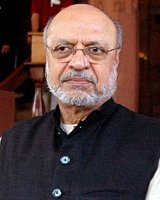
Shyam Benegal is an Indian Film Director, Script Writer and Documentary filmmaker. Benegal is widely considered one of the greatest filmmakers in 1970’s.
When he was twelve years old, he made his first film, on a camera given to him by his photographer father Sridhar B. Benegal.
In 1959, he started working as a copywriter at a Mumbai in Lintas Advertising Agency. In 1962 Benegal made his first documentary in Gujarati, “Gher Betha Ganga” (Ganges at the doorstep). In 1963 he had stint with another advertising agency called ASP (Advertising, Sales and Promotion). During his advertising years, he directed over 900 documentaries and advertising films.
Between 1966 and 1973, Benegal taught at the Film and Television Institute of India (FTII), Pune. In 1980 – 83 and 1989 – 92, Benegal became Chairman of the FTII. He had started making documentaries. He was awarded the Homi Bhabha Fellowship (1970 – 72) which allowed him to work at the Children’s Television Workshop, New York.
In 1973, he made his first film “Ankur” (The Seedling). The plot is based on a true story that occurred in Hyderabad, in the 1950s. It was filmed almost entirely on location. The film was both a commercial and critical success. A recent reviewer said, ” Shyam Benegal creates a sublime and provocative examination of hypocrisy, economic disparity, and the social status of women in Ankur”. Ankur has won three Naional Film Awards and 43 other prizes, both in India and abroad. It was nominated for the Golden Bear at the 24th Berlin International Film Festival.
In Benegal’s next film, Nishant (Night’s End) (1975), film focuses on the power of the rural elite. The film won the 1977 National Film Award for Best Feature Film in Hindi. The film was selected to complete for the Palme d’Or at the 1976 Cannes Film Festival. The film was invited to the London Film Festival of 1977, and the Chicago International Film Festival of 1977, where it was awarded the Golden Plaque.
In 1976, Manthan (The Churning) is a film inspired by the pioneering milk cooperative movement of Verghese Kurien. Aside from the great measurable success that this project was, it also demonstrated the power of “collective might” as it was entirely crowdfunded by five lakh (half a million) farmers who donated Rs. 2 each. Manthan is the first crowdfunded Indian film. The film won the 1977 National Film Award for Best feature film in Hindi and National Film Award for Best Screenplay for Vijay Tendulkar, and was also India’s submission for the Academy Award for Best Foreign Language Film for 1976.
Benegal made a biopic “Bhumika” (The Role) (1977), broadly bwaased on the life of well-known Marathi stage and film actress of the 1940s, Hansa Wadkar (played by Smita Patil). The film won two National Film Awards and Filmfare Best Movie Award. It was invited to Carthage Film Festival 1978, Chicaga Film Festival, where it was awarded the Golden Plaque 1978, and in 1986 it was invited to Festival of Images, Algeria.
Benegal used a variety of new actors, mainly from the FTII and NSD, such as Naseeruddin Shah, Om Puri, Smita Patil, Shabane Azmi, Kulbhushan Kharbanda and Amrish Puri.
He directed TV Serials such as Yatra (1986), for the Indian Railways. One of the biggest projects undertaken on Indian Television, the 53-episode television serial Bharat Ek Khoj (1988) based on Jawaharlal Nehru’s book, Discovery of India.
Benegal was backed by star Shashi Kapoor, for whom he made Junoon (1978). The story is set around the Indian Rebellion of 1857. In 1979 the film won National Film Awards for Best Feature Film in Hindi, Best Cinematography, Best Audiography. In 1980 film won Filmfare Awards for Best Film, Best Director, Best Dialogues, Best Cinematography and Best Sound Recording. Inaugural film at the 7th International Film Festival, New Delhi, 1979. Official Indian entry at the XIth Moscow International Film Festival. Featured at the Montreal World Film Festival 1979, the Cairo International Film Festival 1979, the Sydney Film Festival 1980 and the Melbourne International Film Festival 1980.
In 1981 Kalyug made by Benegal, was based on the Mahabharata. Kalyug was entered into the 12th Moscow International Film Festival.
Mandi (Market Place) is a 1983 Hindi film directed by Benegal. The film is a comedy on politics and prostitution. The film won the 1984 National Film Award for Best Art Direction for Nitish Roy. It was selected at Indian Panorama at Filmostav, Bombay 1984, and was invited to the Los Angeles Exoisutuib (FILMEX), the Hong Kong International Film Festival 1984, and London Film Festival 1983.
Trikal (Past, Present and Future) is a 1985 film written and directed by Benegal, based on the last days of Portuguese in Goa, in the early 1960s, He explored human relationships in the film. The film was selected for the Indian Panorama at Filmostav 1986. It was later invited to the London Film Festival 1986. National Film Award for Best Direction and Best Costume Design.
Benegal made documentary film based on Satyajit Ray’s life, Satyajit Ray, in 1985. Benegal making a trilogy on Indian Muslim women, starting with Mammo (1994), Sardari Begum (1996) and (2001). In 1992, he made Suraj ka Satvab Ghoda (Seventh Horse of the Sun) won National Film Award for Best feature film in Hindi.
In 1996 he made film based on the book “The Making of the Mahatma”, based on Fatima Meer’s, The Apprenticeship of a Mahatma. Netaji Subhas Chandra Bose : The Forgotten Hero is a 2004 epic biographical war film, written and directed by Benegal. In 1999, Samar (Conflict) film based on India’s caste system, which won National Film Award for Best feature film. In 2008, he made film Welcome to Sajjanpur. In March 2010, Benegal released the political satire Well Done Abba.
In 2005, he was honoured with the Dadasaheb Phalke Award, India’s highest award in the field of cinema. In 1985 he was a member of the Jury at the 14th Moscow International Film Festivaland in 2009 he was a member of the Jury at the 31st Moscow International Film Festival. Benegal is the current President of the Federation of Film Societies of India. He owns a production company called Sahyadri Films.
Photo courtesy Google. Excerpts taken from Google.
 Writer Sunita