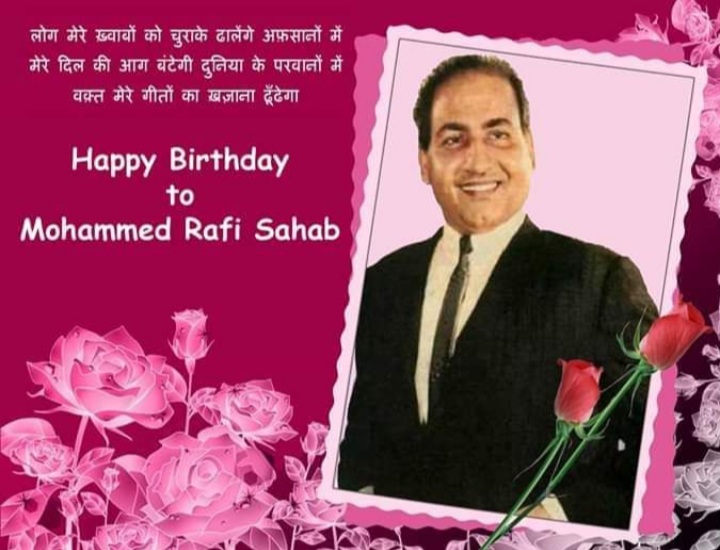
Mohammed Rafi was an Indian Film playback singer. Rafi was notable for his versatility and range of voice; his songs varied from fast peppy numbers to patriotic songs, sad numbers to highly romantic songs, qawwalis to ghazal and bhajans to classical songs.
Poet Tanvir Naqvi introduced Rafi to film producers including A. R. Kardar, Mehboob Khan and actor- director Nazeer. Rafi’s first song with Naushad was “Hindustan Ke Hum Hain” with Shyam Kumar, Alauddin and others, from A. R. Kardar’s Pehle Aap (1944). Around the same time, Rafi recorded another song for the 1945 film Gaon Ki Gori, “Aji Dil Ho Kaaboo Main”. He considered this song to his first Hindi language song.
Rafi sang a number of songs for Naushad. Rafi’s association with Naushad helped the former establish himself as one of the most prominent playback Singers in Hindi Cinema. Rafi ended up singing a total of 149 songs (81 of them solo) for Naushad.
S. D. Burman used Rafi as a singing voice of Dev Anand and Guru Datt. Rafi worked with Burman in 37 films. Rafi’s partnership with Shankar- Jaikishan was among the most famous and successful the Hindi film industry. He worked with them from their first film Barsaat (1949). Out of six Filmfare Awards, Rafi won three for Shankar-Jaikishan songs. Shankar-Jaikishan had Rafi give playback for Kishore Kumar in the film Sharaarat. Rafi sang a total of 341 numbers – 216 Solo – for Shankar- Jaikishan.
Rafi got his first Filmfare Award for the title song of Chaudhvin Ka Chand (1960), composed by Ravi. He received the National Award for the song “Babul Ki Duaen Leti Jaa” from the film Neel Kamal (1968), also composed by Ravi. Rafi wept during the recording of this song, which he admitted in a 1977 interview with the BBC. Ravi and Rafi produced several other songs in the films. Madan Mohan was another composer whose favorite singer was Rafi. Rafi’s first solo with Madan Mohan in Aankhen (1950). They teamed up to produce many songs .
Rafi and O. P. Nayyar created music in the 1950s and 1060s. O. P. Nayyar was once quoted as saying “If there had been no Mohammed Rafi, there would have been no O. P. Nayyar”. Nayyar got Rafi to sing for singer – actor Kishore Kumar. Rafi sang a total of 197 numbers (56 solo) for Nayyar.
The composer duo Laxmikant – Pyarelal patronized Rafi as one of their singers, right from their very first song by him from the film Parasmani (1963). Rafi and Laxmikant – Pyarelal won the Filmfare Award for the song “Chaahoonga Mein Tujhe Saanjh Suvere” from Dosti (1964). Rafi rendered the highest number of songs for this music director duo Laxmikant – Pyarelal, as complared to all the music directors : 388,
Once, when composer Nisar Bazmi, who once worked with Laxmikant – Pyarelal before he had migrated to Pakistan, didn’t gave enough money to pay him, Rafi charged a fee of one rupee and sang for him. He also helped producers financially. As Laxmikant once observed – “He always gave without thinking of the returns”.
Kalyanji Anandji composed around 170 songs in the voice of Rafi. Kalyanji’s relationship with Rafi started with the 1958 film, Samrat Chandragupta, his debut film as a solo composer.
Rafi sang the highest number of duets with Asha Bhosale (female), Manna Day (male) and Lata Mangeshkar (female). In the song “Humko Tumse Ho Gaya Hai Pyaar” (Film Amar Akbar Anthony), Rafi sang one song with Kishore Kumar, Late Mangeshkar, and Mukesh, the most legendary singers in Bollywood. This was probably the only time that all of them rendered their voices for one song. Rafi sang frequently for all music directions during his lifetime. He also sang for many small time and lesser-known music directors. Many for whom he sang for free while making their compositions immortal: he selflessly believed in financially assisting producers and helping small-time projects who could not afford much. Many in the industry received regular help from Rafi.
Rafi sang several songs in Chris Perry’s Konkani album Golden Hits with Lorna Cordeiro. He recorded many private albums in various genres and languages. Rafi recorded Hindi songs in English on 7″ release in 1968. He also sang 2 songs in Mauritian Creole while on his visit to Mauritius in the late 1960s.
In the 1970s, Rafi suffered from a throat infection for an extended period of time and suffered a major setback, when Kishore Kumar emerged as the main Bollywood playback singer. Some of hit songs of the early 1970s were with music directors : Laxmikant – Pyarelal, Madan Mohan, R. D. Burman and S. D. Burman. In 1974 he won the Film World magazine Best Singer Award for the song “Teri Galiyon Me Na Rakhenge Kadam Aaj Ke Bad” (Hawas, 1974) composed by Usha Khanna.
Rafi sang for many successful films in the late 1970s and the early 1980s. Many of whose hit songs were dominating the charts in the late 70s on radio programs such as Vividh Bharati, Binaca Geetmala and Radio Ceylon. Rafi gave a performance at the Royal Albert Hall and in 1980 he performed at the Wembley Conference Center. From 1970 until his death he toured around the world extensively giving concert performances to packed halls.
Singers like Mahendra Kapoor, Mohammed Aziz, Shabbir Kumar, S. P. Balasubrahmanyam, Udit Narayan and Sonu Nigam were influenced by Rafi’s style singing. On 22 September 2007, a shrine to Rafi designed by artist Tasawar Bashir was unveiled on Fazeley Street, Birmingham, UK. Bashir is hoping that Rafi will attain sainthood as a result. The Padma Shri Mohammed Rafi Chowk in the Bandra suburb of Mumbai and Pune (extending MG Road) is named after Rafi.
In the summer of 2008, the City of Birmingham Symplony Orchestra released a double CD titled Rafi Resurrected comprising 16 songs by Rafi. Bollywood playback singer Sonu Nigam provided the vocals for this project and toured with the CBSO in July 2008 at venues including the English National Opera in London, Manchester’s Apollo Theatre and Symphony Hall, Birmingham.
There have been appeals to the Government of India to honour the singer, posthumously, with the Bharat Ratna (India’s Highest Civilian Award). An official biography was written on Rafi’s life by Sujata Dev titled Mohammed Rafi – Golden Voice of the Silver Screen launched on his 91st birthday. As well as and Award winning documentary titled Dastaan-E-Raffi directed by Rajni Acharya and Vinay Patel (which took 5 years to make) was released to commemorate his 92nd birthday which was later released on DVD. It featured overr 60 interviews of various Bollywood personas and closely recalled his story through his songs and the personal recounts. Many biographies and documentaries continue to be written and made in him.
Mohammed Rafi – Golden Voice of the Silver Screen, a 2015 book by Shahid Rafi and Sujata Dev, states that according to “industry sources”, Rafi sang 4,425 Hindi film songs, 310 non-Hindi film songs, and 328 non-film songs between 1945 and 1980, A 2005 Manorama Online article states that “Researchers” have found 7,405 songs sung by Rafi.
He received four Filmfare Awards and one National Film Award. In 1967, he was honored with the Padma Shri award by the Government of India. In 2001, Rafi was honoured with the “Best Singer of the Millennium” title by Hero Honda and Stardust Magazine. In 2003, Rafi was voted for the Greatest Voice in Hindi Cinema in the CNN-IBN’s poll.
Photo courtesy Google. Excerpts taken from Google.
 Writer Sunita