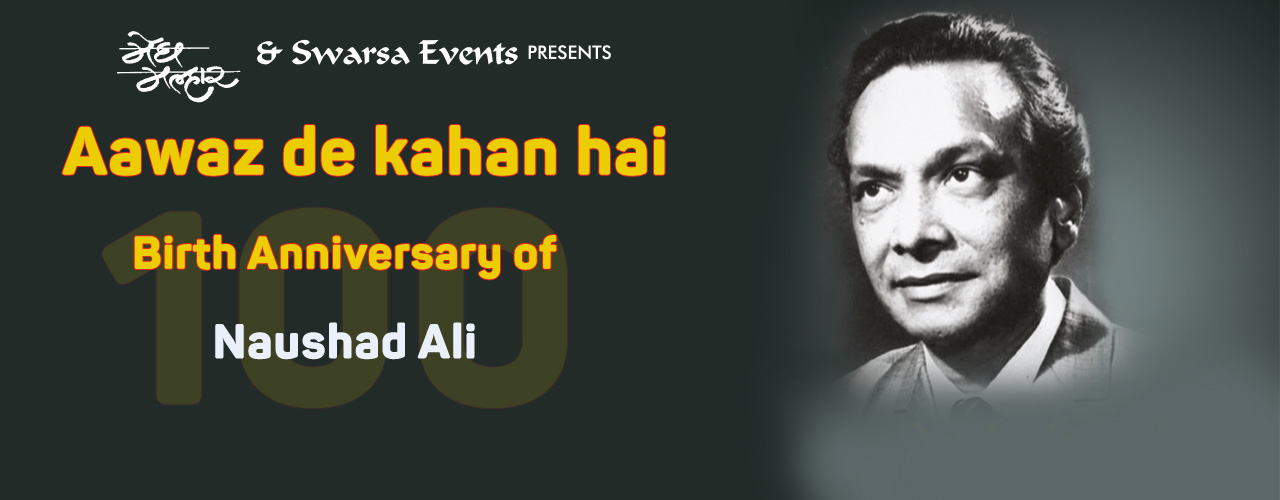
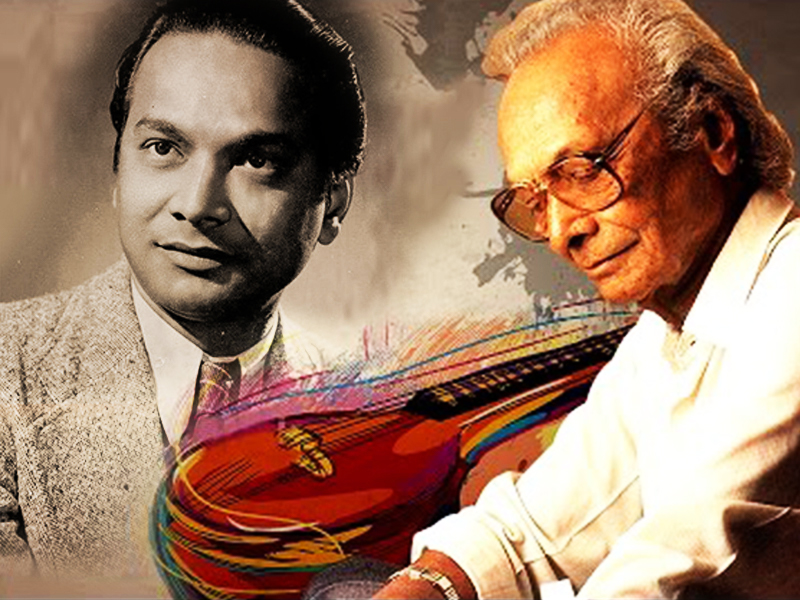
Naushad Ali was an Indian Music Director for Hindi Films. He is particularly known for popolarising the use of classical music in films.
Naushad had already become a Cinema fan in the silent Era and then, in 1931, Indian Cinema got voice and music that further fascinated the 13 – year – old boy.
He composed for his first independent film “Prem Nagar” in 1940 that had a story set in Kutch for which he did a lot of research into the folk music of the area. With A. R. Kardar’s film Nayi Duniya (1942), he got first credit as “music director” and he began to work regularly for Kardar Productions. He, however, had a flexibility that he could work outside Kardar Productions and this arrangement continued throughout his career. He first got noticed with A. R. Kardar’s film Sharda (1942) wherin 13-year-old Suraiya debuted with the song “Panchhi Ja” for the playback for heroine Mehtab. It was Rattan (1944) that took Naushad right to the top and enabled him to charge Rs.25,000/- a film during those days.
Film expert and author Rajesh Subramanian opines that Kardar Productions spent Rupees seventy-five thousand in 1944 to make Rattan. The Music by Naushad was such a phenomenal hit that the company earned Rs. 3 lacs as Royalty from gramophone sales in the first year.
Naushad gave a new trend to popular film music by basing his tunes on classical music ragas folk music. Naushad was known for his skillful adaptation of the classical musical tradition for movie songs. For some movies like Baiju Bawara, he composed all scores in classical raga modes and arranged for the well-known vocalist Amir Khan to be a music consultant for this film. Baiju Bawara demonstrated Naushad’s grasp of classical music and his ability to bring it to the masses, for which he won the first Filmfare Best Music Director Award in 1954.
Naushad commented on a pre-release meeting about “Baiju Bawara”. : “When people heard that the film would be full of classical music and ragas, they protested, ‘People will get a headache and they will run away’. I was adamant. I wanted to change public taste. Why should people be fed what they like all the time? We presented them with music from our culture and it worked.”
For Aan (1952), he was the first to use a 100-piece orchestra. He was the first composer to have developed the system of western notation in India. The notation for the music to the film “Aan” was published in book form in London. In Uran Khatola (1955), he recorded an entire song without the use of Orchestra, having replaced the sound of musical instruments with choral sound of humming.
For Mughal-e-Azam (1960) song Ae Mohabbat Zindabad, he used a chhorus of 100 persons. He asked Lata Mangeshkar to render a part of the song “Pyaar Kiya To Darna Kya” in a bathroom that had glazed tiles and then recorded the music to get the echo effect. In 2004, a colorized version of the classic Mughal-e-Azam was released, for which Naushad had the orchestral music specially re-created (in Dolby Digital) by today’s industry musicians, while maintaining all the solo vocals from the original soundtrack. To elaborate, the playback vocals (though not the chorus) recorded four decades ago are mixed with orchestra tracks created in the present millennium.
For Ganga Jamuna (1961), he used lyrics in chaste Bhojpuri dialect. He used just six instruments in the title song of Mere Mehboob (1963).
As Indian film music gradually assumed a Western bend starting in the late 1960s, Naushad came to be considered old-fashioned. Composers who could compose rock-and-roll and disco-infected music started getting increasingly popular. Naushad was still esteemed as a maestro, but his talents were sought mostly for historical movies where traditional scores were appropriate. It can be said of Naushad that in the early days of popular cinema music in the thirties and forties he set the standards for classical and folk music that resonated with the idea of India. In short the brought out the beauty of Indian music in a short film song of a few minutes which was not an easy feat. The composers who followed him were inspired by this aspect of his compositions.
His first musically successful film was Rattan (1944), followed by 35 silver jubilee hits, 12 golden jubilee and 3 diamond jubilee mega successes. Naushad was conferred the Dadasaheb Phalke Award and the Padma Bhushan in 1981 and 1992 respectively for his contribution to the Hindi film industry.
Naushad was ranked as one of the most respected and successful music directors of Indian Film Industry. Naushad had requested the Maharashtra State Government to sanction a plot for an institution for promoting Hindustani music. This was sanctioned during his lifetime and the ‘Naushad Academy of Hindustani Sangeet’ was formed.
Photos courtesy Google. Excerpts taken from Google.
 Writer Sunita