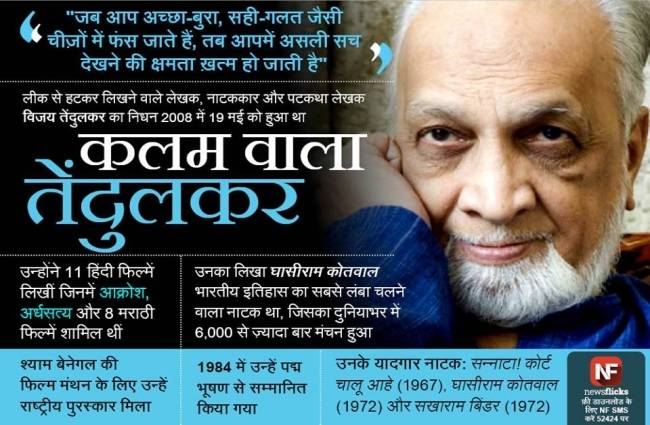
Vijay Tendulkar was a leading Indian playwright, movie and television writer, literary essayist, political journalist, and social commentator primarily in Marāthi. Vijay Tendulkar is one of India’s greatest playwrights, whose hard-hitting Marathi plays established him as an irreverent but brilliant writer of plays with contemporary, unconventional themes. Many of Tendulkar’s plays derived inspiration from real-life incidents or social upheavals, which provide clear light on harsh realities. He has provided guidance to students studying “play writing” in US Universities. Tendulkar had been a highly influential dramatist and theatre personality in Mahārāshtra for over five decades.
He grew up watching western plays and felt inspired to write plays himself. At age eleven, he wrote, directed, and acted in his first play. Tendulkar began his career writing for newspapers. He had already written a play, Āmcyāvar Koṇ Preṃ Karṇār? ( Who is going to love me?), and he wrote the play, Gṛhastha (The Householder), in his early 20s.
Breaking the vow, in 1956 he wrote Shrimant (Rich), which established him as a good writer. Shrimant jolted the conservative audience of the times with its radical storyline, wherein an unmarried young woman decides to keep her unborn child while her rich father tries to “buy” her a husband in an attempt to save his social prestige.
Tendulkar wrote the play Gidhāḍe (The Vultures) in 1961, but it was not produced until 1970. The play was set in a morally collapsed family structure and explored the theme of violence. In his following creations, Tendulkar explored violence in its various forms: domestic, sexual, communal, and political. Thus, Gidhāḍe proved to be a turning point in Tendulkar’s writings with regard to establishment of his own unique writing style.
Based on a 1956 short story, Die Panne (“Traps”) by Friedrich Dürrenmatt, Tendulkar wrote the play, Śāntatā! Court Cālū Āhe (“Silence! The Court is in Session”). It was presented on the stage for the first time in 1967 and proved as one of his finest works. Satyadev Dubey presented it in movie form in 1971 with Tendulkar’s collaboration as the screenplay writer.
In his 1972 play, Sakhārām Binder (Sakhārām, the Binder), Tendulkar dealt with the topic of domination of the male gender over the female. The main character, Sakhārām, is a man devoid of ethics and morality, and professes not to believe in “outdated” social codes and conventional marriage. He accordingly uses the society for his own pleasure. He regularly gives “shelter” to abandoned wives and uses them for his sexual gratification while remaining oblivious to the emotional and moral implications of his exploits. He justifies all his acts through claims of modern, unconventional thinking, and comes up with hollow arguments meant in fact to enslave women. Paradoxically, some of the women which Sakhārām had enslaved buy into his arguments and simultaneously badly want freedom from their enslavement.
In 1972, Tendulkar wrote another, even much more acclaimed play, Ghāshirām Kotwāl (“Officer Ghāshirām”), which dealt with political violence. The play is a political satire created as a musical drama set in 18th century Pune. It combined traditional Marathi folk music and drama with contemporary theatre techniques, creating a new paradigm for Marathi theatre. The play demonstrates Tendulkar’s deep study of group psychology, and it brought him a Jawaharlal Nehru Fellowship (1974–75) for a project titled, “An Enquiry into the Pattern of Growing Violence in Society and Its Relevance to Contemporary Theatre”. With over 6,000 performances thus far in its original and translated versions, Ghāshirām Kotwāl remains one of the longest-running plays in the history of Indian theatre.
Tendulkar wrote screenplays for the movies Nishānt (1974), Ākrosh (The Cry) (1980), and Ardh Satya (The Half-Truth) (1984) which established him as an important “Chronicler of Violence” of the present. He has written eleven movies in Hindi and eight movies in Marathi. The latter include Sāmanā (“Confrontation”) (1975), Simhāasan (“Throne”) (1979), and Umbartha (“The Threshold”) (1981). The last one is a groundbreaking feature film on women’s activism in India. It was directed by Jabbar Patel.
In 1991, Tendulkar wrote a metaphorical play, Safar, and in 2001 he wrote the play, The Masseur. He next wrote two novels — Kādambari: Ek and Kādambari: Don. In 2004, he wrote a single-act play, His Fifth Woman — his first play in the English language — as a sequel to his earlier exploration of the plight of women in Sakhārām Binder. This play was first performed at the Vijay Tendulkar Festival in New York in October 2004.
In the 1990s, Tendulkar wrote an acclaimed TV series, SwayamSiddha, in which his daughter Priyā Tendulkar, noted Television actress of ‘Rajani’ fame, performed in the lead role. His last screenplay was for Eashwar Mime Co. (2005), an adaptation of Dibyendu Palit‘s story, Mukhabhinoy, and directed by theatre director, Shyamanand Jalan and with Ashish Vidyarthi and Pawan Malhotra as leads.
Society and politics are strongly highlighted in Tendulkar’s plays. In his writing career spanning more than five decades, Tendulkar has written 27 full-length plays and 25 one-act plays. Several of his plays have proven to be Marathi theatre classics. His plays have been translated and performed in many Indian languages. By providing insight into major social events and political upheavals during his adult life, Tendulkar became one of the strongest radical political voices in Maharashtra in recent times. While contemporary writers were cautiously exploring the limits of social realism, he jumped into the cauldron of political radicalism and courageously exposed political hegemony of the powerful and the hypocrisies in the Indian social mindset. His powerful expression of human angst has resulted in his simultaneously receiving wide public acclaim and high censure from the orthodox and the political bigwigs.
The true story of a journalist who purchased of a woman from the rural sex industry to reveal police and political involvement in this trade, only to abandon the woman once he had no further need for her, is detailed in Tendulkar’s Kamalā. The play was later made into a film Kamla (film). The real-life story of an actress whose acting career got ruined after her same-sex affair became public knowledge inspired Tendulkar to write Mitrāchi Goshta (A Friend’s Story).
Tendulkar has translated nine novels, two biographies, and five plays by other authors into Marathi.
Tendulkar won Maharashtra State government awards in 1969 and 1972; and Mahārāshtra Gaurav Puraskār in 1999. He was honoured with the Sangeet Nātak Akademi Award in 1970, and again in 1998 with the Academy’s highest award for “lifetime contribution”, the Sangeet Natak Akademi Fellowship (“Ratna Sadasya”). In 1984, he received the Padma Bhushan award from the Government of India for his literary accomplishments.
In 1977, Tendulkar won the National Film Award for Best Screenplay for his screenplay of Shyām Benegal‘s movie, Manthan (1976). He has written screenplays for many significant art movies, such as Nishānt, Ākrosh, and Ardh Satya.
As The New York Times noted in an obituary for Tendulkar, “It was a measure of Mr. Tendulkar’s gifts that he achieved worldwide fame despite writing in Marathi, the language of his home state, Maharashtra, in west central India. Most of his plays were translated into Hindi and English for national and international audiences.
Photo courtesy Google. Excerpts taken from Google.
 Writer Sunita