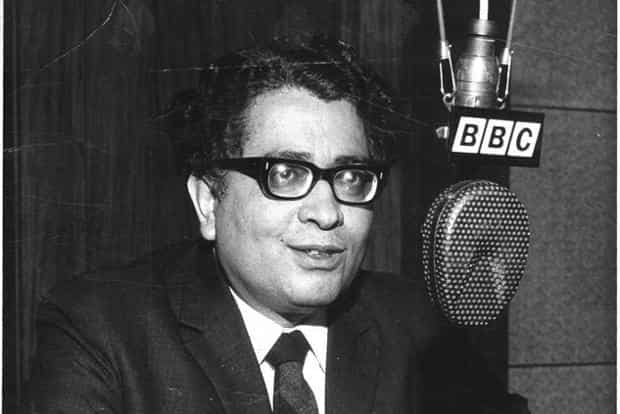
Mohan Rakesh was a pioneering figure in the Nai Kahani (“New Story”) literary movement of 1950s Hindi literature. He is best known for writing Ashadh Ka Ek Din (One Day in Aashad) in 1958, which is regarded as the first modern Hindi play and won a competition organized by the Sangeet Natak Akademi. Beyond drama, Mohan Rakesh made important contributions across multiple genres including novels, short stories, travelogues, literary criticism, and memoirs.
Mohan Rakesh was awarded the prestigious Sangeet Natak Akademi Award in 1968 in recognition of his outstanding contributions to Indian theatre and literature.
Mohan Rakesh began his career working as a postman in Dehradun from 1947 to 1949. After moving to Delhi, he secured a teaching position in Jalandhar, Punjab, where he later became the Head of the Hindi department at DAV College. In addition to his academic work, he also briefly edited the Hindi literary journal Sarika during 1962–63.
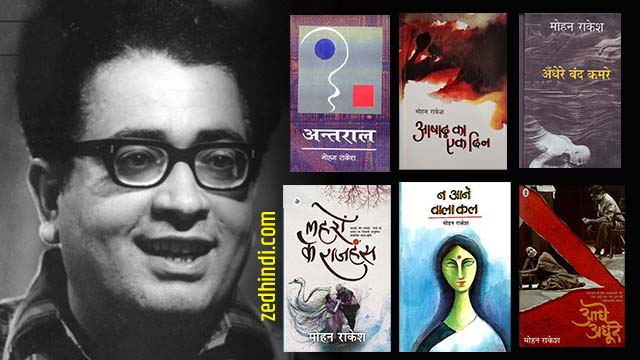
Mohan Rakesh’s first collection of short stories, Insan ke Khandhar, was published in 1950, followed by Naye Badal in 1957. His notable novels include Andhere Band Kamare (Closed Dark Rooms) and Na Aane Wala Kal (The Tomorrow That Never Comes).
His plays, especially Ashadh Ka Ek Din (One Day in Aashad) (1958), played a crucial role in reviving Hindi theatre during the 1960s. Another highly regarded play is Adhe Adhure (The Incomplete Ones or Halfway House) (1969).
Ashadh Ka Ek Din was first performed in 1960 by the Kolkata-based Hindi theatre group Anamika, directed by Shyamanand Jalan. It was later staged in 1962 by Ebrahim Alkazi at the National School of Drama in Delhi, which cemented Mohan Rakesh’s reputation as the first modern Hindi playwright.
Mohan Rakesh’s first collection of short stories, Insan ke Khandhar, was published in 1950, followed by Naye Badal in 1957. His notable novels include Andhere Band Kamare (Closed Dark Rooms) and Na Aane Wala Kal (The Tomorrow That Never Comes).
His play Ashadh Ka Ek Din (One Day in Aashad) (1958) played a major role in reviving Hindi theatre during the 1960s. Another significant work is Adhe Adhur (The Incomplete Ones).
Lahron Ke Rajhans (The Swans of the Waves), a notable play based on an ancient Buddhist tale about the renunciation of the Buddha and its impact on his family, was initially written as a short story and later adapted into a radio play titled Sundri, which was broadcast by All India Radio, Jalandhar. Mohan Rakesh struggled with different versions of this play for nearly 20 years before creating his masterpiece.
Prominent Indian theatre directors such as Om Shivpuri, Shyamanand Jalan, Arvind Gaur, and Ram Gopal Bajaj have directed Lahron Ke Rajhans. In 2005, the writing process of the play—along with Mohan Rakesh’s diaries, writings, and letters about it—was recreated in a play titled Manuscript by a Delhi theatre group.
In July 1971, Mohan Rakesh was awarded the Jawaharlal Nehru Fellowship for research on The Dramatic Word. Unfortunately, he was unable to complete this work before his death on 3 January 1972.
Two of his literary works were adapted into films by the acclaimed filmmaker Mani Kaul. The first, Uski Roti (1969), was based on Mohan Rakesh’s short story of the same name, for which Rakesh also wrote the dialogues. The second film, Ashadh Ka Ek Din (1971), was adapted from his celebrated play. Both films are considered landmark works in Indian Parallel Cinema.
In the 1990s, Mitti Ke Rang, a series of short stories broadcast on Doordarshan, was based on Mohan Rakesh’s writings.
Connoisseurs of Hindi literature regard Mohan Rakesh as a pioneering voice who brought the realities of Indian middle-class life vividly to the forefront through his characters. In the aftermath of Partition, as India struggled to rebuild and adapt to a rapidly modernizing world, Rakesh captured the dilemmas faced by ordinary Indians navigating the complexities of a transforming society in his short stories and plays.
Theatre director and writer Kuldeep Kunal describes Rakesh’s plays as “forever relevant and closer to realism.” Renowned writer and translator Rajinder Paul notes that Mohan Rakesh “struggled like a sculptor with the stony language of Hindi to sharpen its edges.”
Professor and author Renu Juneja, writing in the Journal of South Asian Literature, observes, “Rakesh’s women are exceptionally strong in dealing with the pressures of convention or circumstance, and so memorably vital that he has often been accused of rendering his male characters too weak and vacillating.”
Hindi theatre remains deeply grateful to Mohan Rakesh for enriching it with first-rate works and for creating immensely popular and enduring plays.
Photos courtesy Google. Excerpts taken from Google.
 Writer Sunita