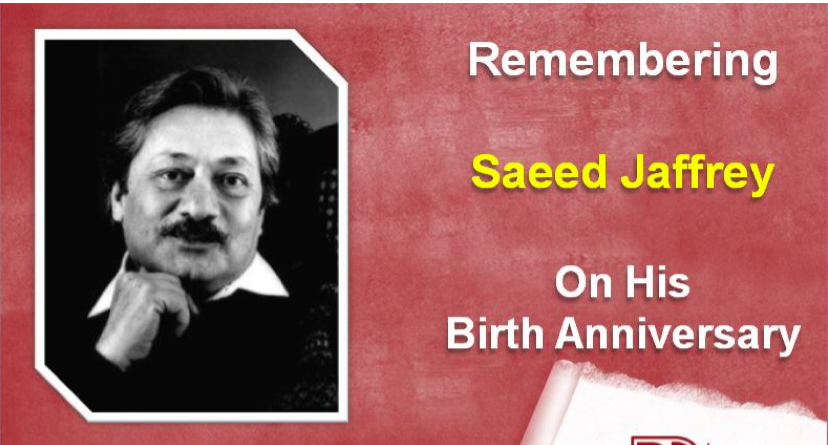
Saeed Jaffrey was a British-Indian actor. His career covered film, radio, stage and television roles over 6 decades and more than a hundred and 50 British, American, and Indian movies. During the 1980s and 1990s he was considered to be Britain’s highest-profile Asian Actor.
In February 1951 Jaffrey successfully auditioned as an announcer at All India Radio. He started his radio career as an English Announcer with the External Services of All India Radio on 2 April 1951. Unable to afford a place to stay and having no relatives in the city, Jaffrey spent his nights on the bench behind the office building.
Along with Frank Thakurdas and ‘Benji’ Benegal’, Jaffrey set up the Unity Theatre, an English language repertory company at New Delhi in 1951. The first production was of Jean Cocteau‘s play The Eagle Has Two Heads, with Madhur Bahadur playing the role of the Queen’s Reader opposite Saeed as Azrael. Unity Theatre subsequently staged J. B. Priestley‘s Dangerous Corner, Dylan Thomas‘ Under Milk Wood, Molière‘s The Bourgeois Gentleman, Christopher Fry‘s The Firstborn and T. S. Eliot‘s The Cocktail Party .
In 1957 Jaffrey graduated from the Catholic University of America‘s Department of Speech and Drama and was selected to act in summer stock plays at St. Michael’s Playhouse in Winooski, Vermont. He played the lead in three of the plays put on by St. Michael’s Playhouse: Sakini, the Okinawan interpreter in The Teahouse of the August Moon; barrister Sir Wilfred Robarts in Agatha Christie‘s Witness for the Prosecution; and Voice of God, with Gino, in The Little World of Don Camillo.
Jaffrey was the first Indian to take Shakespearean plays on a tour of the United States. He was cast in the role of Friar Laurence in Romeo and Juliet. He played Gremio in The Taming of the Shrew. In 1958 Jaffrey joined Lee Strasberg‘s Actors Studio and played the lead in an Off-Broadway production of Federico García Lorca‘s Blood Wedding. At this time, he met Ismail Merchant who had recently arrived from Bombay to attend the New York University Stern School of Business. Merchant approached Jaffrey with a proposal to put on a Broadway production of The Little Clay Cart starring the Jaffreys. James Ivory, then a budding filmmaker from California, approached Jaffrey to provide the narration for his short film about Indian miniature painting, The Sword and the Flute (1959). Jaffrey provided the narration for Ismail Merchant’s Oscar-nominated short film, The Creation of Woman (1960). The same year, he appeared in a limited run off-Broadway production of Twelfth Night at the Equity Library Theatre in the role of sea captain Antonio.
In 1961 when “The Sword and the Flute” was shown in New York City, the Jaffreys encouraged Ismail Merchant to attend the screening. The Jaffreys planned to go back to India, start a travelling company and tour with it. They would often discuss this idea with James Ivory and started writing a script in his brownstone on East 64th Street. In 1961 Jaffrey was forced to give up his job as Publicity Officer with the Government of India Tourist Office. He went back to radio and joined The New York Times Company‘s radio station WQXR-FM where his first broadcast program was Reflections of India with Saeed Jaffrey. Saeed also took up acting on stage.
1963, Jaffrey toured with Lotte Lenya and the American National Theater and Academy to perform Brecht on Brecht, a revue which was seen in Boston, Chicago, Milwaukee and Detroit. In summer 1964, Jaffrey along with some actor friends, created a multi-racial touring company called Theater In The Street, giving free performances of Molière’s The Doctor Despite Himself in Harlem, Brooklyn and Bedford–Stuyvesant.
In 1965 Jaffrey was offered the role of the Hindu God Brahma in Kindly Monkeys at the Arts Theatre, London. Favourable reviews of the play brought an offer from the BBC World Service to write, act and narrate scripts in Urdu and Hindi. Jaffrey played the small part of barrister Hamidullah in the BBC Television adaptation of A Passage to India. In early 1966, Jaffrey returned to New York City to play the haiku-karate expert Korea police Chief Kim Bong Choy in Nathan Weinstein, Mystic, Connecticut that opened on Broadway at the Brooks Atkinson Theatre. In summer that year he played a role in The Coffee Lover, a comedy starring Alexis Smith that toured Massachusetts, Connecticut and Maine. Later that year, he recorded a narration of the Kama Sutra titled The Art of Love for Vanguard Records. It was listed by Time magazine in February 1967 as “one of the five best spoken word records ever made”.
Back in London, Jaffrey was given the opportunity to shoot in India for the next Merchant Ivory film, The Guru (1969). He became the first Indian in a starring role in London’s West End theatre when he played a Pakistani photographer in On A Foggy Day. In 1975 he appeared as Billy Fish in John Huston’s classic film The Man Who Would Be King.
In the 1980s Jaffrey won substantial roles on British Television in colonial dramas The Jewel in the Crown and The Far Pavilions plus the British Indian sitcom Tandoori Night, Little Napoleons (1994) and the ITV soap Coronation Street. He was the subject of This is Your Life in 2001 when he was surprised by Michael Aspel during the curtain call of the musical The King and I at the London Palladium.
He broke into Indian films with Satyajit Ray‘s Shatranj Ke Khilari (The Chess Players) (1977) for which he won the Filmfare Best Supporting Actor category.
Saeed Jaffrey was seen as shopkeeper, Lallan Miyan, in the 1989 superhit film, Chashme Buddoor. Lallan used to sell cigarettes to three friends – but on credit. He later pesters them to clear all their dues. Jaffrey was one of the comic actors in Bollywood and could any role unique with his subtle mannerisms and amazing comic timing. Lallan Miyan won him popularity with Indian audiences.
Jaffrey played an important role, in the 1985 film, Ram Teri Ganga Maili. His role was widely appreciated and even won him a nomination for the Filmfare Award in the Best Supporting Actor category.
Jaffrey played the role of Khan Baba in 1991 film, Henna. His wonderful performance, Jaffrey had emotional role in the film, which he essayed with perfect. Jaffrey was nominated for the Filmfare Award in for Best Supporting Actor category. He was the first Asian to receive British and Canadian Academy Awards nominations besides being the first Indian to receive the Order of the British Empire (OBE) for his contribution to drama.
Photo courtesy Google. Excerpts taken from Google.
 Writer Sunita