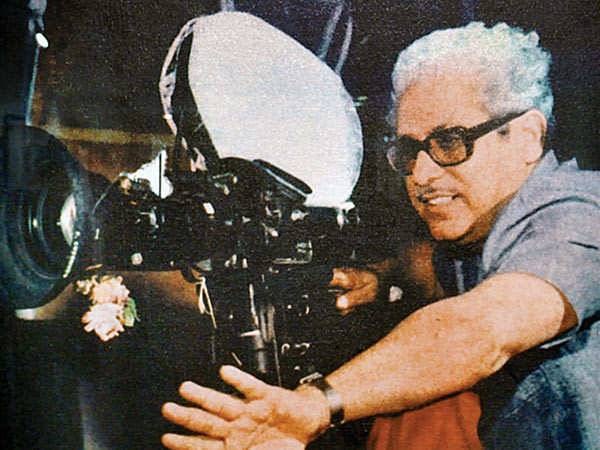

Basu Chatterjee was an Indian film director and screenwriter. Chatterjee worked in Hindi as well as Bengali Cinema. His films, which were considered to be more realisti.
In 1950s, Chatterjee arrived in Bombay (now Mumbai ) and started his career as an illustrator and cartoonist for the weekly tabloid Blitz published by Russi Karanjia. He worked there for 18 years before changing career paths to filmmaking, when he assisted Basu Bhattacharya in the Raj Kapoor and Waheeda Rehman starrer Teesri Kasam (1966), which later won the National Film Award for Best Feature Film.
Eventually, he made his directorial debut with Sara Akash (The Whole Sky) in 1969, which won him the Filmfare Best Screenplay Award and National Film Award for Best Cinematography. Film based on first part of Novel Sara Akash (The Infinite Cosmos, 1951) by Rajendra Yadav. Film is startlingly unconventional in its telling of simple domestic story.
Piya Ka Ghar (My beloved’s House) is a 1972 film directed by Chatterjee. It is a remake of Raja Thakur’s Marathi language film “Mumbaicha Jawai.” Chatterjee explored the eternal problem of affordable housing. A young bride arrives from her spacious home in the village to a two-room house in a chawl packed with extended family members. In this cramped space, the consummation of the marriage becomes a serious challenge.
Us Paar (1974), Rajnigandha (1974), Chhoti si Baat (1975), Chitchor (1976), Swami (1977), Khatta Meetha, Priyatama, Chakravyuha (1978), Jeena Yahan (1979), Baton Baton Mein (1979), Apne Paraye (1980), Shaukeen and Ek Ruka Hua Faisla films directed by Chatterjee.
He has also directed many Bengali films such as Hothat Brishti, Hochcheta Ki and Hothat Shei Din.
Television Series “Byomkesh Bakshi” and “Rajani” for Doordarshan. Byomkesh Bakshi is an intelligent detective from Kolkata solves, without any weapons, many mysteries that remain unsolved by police. Byomkesh Bakshi offered compact suspenseful stories within a 40 minute timeframe with solid performances and a neat resolution, without any technical fussiness or narrative flourishes.
In 1992, Chatterjee was awarded National Film Award for Best Film on Family Welfare for his film Durga.
As his characters emerged from chawls and apartments in search of work and love, they were followed everywhere by Chatterjee – and Mahjan’s Camera. They queued up for buses and trains, went to the office and grabbed a cup of tea and bhel puri by the beach. Mumbai was as much a character in the movie as its residents. Chatterjee plucked individual stories out of the masses and grafted aspirations and possibility onto their journeys, making life in India, particularly in Mumbai. The films of Chatterjee have special significance. The universe which his films created makes us fall in love with this idea of to be around people and know them more.
Chatterjee was a member of the jury at the 10th Moscow International Film Festival in 1977 and a member of the International Film And Television Club of the Asian Academy of Film & Television. A retrospective of Chatterjee’s work was held as part of the Kala Ghoda Art Festival Mumbai in February of 2011.
Photos courtesy Google. Excerpts taken from Google
 Writer Sunita