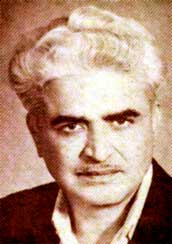
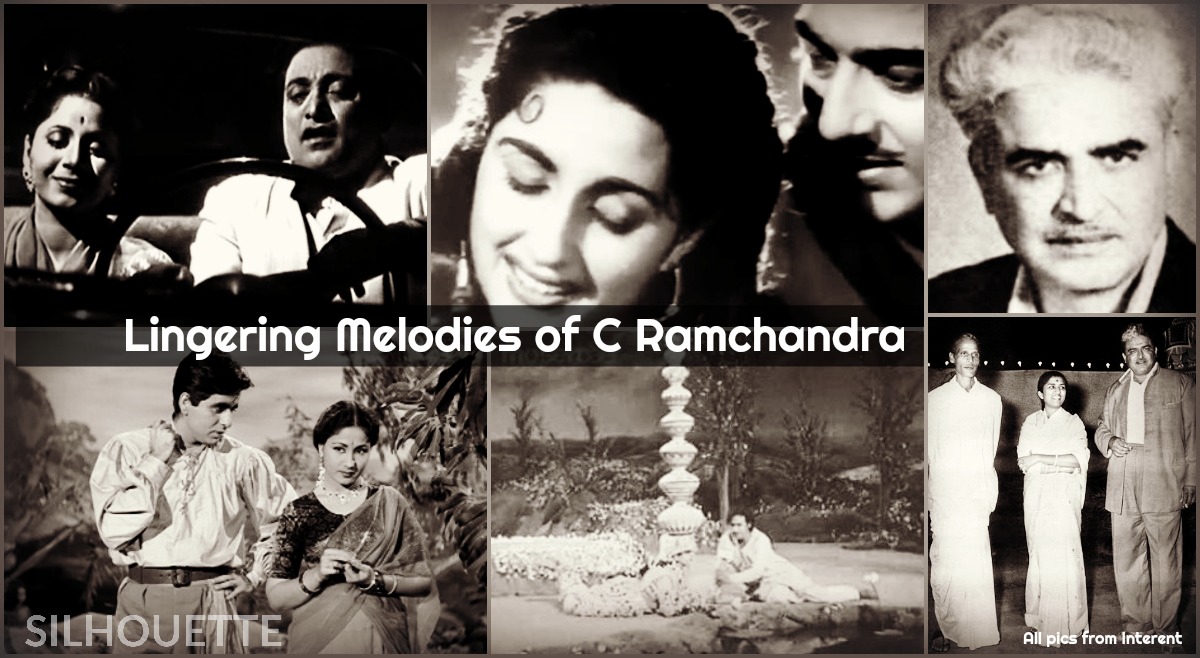
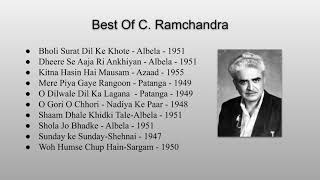
Ramchandra Narhar Chitalkar mostly used the C. Ramchandra, was an Indian music director and occasional playback singer.
He also used the names Annasaheb (in the movies Bahadur Pratap, Matwale, and Madadgaar), Ram Chitalkar (in the movies Sukhi Jeevan, Badla, Mr. Jhatpat, Bahadur, and Dosti), and Shyamoo (in the movie Yeh hai duniya). Further, he often sang and acted in Marathi movies under the name R. N. Chitalkar. For his career as an occasional playback singer he used only his surname Chitalkar. Chitalkar sang some renowned and unforgettable duets with Lata Mangeshkar such as “Kitna Haseen Hai Mausam” in the film Azaad (1955).
He joined the movie industry playing the lead role in Y. V. Rao’s movie, Naganand. He also had some small roles at Minerva Movietone in the movies Said-e-Havas (1936) and Atma Tarang (1937). Ramchandra provided harmonium accompaniment for Minerva composers Bundu Khan and Habib Khan. He debuted as music director in Tamil movies with Jayakkodi and Vana Mohini.
Influenced by Benny Goodman, Ramchandra introduced in his compositions the alto sax in combination with guitar and harmonica. He also included whistling in one of his famous songs, “Aana meri jaan Sunday ke Sunday” in film Shehnai (1947). He received public notice as a good composer in Bhagwan Dada’s Sukhi Jeevan (1942), and established a long association that culminated with the musical box office hit Albela (1951). The film features several westernized songs such as “Shola Jo Bhadke and Ye Deewana, Ye Parwana” which are said to have “employed cabaret type dance/choruses featuring bongo drums, oboes, clarinets, trumpets, saxophones, etc. C. Ramchandra himself sand most of the male songs in the movie. Apart from the highly popular Western-style songs, the movie also had classic melodies like “Dheere se aaja re ankhiyan me”, “Balama bada nadan re” etc.
He provided the musical score for the scat song “Eena Meena Deeka” in Aasha (1957). The song “Eena Meena Deeka” sung by Asha Bhosale and Kishore Kumar in two different versions, became very popular. It is one of the Hindi Cinema’s first rock and roll numbers. The words of the song were inspired by children playing outside Ramchandra’s music room. The children were chanting “Eeny, meeny, miny, moe” which inspired Ramchandra and his assistant John Gomes to create the first line of the song, “Eena Meena Deeka, De Dai Damanika”, Gomes, who was a Goan, added the words “Maka Naka” (Konkani for “I don’t want”). They kept on adding more rhymes till they ended with “Rum Pum Rosh”. Eastern Eye magazine declared Kishore Kumar’s version of “Eena Meena Deeka” as one of his 10 best songs. An advertising campaign by the JWT Agency of London for the UK Bank HSBC in October 2008 used the “Eena Meena Deeka” song from the film as background music.
C. Ramchandra’s biggest success as a music composer was the 1953 movie Anarkali starring Beena Roy in the title role and Pradeep Kumar. The songs that he composed for this movie are today legendary. Songs of this movie like “Yeh Zindagi Usiki Hai”, “Mujhse Mat Poochh Mere Ishq Main Kya Rakha Hai”, “Mohabbat Aisi Dhadkan Hai”, “Jaag Dard-e-Ishq Jaag” etc. went on to become huge hits and were highly acclaimed. Anarkali also perhaps saw the famed composer-singer combination of Ramchandra and Lata Mangeshkar at their best ever together. A film critic in London who watched the movie is said to have remarked that the heroine sang like an angel without knowing that the angel was actually Lata giving playback for the actress. Similarly, C. Ramchandra’s compositions in V. Shantaram’s Navrang (1959) and Stree (1961) were also quite popular and are still remembered.
The highly popular patriotic song “Aye Mere Watan Ke Logo“, which was sung by Lata Mangeshkar and penned by poet Pradeep, was a composition of Ramchandra. It was later performed live, by Lata Mangeshkar, in the presence of Jawaharlal Nehru at the National Stadium, in New Delhi on Republic Day in 1963. It is said Jawaharlal Nehru became so sentimental that tears rolled down his cheeks.
Ramchandra similarly provided a memorable musical score accompanying a competition between two dancers whose roles were played by Padmini and Vyjayanthimala for t he song Kannum Kannum Kalanthu lyrics penned by Kothamangalam Subbu, sung by P. Leela and Jikki in the Tamil movie Vanjikottai Valiban (1958). He remade the song in Hindi as “Aaja Tu Aaja” from Raj Tilak (1958) written by P. L. Santoshi where Asha Bhosle and Sudha Malhotra rendered their voice. Ramchandra provided music compositions for a few Marathi, Telugu, Tamil, and Bhojpuri movies besides Hindi movies. He also produced three Hindi movies with New Sai Productions Namely Jhanjhar (1953), Lehren (1953), Duniya Gol Hai (1955).
In the late 1960s, Ramchandra produced two Marathi movies, Dhananjay (1966) and Gharkul (1970). Apart from composing music, he also acted in them. Ramchandra wrote his autobiography The Symphony of My Life (माझ्या जीवनाची सरगम in Marathi) in 1977.
Mumbai based troupe Musicolor, which is promoting vintage music, presented an exclusive tribute programmes featuring the gems of C. Ramchandra at Dinanath Mangeshkar Aditorium on 22 January 2010.
Though Ramchandra used a number of ragas in his compositions, his favourite remained raga “Bageshri” (Radha na bole – Azad, 1955). In a 1978 interview at BBC studios with Mahendra Kaul, he ascribed the reason to Bageshri’s simplicity. However, he also composed songs in other ragas including Malkauns (Aadha hai chandrama- Navrang)
Photos courtesy Google. Excerpts taken from Google.
 Writer Sunita