

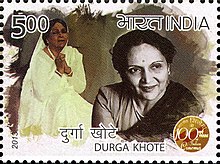
Durga Khote was an Indian actress, beginning as one of the foremost leading ladies of her times, she remained active in Hindi and Marathi cinema, as well as theatre, for over 50 years, starring in around 200 films and numerous theatre productions.
In 2000, in a millennium issue, India Today named her among “100 People Who Shaped India”, noting : “Durga Khote marks the pioneering phase for women in Indian Cinema” as she was one of the first women from respectable families to enter the film industry, thus breaking a social taboo.
She also ranks among the top ten actresses in mother roles in Hindi cinema,] most notable among them were as Jodhabai in K. Asif‘s Mughal-e-Azam (1960); as Kaikeyi in Vijay Bhatt‘s classic Bharat Milap (1942); her other memorable roles as mother were in Charnon Ki Dasi (1941); Mirza Ghalib; Bobby (1973) and Bidaai (1974). She has received the highest award in Indian Cinema, the Dadasaheb Phalke Award (1983), for lifetime contribution to Indian cinema.
Durga Khote debuted in a minor role in the obscure 1931 silent film Farebi Jaal, by the Prabhat Film Company, followed by Maya Machindra (1932). She was soon promoted to play heroine in the 1932 double version (Hindi and Marathi) “Ayodhyecha Raja“, another Prabhat film, which was the first ever Marathi talkie, and proved to be a runaway hit, where she played the role of Rani Taramati. Indeed, she ventured yet another pioneering trend: Despite working closely with the Prabhat Film Company, she broke away from the “studio system” (exclusive contract with a studio to work in its films on a monthly salary) then in vogue and became one of the first “freelance” artistes of that era by working occasionally with the New Theatres, East India Film Co. (both at Calcutta), and Prakash Pictures.
In 1936, she played Saudamini in Amar Jyoti, which is one of her most memorable roles. The film was about a “rebellious female pirate”. The story’s social relevance in the form of a costume action adventure involved a queen who becomes a pirate when she faces extreme “patriarchal laws” and is denied custody of her son. The film has been cited as a “great film”, an “outstanding film”, an “adventure classic” and the first Indian film screened at the Venice Film Festival. The film became a big success at the box office with three main reasons cited of this achievement. The first was Durga Khote as the pirate Saudamini, leaving an impact on the audiences, where she excelled in her role. The second reason for the success of the film is attributed to the special effects. The third was the music and the songs.
The characters played by her were very much like her regal personality and she commanded a screen presence even in front of legendary actors like Chandra Mohan, Sohrab Modi and Prithviraj Kapoor. In 1937, she produced and directed a film titled Saathi, making her one of the first women to step into this role in Indian cinema. The 40s opened for her in a big way, with award-winning performances in Aachary Atre’s Payachi Dasi (Marathi) and Charnon Ki Dasi (Hindi) (1941) and Vijay Bhatt‘s classic Bharat Milap (1942), both of which got her the BFJA Best Actress Award for two consecutive years.
Durga Khote remained active in the theatre circuit for many years, especially the Marathi theatre in Mumbai. She was actively associated with the Indian People’s Theatre Association (IPTA), where she worked alongside luminaries like Balraj Sahni, Prithviraj Kapoor and K. A. Abbas. She worked in several plays for the Mumbai Marathi Sahitya Sangh. In 1954, she famously performed the role of Lady Macbeth in V. V. Shirwadkar‘s Marathi adaptations of Macbeth, as Rajmukut, The Royal Crown, along with Nanasaheb Phatak.
During later years, she played several important character roles, such as the mother of the protagonist. Her portrayal of Jodhabai, the queen of Akbar torn between duty towards her husband and love towards her son in Mughal-e-Azam (1960) was well received. In 1963, she acted in Merchant Ivory‘s debut film The Householder (1963). She went on to play other widely appreciated character roles in later movies, such as the role of the grandmother of the heroine in Bobby (1973), the hero’s aunt in Abhimaan (1973), and the very memorable Bidaai (1974), where she played a mother, a very sensitive role that can make one cry and received the Filmfare Best Supporting Actress Award.
Her final memorable role was in Subhash Ghai‘s Karz (1980), where she played the role of the mother of Raj Kiran and later, mother to Rishi Kapoor, who played the role of Raj Kiran’s reincarnation after the screen death of Raj Kiran in the movie. Director Subhash Ghai said in an interview that Karz was a story where the role of a mother was very important. “I needed someone to play the role who would look like a queen but would also have to look majestic and dignified and still like a queen, while doing the work of a maid-servant”, he said. “Durgaji knew how to carry herself and was extremely hardworking.
Shashi Kapoor once said of her : “The most noteworthy thing about her was her professionalism and her desire to always be working on something which interested and moreover something which, according to her, was worthwhile. She never worked only for money.”
She acted in over 200 films in her career. By the 1980s she successfully diversified into production of short films, ad films and documentaries by setting up Fact Films and later, Durga Khote Productions, which produced the Doordarshan TV series Wagle Ki Duniya.
“I have a wish, that everyday – young and old, women and men, girls and boys, give dignity to labour. Irrespective of what the job is. Even if one is sweeping the floor, do it so well that people ask who cleaned the floor,” said Durga Khote in an interview.
Durga Khote was awarded the Padma Shri in 1968 and the Dadasaheb Phalke Award in 1984. A Postage stamp, bearing her face, was released India Post to honour her on 3rd May 2013. Later in life, Durga Khote wrote an autobiography in Marathi, entitled “Mee, Durga Khote’, which was translated into English as “I, Durga Khote“.
Photos courtesy Google. Excerpts taken from Google.
 Writer Sunita