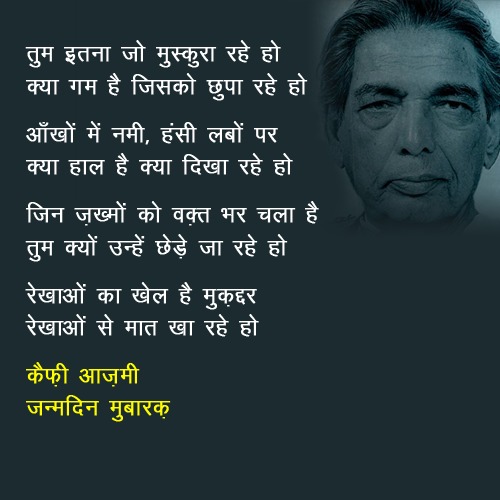
Kaifi Azmi (original name Akthar Husain Rizvi) was an Indian Urdupoet. He is remembered as the one who brought Urdu literature to Indian motion pictures. Together with Pirzada Qasim, Jaun Elia and others he participated in many memorable Mushaira gatherings of the twentieth century.
At age eleven, Azmi wrote his first ghazal in BahraichItna To Zindagi Mein Kisi Ki Khalal Pade and somehow managed to get himself invited to a Mushaira and over there, he recited a ghazal, rather a couplet of the ghazal which was very much appreciated by the President of the Mushaira, Mani Jaisi, but most of the people, including his father, thought he recited his elder brother’s ghazal. When his elder brother denied it, his father and his clerk decided to test his poetic talent. They gave him one of the lines of a couplet and asked him to write a ghazal in the same meter and rhyme. Azmi accepted the challenge and completed a ghazal. This particular ghazal was to become a rage in undivided India and it was immortalised as it was sung by legendary ghazal singer, Begum Akhtar. Azmi abandoned his studies of Persian and Urdu during the Quit India agitations in 1942 and shortly thereafter became a full-time Marxist when he accepted membership of the Communist Party of India in 1943. During this period, the leading progressive writers of Lucknow noticed him. They were very impressed by his leadership qualities. They also saw in him a budding poet and extended all possible encouragement towards him. Consequently, Azmi started to win great acclaim as a poet and became a member of Progressive Writers’ Movement of India. At the age of twenty-four, he started activities in the textile mill areas of Kanpur. As a full-time worker, he left his life of comfort, though he was the son of a Zamindar. He was asked to shift his base to Bombay, work amongst the workers and start party work with a lot of zeal and enthusiasm.
Azmi has its own merits; intensity of emotions, in particular, and the spirit of sympathy and compassion towards the disadvantaged section of society, are the hallmark of his poetry. His poems are also notable for their rich imagery and in this respect, his contribution to Urdu poetry can hardly be overstated. Azmi’s first collection of poems, Jhankar was published in 1943. His important works including anthologies of poetry, were Aakhir-e-Shab, Sarmaya, Awaara Sajde, Kaifiyaat, Nai Gulistan, an anthology of articles he wrote for Urdu Blitz, Meri Awaaz Suno, a selection of his film lyrics, and the script of Heer Ranjha in Devanagari.
His best known poems are Aurat, Makaan, Daaera, Sanp, and Bahuroopni. Azmi also lamented the restoration of the Somnath temple in his poem Somnath, warning that it would result in the end of the world.
Kaifi changed the tenor and vocabulary of the Hindi film song, creating a fresh new wave in Hindi film lyrics that lasted many years. His greatest feat as a writer was Chetan Anand‘s “Heer Raanjha” (1970) wherein the entire dialogue of the film was in verse. It was a tremendous achievement and one of the greatest feats of Hindi film writing. Azmi also won great critical accolades for the script, dialogues and lyrics of M. S. Sathyu‘s “Garam Hawa” (1973), based on a story by Ismat Chughtai. Azmi also wrote the dialogues for Shyam Benegal‘s “Manthan” (1976) and Sathyu’s Kanneshwara Rama (1977). For Manthan Kaifi Sahab won National Award for Best dialogue.
In Guru Dutt‘s all time classic film, “Kaagaz Ke Phool” (1959), Kaifi Sahab contributed by writing the unforgettable song “Waqt Ne Kiya Kya Haseen Sitam Tum Rahe Na Tum Hum Rahe Na Hum” which expresses the two peopled who have loved and lost each other over a period of time. .
Chetan Anand‘s “Haqeeqat” (1964), India’s greatest war film. Haqeeqat film’s song ” Kar chale hum fida jan-o-tan sathio
ab tumhare hawale watan sathio zinda rahne ki mausam bahut hai magar
jan dene ki rut roz ati nahi
husn aur ishq dono ko ruswa kare
wo jawani jo khu me nahati nahi
aaj dharti bani hai dlhan sathio
Kar Chale hum Fida Jaan-o-Tan Sathio” (“I sacrifice now, this life and body, o friends…
the nation is in your hands now, o friends…
so many seasons are there to live, but…
the season to give up one’s life doesn’t come often, …
leaving behind both, the beauty & the love,
of what value is that youth, which doesn’t bathe in blood…
today the earth has become my bride, o friends
I sacrifice now, this body and life, o friends…”)
Some notables films for which he wrote lyrics include Kohra (1964), Anupama (1966), Uski Kahani (1966), Saat Hindustani (1969), Shola Aur Shabnam, Parwana (1971), Bawarchi (1972), Pakeezah (1972), Hanste Zakhm (1973), Arth (1982) and Razia Sultan (1983). For Naunihal (1967), he wrote the song “Meri Aawaz Suno Pyar ka Raaz Suno” (Hear my voice, hear the secret of love) sung by Mohammad Rafi. The song is picturised over the funeral procession of Prime Minister of India, Jawahar Lal Nehru.
Azmi wrote the lyrics for “Bible Ki Kahaniyan“, the first Christian mythological television show broadcast in India. He also played a memorable role of Naseem’s grandfather in “Naseem” (1995). His autobiography is included in a collection of his works, Aaj Ke Prashid Shayar : Kaifi Azmi.
Azmi was the subject of a documentary film called Diksha (2015), directed by Raman Kumar. In 1997, he recited his own poems for Kaifiyaat, an audio book on his collected works.
Kaifi Aur Mein, a play based on his life, his works and the memoir of his wife, Shaukat Azmi – Yadon Ki Rahguzar (Down Memory Lane), was written and performed by Javed Akhtar and Shabana Azmi, and performed in India as well as abroad in 2006. Another play, directed by Rani Balbir, Waqt Ne Kiya Kya Hasin Sitam, based on Kaifi Azmi’s life and writings was staged in 2005, and received rave reviews.
He was the recipient of Padma Shri, India’s fourth-highest civilian award in 1974. Besides he was awarded the Uttar Pradesh Urdu Academy Award and the Sahitya Akademi Award for Urdu for his collection Awaara Sajde, Special Award of Maharashtra Urdu Academy, Soviet Land Nehru Award, Lotus Award from the Afro-Asian Writers’ Association, and President’s Award for National Integration. In 1998, Government of Maharashtra conferred the Jyaneshwara Award on him. He was also honoured with the prestigious Sahitya Akademi Fellowship for lifetime achievement.
In 2000, he was conferred the first Millennium Award by the Government of Delhi and the Delhi Urdu Academy. He has also been honoured with a doctorate from Vishva Bharati University, Santiniketan. The Speaker, Lok Sabha, Shri Somnath Chatterjee at a function of renaming of the road as “Kaifi Azmi Sadak” in New Delhi on February 22, 2005. The government has also inaugurated a train named “Kaifiyat Express” which runs from his hometown Azamgarh to Old Delhi.
On 14 January 2020, search Engine Google commemorated Kaifi Azmi with a Doodle on his 101st birth anniversary. Google commented : “With work ranging from passionate love poems and activist verses to Bollywood songs lyrics and screenplays, Azmi has become one of the most renowned poets of the 20th century in India, and his humanitarian efforts continue to impact people’s lives today.” There is street also named after him Kaifi Azmi road in Hyderabad. There is also a road in R. K. Puram, New Delhi named Kaifi Azmi Marg after him.
Photos courtesy Google. Excerpts taken from Google.
 Writer Sunita