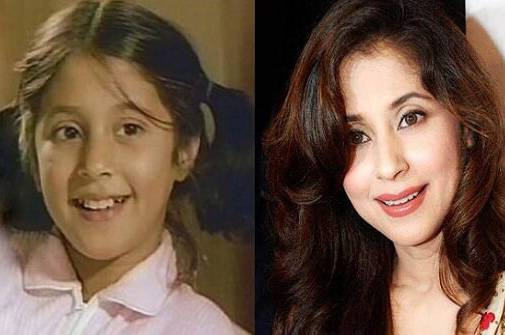
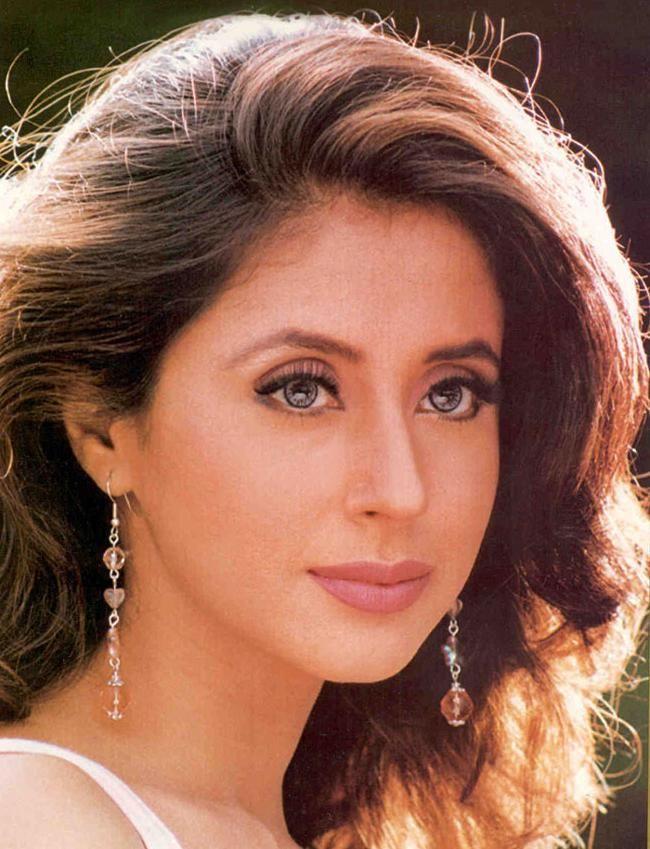
Urmila Matondkar is an Indian Actress and Politician. Known for her work in Hindi films, in addition to Telugu, Malayalam, Marathi and Tamil Cinema, she has received numerous accolades, including the Filmfare Award and the Nandi Award. She has been praised by the critics for her acting and dancing skills.
Matondkar made her screen debut as a child artiste in Shreeram Lagoo‘s Marathi film Zaakol (1980). Subsequently, she featured in Shyam Benegal‘s crime Kalyug (1980), Shekhar Kapur‘s drama Masoom (1983), Praveen Bhatt‘s Bhavna (1984), K. Viswanath‘s Sur Sangam (1985), Rahul Rawail‘s Dacait (1987) and Kalpataru‘s Bade Ghar Ki Beti (1989) as a child star.
She made her debut as an adult in 1989, with T. K. Rajeev Kumar‘s Malayalam blockbuster Chanakyan, opposite Kamal Haasan. Her Bollywood adult debut came with N. Chandra‘s 1991 action drama Narsimha. Upon release, the film emerged a commercial success. Matondkar played the role of Meenu S. Singh, the rebellious daughter of Baapji (played by Om Puri), a goon lord and capitalist of the city.
She next starred in Rajiv Mehra’s ghost comedy Chamatkar, alongside Shah Rukh Khan (1992). Her first Telugu film came with the action-crime Antham, and its Hindi bilingual Drohi opposite Nagarjuna. She played Bhavna, an ornithologist who is in love with Nagarjuna’s character. Upon release, the film received positive reviews from critics. The film marked first of her many collaborations with director Ram Gopal Verma. In 1993, Matondkar appeared in Shreemaan Aashique opposite Rishi Kapoor and Bedardi opposite Ajay Devgn. Varma’s Telugu political thriller Gaayam (1993 ) was her next release. The film garnered positive reviews, with six state Nandi Awards, and emerged a Super Hit at the box office. Matondkar’s performance earned her a Nandi Award for Best Supporting Actress.
In 1995, Matondkar established herself as a leading actress of contemporary Hindi Cinema by featuring in Varma’s musical romance Rangeela (Colourful). The film was a major box office success and received critical acclaim. Co-starring Aamir Khan and Jackie Shroff. Matondkar played Mili Joshi, an effervescent fun-loving friend of a street-toughened orphan, who ambitions of becoming an actress. At the 41st Filmfare Awards, Rangeela was nominated for 12 awards Matondkar including a first Best Actress nomination for Matondkar. The became an overnight sensation and a superstar. Her fame and star status were hits like “Tanha Tanha” and “Rangeela Re”. The film proved to be a turning point for Amir’s career, whose chemistry with Matondkar was also appreciated. Film was screened at the International Film Festival of India.
In the same year, she also starred alongside Mohanlal in the Malayalam action Thacholi Varghese Chekavar. She played Maya, the only witness in a homicide who is kept under house arrest by her parents. In 1996, she played Sapna , the daughter of an RTO official in S. Shankar‘s Indian (1996), which marked her first Tamil film. It was also dubbed and released in Hindi under the title Hindustani. Featuring Kamal Haasan in dual roles alongside Matondkar and Manisha Koirala, it was the most expensive Indian film at that time. Nirupama Subramanian of India Today felt the film was a commercial potboiler and wrote, “Indian has dances, foot-tapping melodies by A. R. Rahman and two pretty women, Manisha Koirala and Urmila Matondkar”. Both Indian and Hindustani were commercial successes. The film was India’s official entry for the Best Foreign Language Film for the Academy Awards in 1996, but was not nominated.
Matondkar’s first release of 1997 was Raj Kanwar‘s melodrama Judaai. It tells the story of Kajal (played by Sridevi), lured by wealth who asks her husband, Raj (played by Anil Kapoor), an honest engineer, to marry Janhvi (played by Matondkar), the rich daughter of his boss. The Indian Express asserted that “it is Urmila Matondkar who comes out with flying colours”. The film emerged as a commercial success and her performance fetched her a Filmfare Best Supporting Actress Award nomination.
Her next releases were the crime comedy Daud alongside Sanjay Dutt, the romantic drama Mere Sapno Ki Rani alongside Sanjay Kapoor and the action romance Aflatoon alongside Akshay Kumar. She next reunited with Varma for her third Telugu release, the road movie Anaganaga Oka Roju, starring alongside J. D. Chakravarthy. The film involves the comic travails of a couple eloping, on the run from their parents who get entangled as murder suspects of a politician, in a police and political mafia road hunt for an incriminating audio tape. The film received positive reviews nd emerged as a box office hit.
Her next release was the crime “Satya“, for which she received another Filmfare Best Actress nomination. The film was r eceived favourably by critics and was a huge hit at the box office, solidifying Matondkar’s position as a leading lady of Bollywood. Satya was on CNN-IBN‘s 2013 list of the 100 greatest Indian films of all time, in the 100 Filmfare Days series and on the “70 iconic movies of independent India” list. It was mentioned in Rachel Dwyer’s 100 Bollywood Films (where she called it a “masterpiece”), and i n critic and author Shubhra Gupta’s 50 Films That Changed Bollywood, 1995 – 2015.
In 1999, Matondkar had six film releases, However, Matondkar’s performances were generally well received by critics, Her first hit that year wasbb Varma’s psychological horror thriller Kaun, opposite Manoj Bajpayee, where she played a nameless character. Khalid Mohamed of The Times of India (who would later cast her in Tehzeeb) wrote, “She rivets the viewer’s interest, carrying off entire reels on her shoulders, through a gamut of quicksilver facial expressions .
During the 2000s, Matondkar revealed strong, dramatic and psychological features in her roles, and delivered a number of critically acclaimed performances. In 2000, Matondkar re-united with Varma for the action Jungle, Taran Adarsh of Bollywood Hungama wrote, “Urmila Matondkar is at ease in a role that gives her ample scope to showcase her talent. Her scenes with Durga can easily be singled out, for they have been shot with brilliance.”[40] The film was both critically and commercially successful. She next starred opposite Govinda in David Dhawan‘s romantic comedy Kunwara.
The next year, Matondkar portrayed Ria, an o bsessed over, in Rajat Mukherjee’s romantic thriller Pyaar Tune Kya Kiya, a film which received critical acclaim. Her performance was highly acclaimed and several critics noted her for showing great emotional range and depth. Taran Adarsh of Bollywood Hungama, in a positive review wrote, “the ‘actual hero’ of the film is definitely Urmila Matondkar, who will walk away with all laurels at the end of the day. Her career – best performance, she oozes intensity, love, hate, relentlessness and obsessive behaviour with perfection. Planetbollywood.com described Matondkar as : “The star of the show is Urmila who is simply mind blowing in this film. The film is sure to get her nominated for best actress or even in some cases best villain. Not only does she look amazing, but she acts so well it will leave you speechless. If you hate everything else in the film, her performance will surely win you over! Her last two scenes in the film are simply breath taking. Ladies and gentlemen stand up nd applaud this fantastic performance!” The film emerged successful at the box office. Matondkar received various Best Villain nominations for her performance, including a Filmfare Award for Best Performance in a Negative Role nomination.
Her first release of 2003 was the supernatural horror Bhoot. She played Swati, a ghost-possessed woman. Taran Adarsh wrote praised her performance and wrote: “…the film clearly belongs to Urmila Matondkar all the way. To state that she is excellent would be doing gross injustice to her work. Sequences when she is possessed are simply astounding. If this performance doesn’t deserve an award, no other performance should. It beats all competition hollow”. Khalid Mohamed wrote, “Matondkar is consistently excellent – controlled and persuasively vulnerable – as the beleaguered wife, evoking your concern and empathy. She’s the major triumph of Bhoot actually”. She received her first Filmfare Award under the Best Actress Critics’ Choice) as well as various Best Actress awards at different award ceremonies, including Star Screen Awards, Zee Cine Awards and Bollywood Movie Awards. She received another Filmfare Award for Best Actress nomination and also received the national honour Rajiv Gandhi Award for the work in the film, also recognising her achievements in Bollywood. The film became successful at the box office with gross earnings.
She achieved further critical acclaim for her portrayal of the title role of a girl in a strained relationship with her mother, in Khalid Mohammed’s crime drama Tehzeeb (2003). Rediff c omplimented her by stating, “Urmila as the emotionally scarred Tehzeeb, who is uncomfortable expressing her feelings even to her husband, has done a commendable job. The only person she expresses her love to is her mentally challenged sister.”
She next played the role of Puro, a North Indian girl who leads a happy life but her dreams of a happy future are shattered when, one evening, she is kidnapped by Bajpayee’s character, in the background of the 1947 India partition in the critically acclaimed Pinjar (2003). Derek Elley of Variety reviewed the film commenting, “A handsomely shot drama centered on a Hindu woman’s travails during the 1947 Partition, “Pinjar” ranks as one of the better Bollywood treatments of this still hot-button issue. Good performances, especially by lead actress Urmila Matondkar and by Manoj Bajpai as her Muslim partner, compensate for a slightly wobbly structure”.
In 2004, Matondkar starred in the thriller Ek Hasina Thi. The film (which marked the debut of Sriram Raghavan) tells the story of a Sarika Vartak, a deceived woman, played by Matondkar, who is jailed and arrested for having links with the underworld, because of her lover, played by Khan, and later flees from prison to seek revenge on him. Upon release, the film was positively received by critics, with Matondkar’s performance earning praise. The Deccan Herald commented : “An author-backed role ensures that Urmila gets to do everything just right. Whether it’s kicking a bully into shape in the dreary prison of which she’s an inmate or whether it’s making nice with Karan while plotting his ruin, she’s a total treat. She carries off the transition from naive to knowing effortlessly. Seductive and steely, she’s quite explosive.”[55] The film was a box office success. For he r performance, Matondkar received nominations at the Filmfare, Screen, Zee Cine and IIFA ceremonies. The film was premiered at the New York Asian Film Festival.
In 2005, she played the title r ole in the horror Naina. The film tells the story of Matondkar’s character who after receiving an eye transplant, realises t hat she can see into the supernatural world. The film was premiered in the Marché du Film section at the 2005 Cannes Film Festival. She next starred as Trisha Chaudhary, a caring daughter of Professor Uttam Chaudhary, played by Anupam Kher, in Jahnu Barua‘s art drama Maine Gandhi Ko Nahin Mara. The film was well received by critics, with Rediff stating, “Her credibility as a versatile actress is further established in her reserved albeit realistic delivery of emotions.”[Matondkar won her second Bollywood Movie Award for Best Actress. In 2006, she appeared in Pankaj Parashar‘s romance Banaras : A Mystic Love Story,
During her years in the film industry, Matondkar has been involved in different charitable organisations and has particularly supported women’s causes in India. In February 2013, Matondkar along with Parineeti Chopra, walked for Manish Malhotra in London, England, to support the Angeli Foundation – a charity that works to empower the Girl Child in India.
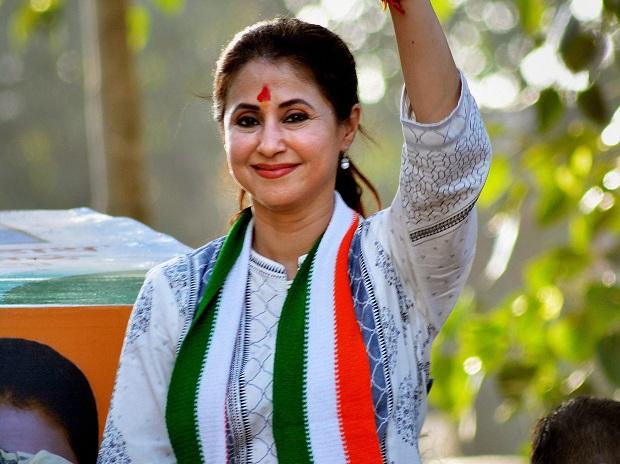
Matondkar joined the Indian National Congress on 27 March 2019. She contested from Mumbai North constituency in the 2019 Lok Sabha Election, but lost. On 10 September 2019, she resigned from the party, citing petty internal politics. On 1 December 2020, she joined Shiv Sena in presence of party president Uddhav Thackeray. Shiv Sena hoped to add a nationally recognised face and voice, well conversant in Marathi, Hindi as well as English, to represent the party.
Photos courtesy Google. Excerpts taken from Google.
 Writer Sunita