

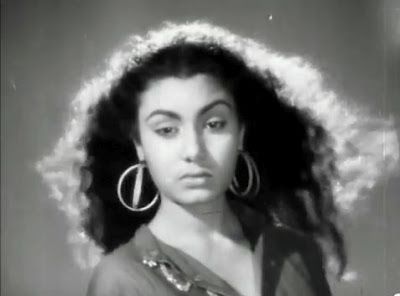
Nawab Bano, better known by her stage name Nimmi, was an Indian Screen Actress who achieved stardom in the 1950s and early 1960s in Hindi films. She was one of the leading actresses of the “Golden Era” of Hindi Cinema. She gained popularity by playing spirited village belle characters, but has appeared in diverse genres such as fantasy and social films.
In 1948, via the connection with her mother Wahidan who had worked with the famous filmmaker Mehboob Khan, in the 1930s, invited the young Nimmi to watch the making of his current production Andaz at Central Studios. She had shown an interest in movies and this was an opportunity to understand the film making process. On the sets of Andaz, Nimmi met Raj Kapoor, who was starring in the film.
At that time, Raj Kapoor was filming his production of Barsaat (Rain) in 1949. Raj Kapoor changed her name from Nawab Bano to “Nimmi”. Having already cast the famous actress Nargis in the female lead role, he was on the lookout for a young girl to play the second lead. After observing Nimmi’s unaffected and shy behaviour as a guest on t he sets of Andaz, he cast the teenaged Nimmi in Barsaat opposite the actor Prem Nath. Nimmi played the role of an innocent mountain shepherdess in love with a heartless city man. Barsaat, released in 1949, made movie history. It was a phenomenal and commercial success. Despite the presence of established and popular stars Nargis, Raj Kapoor and Prem Nath, Nimmi had a very prominent and well-received role and was an instant hit with the audiences.
After Barsaat, Nimmi was flooded with film offers. She quietly polished her histrionic abilities and developed a mannered but effectively unique style of acting. The actress, with her saucer shaped expressive eyes, quickly won a loyal fan base with her intense and expressive performances.
Sazaa (punishment) is a 1951 film starring Nimmi. Kohli wrote, “Given the limited scope of the script, the cast performs well with the dreamy-eyed Nimmi particularly excelling”. Nimmi formed a very popular and dependable screen pair with Dilip Kumar. Deedar is 1951 film starring Nimmi and Dilip Kumar. Daag (The Stain) is 1952 film starring Nimmi and Dilip Kumar.
Mehboob Khan was to cast her in Aan (1952). The film was made with an extremely large budget. Nimmi played one of the female leads. Such was Nimmi’s popularity at this point that when a first edit of the film was shown to the film’s financiers and distributors, they objected that Nimmi’s character died too early. An extended dream sequence was added to give Nimmi more prominence and screen time in the film. Aan was one of the first Indian movies to have a worldwide release. The film had an extremely lavish London premiere which Nimmi attended. The English version was entitled Savage Princess. On the London trip, Nimmi met many western film personalities including Errol Flynn. When Flynn attempted to kiss her hand, she pulled it away, exclaiming, “I am an Indian girl, you cannot do that!” The incident made the headlines and the press raved about Nimmi as the “… unkissed girl of India“. Nimmi further revealed in a 2013 interview, that at the London premiere of Aan, she received four serious offers from Hollywood, including one from Cecil B. DeMille who greatly admired the film and Nimmi’s performance. Nimmi declined these offers, choosing to focus on her flourishing career in India.
After the great box-office success of Aan, Mehboob Khan asked her to appear in his next film Amar (1954). Nimmi played a poor, milkmaid seduced by a lawyer (Dilip Kumar). The film also starred Madhubala as Kumar’s wronged fiancée. Its controversial subject of rape was way ahead of its time. Nimmi’s intense performance and the film were applauded by critics.
She acted and turned producer with the popular film Danka (1954) which was released under her own production banner. Kundan (1955), produced by Sohrab Modi co-starring newcomer Sunil Dutt, gave Nimmi a memorable double role as mother and daughter. Based on Victor Hugo’s 1862 novel, Les Miserables, the film had Modi playing a poverty-stricken young man who gets into trouble with the police for stealing a loaf of bread. Over the years, he avoids a policeman who is on his trail even as he tries to live and honest life.
In 1955, Uran Khatola (Flying Bedstead), she starring with Dilip Kumar. A man’s plane crashes is a city that is ruled by women and he starts liking the peasant girl who rescues him. However, the queen of the city also likes him but discovers that he likes someone else. The song “O Door Ke Musafir Ham Ko Bhi Saath le le re” is from this film.
Nimmi next had two big successes in 1956 with Basant Bahar (Beautiful Spring) and Bhai-Bhai (Brotheres). Basant Bahar had nine outstanding songs, In 1957, at the age of 24, Nimmi received the critic’s award for best actress for her role in Bhai Bhai. These films were largely consistent run of success at the box-office. Nimmi had firmly established herself as one of the most bankable and popular leading ladies in Hindi Cinema.
In the late 1950s, Nimmi worked with renowned Directors Chetan Anand (Anjali ), K. A. Abbas (Char Dil Char Rahen) and Vijay Bhatt (Angulimala). Prepared to take risks, Nimmi took on controversial characterizations, such as the prostitute of “Char Dil Char Raahen” (1959). It was during this phase that Nimmi became very selective as she strove for better quality projects and roles.
Director K. Asif had started his version of the Laila–Majnu love legend, “Love & God” even before completing his magnum opus Mughal-e-Azam (1960). Nimmi believed that Love & God would be a fitting swan song to her career. K. Asif had problems casting the male lead before finally selecting Guru Dutt as Nimmi’s co-star. However, Guru Dutt’s sudden death put a halt to the film’s shooting. Sanjeev Kumar was cast as his replacement but the film was shelved altogether when the director K. Asif died. Nimmi had retired from films for over two decades by the time K. Asif’s widow Akhtar Asif released Love & God on 6 June 1986 in incomplete form. The film suffers badly from compromised editing in an attempt to cover the fact that several key scenes and a clear climax were not filmed before Asif died. But the footage that Nimmi completed before the film was shelved showed she had delivered a subtle and sensitive portrayal and looked beautiful in Technicolor and the period costumes.
In 2013, in a rare interview with Rajya Sabha TV, Nimmi recounted her complete Hindi film career, from her beginnings as a child in Agra, her first break in Barsaat to the current day, and her experiences during this time. Nimmi won Kalakar Award (Living Legend Award) in 2015.
Photos courtesy Google. Excerpts taken from Google.
 Writer Sunita