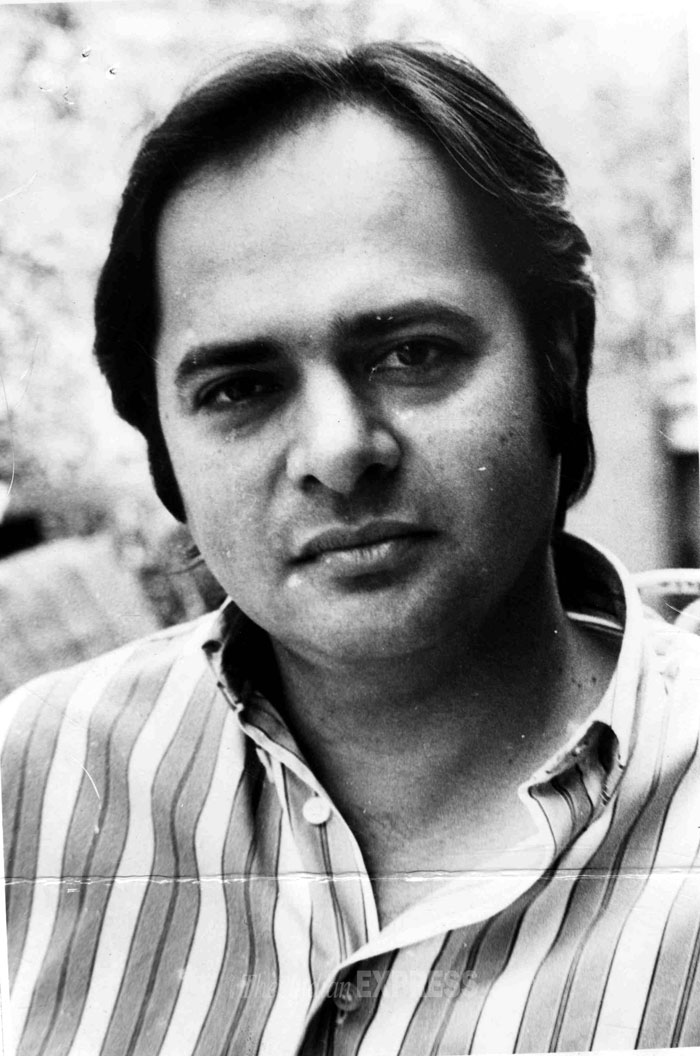
Farooq Shaikh was an Indian Actor, Philanthropist and Television Presenter. He was best known for his work in Hindi Films from 1973 to 1993 and for his work in Television between 1988 and 2002. His major contribution was in Parallel Cinema or the New Indian Cinema. He worked with directors like Satyajit Ray, Sai Paranjpye, Muzaffar Ali, Hrishikesh Mukherjee and Ketan Mehta.
He was active in theatre, doing plays with IPTA and with well-known directors like Sagar Sarhadi. In 1973, while Shaikh was in his final year of law school, MS Sathyu approached him for his directorial debut Garam Hawa. His first major film role was in the 1973 film Garam Hawa, where Farooque had a supporting role and the leading man was Balraj Sahni. The film is credited for being a pioneer of a new wave of Hindi Art Cinema. His salary for his debut film was only Rs. 750. Garam Hawa was India’s official entry to the Academy Award’s Best Foreign Film category, nominated for the Palme d’Or at the Cannes Film Festival, it also won National Film Award and three Filmfare Awards.
Shaikh acted in Satyajit Ray‘s Shatranj Ke Khiladi (Chess Players) (1977).
Shaikh in Gaman (1978) acted as the migrant Bombay taxi driver from Badaun in Uttar Pradesh hoping to return to meet his wife, but never saves up enough to return home. The film, most notably “Seene Mein Jalan, Aankhon Mein Toofaan”, which highlighted the alienation and broken dreams of the migrant community.
He went on to act in several notable films such Noorie (1979), Chashme Buddoor (1981), Umrao Jaan (1981), Bazaar (1982), Saath Saath (1982), Rang Birangi (1983), Kissi Se Na Kehna (1983), Ek Baar Chale Aao (1983), Katha (1983), Ab Ayega Mazaa (1984), Salma (1985), Faasle (1985), Peechha Karo (1986), Biwi Ho To Aisi (1988), and Maya Memsaab (1993) . He formed a successful pair with Deepti Naval. His chemistry with Deepti Naval led to them being cast opposite each other in nine films. He also did a slightly negative role in Katha.
He was paired opposite Shabana Azmi in Sagar Sarhadi’s Lorie, Kalpana Lajmi’s Ek Pal and Muzaffar Ali’s Anjuman (1986). Anjuman based on deals with exploitation of women and problems of local “chikan” embroidery workers. Film set in Lucknow.
He appeared in Saas Bahu Aur Sensex (2008) and Lahore (2009), for which he won the 2010 National Film Award for Best Supporting Actor. His last film as the leading man was Club 60 (2013) which was also his last release before his death. Realbollywood.com said about his performance in the film: “As a grieving father who won’t allow his loss to be forgotten, he hits all the right notes treading that thin line between melancholy and maudlin with majestic grace.” He also appeared in Youngistaan and Children of War, both of which released in 2014.
In the 80s-90s, Farooque Shaikh appeared in several television serials. He played the title role in an episode dedicated to the poet and freedom fighter Hasrat Mohani in the TV series Kahkashan (1988) with Deepti Naval playing his wife. He also worked in the famous TV serial Shrikant which aired on Doordarshan from 1987 to 1991. This show was an adaptation of Sarat Chandra Chattopadhyay‘s novel. This was followed by Aahaa on Zee. Chamatkar on Sony and Ji Mantriji (an adaptation of Yes, Minister), on Star Plus were other notable successes. Shaikh also had a cameo in Life OK’s Do Dil Ek Jaan, where he was seen as the leading lady’s father in the initial episodes. He hosted the TV show Jeena Issi Ka Naam Hai, in which he interviewed celebrities from the Hindi film world. His sense of humour and direct humble approach was the USP of the show.
Veteran actor Farooque Shaikh was one of the talented stars of Hindi cinema who received the same amount of love for his work across different platforms like films, TV and theater. Shaikh was known for his natural acting and he delivered some memorable performances.
Lesser known is his contribution to the UNICEF polio eradication programme. He made several extensive trips to two polio-endemic states, Bihar and Uttar Pradesh, and worked closely with its programme teams who were working with communities to get greater acceptance for the polio vaccine. He also kept on helping 26/11 affected families in Mumbai.
On 25 March 2018, search engine Google commemorated Farooq Sheikh with a Doodle on his 70th birth anniversary. Google commented: “Farouque Shaikh essayed agonizing heartbreak and light-hearted comedy with equa l ease. Beyond the silver screen, Shaikh was integral to Indian theater, and his epistolary play, ‘Tumhari Amrita’ with Shabana Azmi delighted audiences for over two decades.”
He hohored with the Bimal Roy Lifetime Achievement Award in 2019 which was the first time ever the award was presented to an artiste posthumously.
Photo courtesy Google. Excerpts taken from Google.
 Writer Sunita