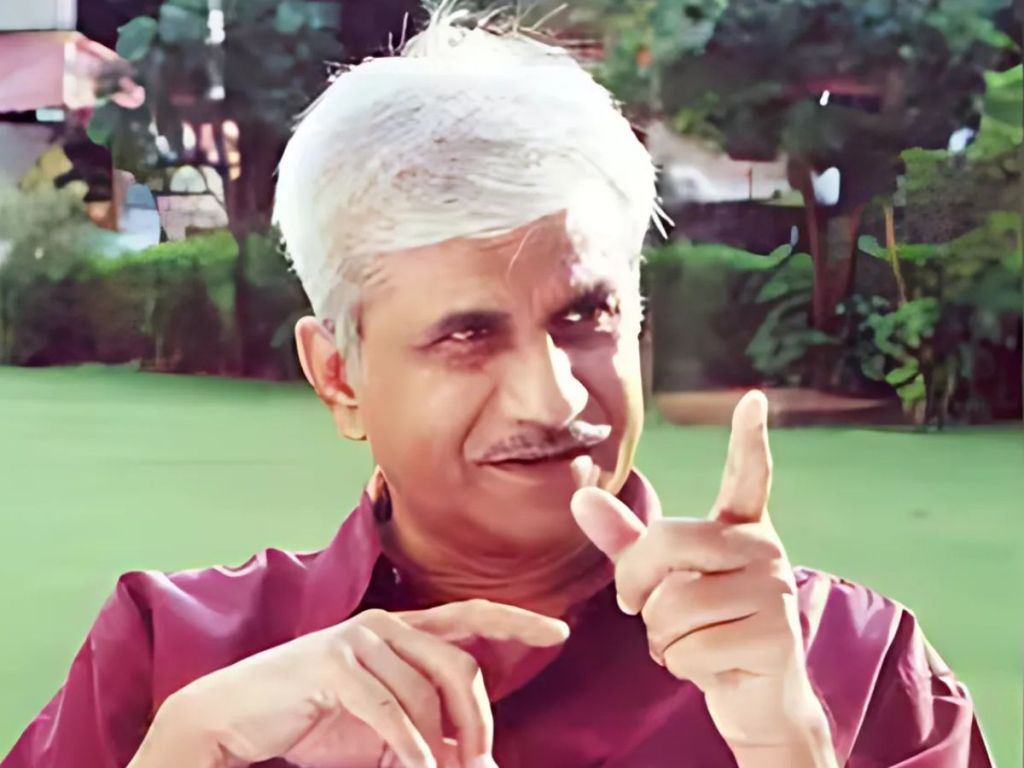
Dr. Jabbar Patel is a renowned Indian theatre and film director, known primarily for his contributions to Marathi theatre and cinema. He gained acclaim for his innovative and socially relevant works that often explore complex social and political themes.
Patel began his career with the Progressive Dramatic Association (PDA) and later co-founded the Theatre Academy after a split due to creative differences. His 1973 production of Vijay Tendulkar’s play Ghashiram Kotwal is widely regarded as a landmark in modern Indian theatre.
Jabbar Patel began his career with the Marathi experimental theatre group Progressive Dramatic Association (PDA), founded by Bhalba Kelkar. Within PDA, he both acted and directed plays. One of his notable directorial successes for PDA was Vijay Tendulkar’s Ashi Pakhare Yeti, which achieved great commercial acclaim.
In 1972, due to differences over the staging of Tendulkar’s Ghashiram Kotwal, Patel and colleagues including Mohan Agashe and Satish Alekar parted ways with PDA to form a new theatre group called Theatre Academy. In 1974, Theatre Academy produced Teen Paishacha Tamasha, an adaptation of Bertolt Brecht’s Threepenny Opera.
In 1974, Jabbar Patel directed the Marathi-language crime drama film Samna. The film was entered into the 25th Berlin International Film Festival, where Patel received a nomination for the Golden Berlin Bear Award.
Jait Re Jait (1977) is a musical milestone in Indian cinema, narrating the stories of a forgotten tribe through dance and featuring a total of 19 songs, many of which remain popular in Maharashtra. The film earned Filmfare Awards for actress Smita Patil and director Jabbar Patel. Patel also received the Maharashtra State Film Award for Best Direction.
At the 25th National Film Awards in April 1978, Jait Re Jait was honoured with the President’s Silver Medal for Best Feature Film in Marathi.
Simhasan (1981) is a montage-style film featuring 35 characters. It is based on two novels by writer and freelance journalist Arun Sadhu: Simhasan and Mumbai Dinank. The film gained popularity for the song “Ushakkal Hota Hota,” which is based on a poem by poet Suresh Bhat. The song is both fiery and poignant, capturing the misery of the common man living amidst a corrupt social and political environment.
Umbartha (The Doorstep) is a 1982 film that tells the story of a woman’s dream to step beyond the confines of her home and bring about social change. Smita Patil played the lead role, earning the Marathi Rajya Chitrapat Puraskar for Best Actress for her performance.
The film was honored as the Best Feature Film in Marathi at the 29th National Film Awards, recognized for its “sincere cinematic statement on the theme of a woman seeking to establish her identity by pursuing a career, even at the risk of alienation from her family.”
Mukta won the 1994 National Film Award for Best Feature Film on National Integration.
Ek Hota Vidushak (Once There Was a Clown) is a 1992 film based on a short story written by Jabbar Patel, with screenplay and dialogues by veteran Marathi writer P. L. Deshpande. The film won multiple awards and was named Best Film at the Maharashtra State Film Awards in 1993.
At the 40th National Film Awards (1992), it won Best Feature Film in Marathi and Best Choreography for Laxmibai Kolhapurkar. Kolhapurkar made history as the first choreographer—and the first woman—to win the National Film Award for choreography.
The film also participated in the Indian Panorama section of the International Film Festival of India in 1993.
Dr. Babasaheb Ambedkar is a 2000 Indian bilingual feature film in English and Hindi that tells the story of B. R. Ambedkar, renowned for his pivotal role in shaping the Constitution of India as chairman of the Drafting Committee of the Indian Constituent Assembly. The film stars Mammootty in the title role.
It won several National Film Awards in 1999, including Best Feature Film in English, Best Actor for Mammootty, and Best Art Direction. The film was screened retrospectively on August 15, 2016, at the Independence Day Film Festival, jointly presented by the Indian Directorate of Film Festivals and the Ministry of Defence, commemorating the 70th Indian Independence Day.
Jabbar Patel served as the director of the sixth Pune International Film Festival (PIFF) and continues to hold the position.
Photo courtesy Google. Excerpts taken from Google.
 Writer Sunita