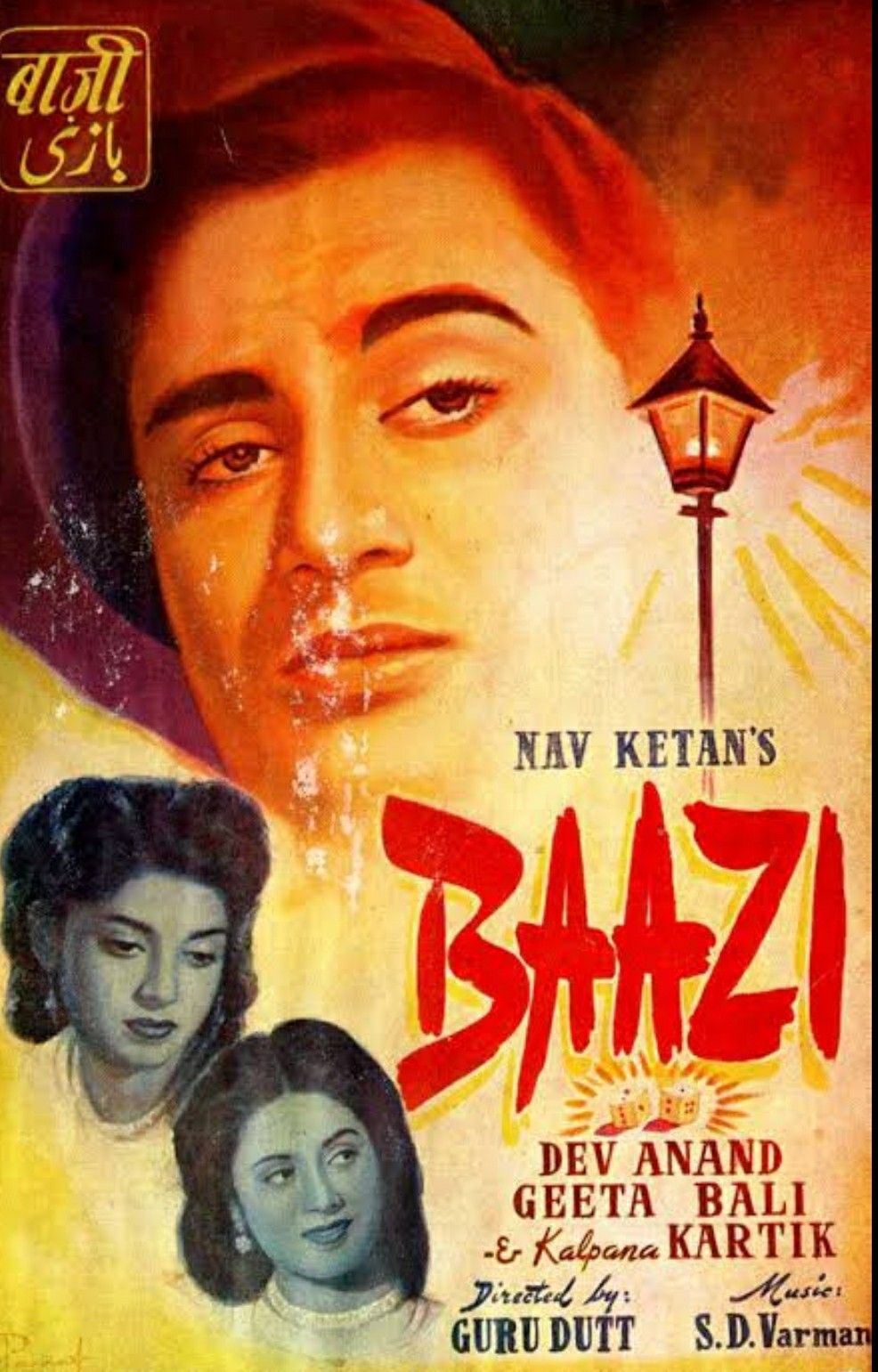
Baazi is Indian Hindi noir film directed by Guru Dutt. This was the second film of Dev Anand’s production house Navketan Films and as per a commitment given by Dev Anand to Guru Dutt in their days of struggle, the movie was given to Dutt for direction. Baazi was the first crime noir made in the country. It initiated a new genre called “Bombay Noir”, the success of which encouraged and defined the later noir films of 1950s and ’60s in Hindi cinema. It was the first film in which Dev Anand came up with his unique style of rapid-fire. The film’s story was partly inspired by the 1946 movie Gilda.
It is a crime thriller and had very popular music composed by S. D. Burman. The film is a tribute to the Forties’ Film noir Hollywood with the morally ambiguous hero, the transgressing siren, and shadow lighting. It was hugely successful at the box office and was the second highest grossing film of 1951 after Awaara.
The Times of India called Baazi, “a milestone in the short lived genre that can be loosely called Bombay Noir.” It was listed by Filmfare in “Best Bollywood Noir Films of “50s”. It is considered one of the Best Noir films to have come from India.
Madan (Dev Anand), once from a respectable family, now lives in poverty with his ailing sister Manju (Roopa Verman) and struggles to find a job. Out of desperation, he turns to gambling and gains a reputation for being exceptionally lucky. One day, a man named Pedro escorts him to the Star Hotel, where he meets the dancer Leena (Geeta Bali) and is offered a job by a mysterious figure known only as “Maalik.” His role is to lure wealthy men to gamble at the club. Though initially reluctant due to moral concerns, Madan refuses the offer and walks away. Soon after, he meets the kind-hearted Dr. Rajani (Kalpana Kartik), who is running a free clinic in his locality and treats his sister’s tuberculosis. A romance blossoms between the two, but Rajani’s wealthy father, a lawyer (K. N. Singh), disapproves of Madan and wants her to marry Inspector Ramesh instead. Pressured by his sister’s worsening health and the need for money, Madan eventually accepts the job at the Star Club, where he grows close to Leena, confiding in her as she develops feelings for him.
Tragedy strikes when Leena is murdered by a bullet meant for Madan, and he is arrested by Inspector Ramesh for her killing, as the weapon bears his fingerprints. The truth, however, is darker—Rajani’s father, who is also the Maalik of the club, had plotted Madan’s murder to remove him from Rajani’s life. Leena had sacrificed herself to save Madan. When Madan refuses to speak out, fearing for his sister’s life under threats from Rajani’s father, he is sentenced to hang. But Inspector Ramesh uncovers new evidence and cunningly tricks Maalik into confessing by faking Madan’s execution. The truth comes to light, Rajani’s father is arrested, and Madan is released after serving a short sentence for his involvement in gambling. In the end, justice prevails and Madan is reunited with Rajani, finally free to begin a new life.
Baazi’s music was a game-changer in the 1950s. S. D. Burman and Sahir Ludhianvi struck a golden partnership with this one. ‘Apne pe bharosa hai toh ek daav laga le’, Sharmaaye Kaahe Ghabraaye Kaahe’, ‘Aah Ki Raat Piya’, ‘Suno Gajar Kya Gaaye’ among other songs gave Baazi memorable music.
The sharp shadows, the precise dialogues, a love triangle, a murder, an investigation, and an innocent hero, Baazi has it all.
Photo courtesy Google. Excerpts taken from Google.
 Writer Sunita