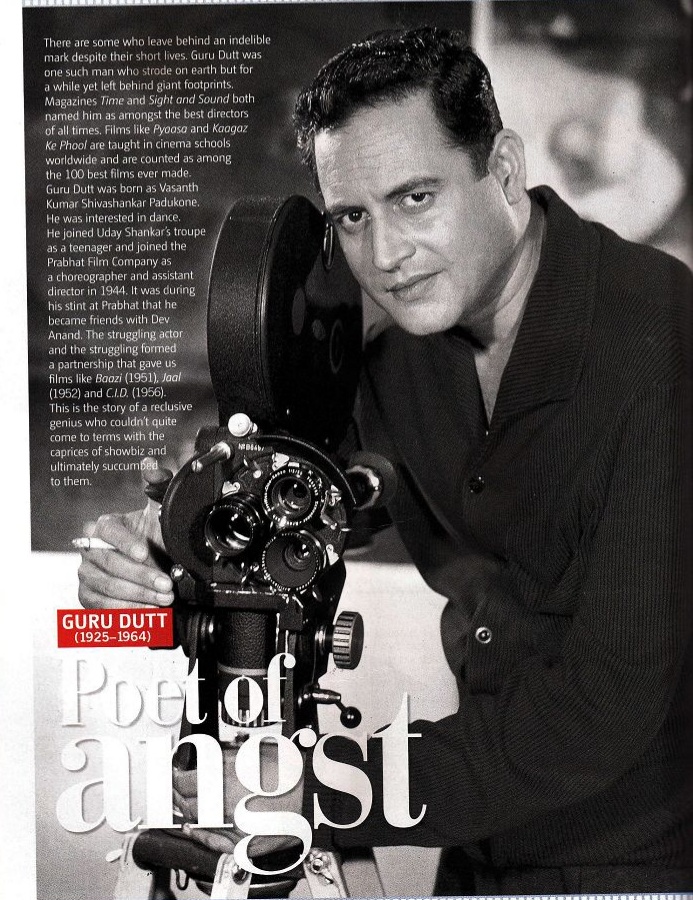
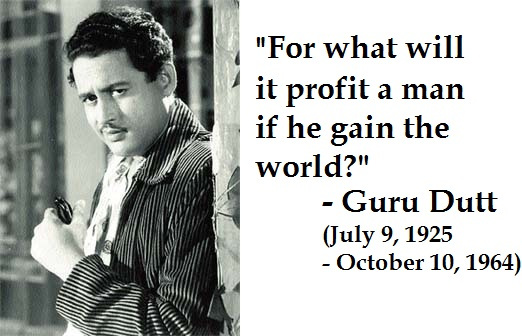
Vasanth Kumar Shivashankar Padukone, better known as Guru Dutt, was an Indian film Director, Producer, Actor, Choreographer, and Writer. He was included among CNN’s “Top 25 Asian Actors” in 2012.
Dutt was lauded for his artistry, notably his usage of close-up shots, lighting, and depictions of melancholia. He directed a total of 8 Hindi films, several of which have gained a cult following internationally. This includes Pyaasa (1957), which made its way onto Time magazine’s 100 Greatest Movies list, as well as Kaagaz Ke Phool (1959), Chaudhvin Ka Chand (1960), and Sahib Bibi Aur Ghulam (1962), all of which are frequently listed among the greatest films in Hindi cinema Beginning in 1942.
He studied at Uday Shankar’s School of Dancing and Choreography in Almora, but was taken out in 1944 after getting involved with the company’s leading lady. From there, gaining employment at a Telephone Operator at a Lever Brothers factory in Calcutta (now Kolkata), Dutt wired home to say he had got the job. However, soon after, he lost interest in the job and left it.
Dutt briefly returned to his parents in Bombay before his uncle found him a job under a 3-year contract with the Prabhat Film Company in Pune later that year. It was at Prabhat that Dutt met two people who would remain his lifelong good friends—actors Rehman and Dev Anand, the latter of whom would later go on to produce Dutt’s directorial debut.
In 1945, Dutt made his acting debut in Vishram Bedekar’s Lakhrani (1945), as Lachman, a minor role. In 1946, he worked as an assistant director and choreographed dances for P. L. Santoshi’s film, Hum Ek Hain, in which Dev Anand made his acting debut.
While his contract with Prabhat ended in 1947, Dutt’s mother got him a job as a freelance assistant with the company’s CEO, Baburao Pai. Dutt developed a flair for writing in English and wrote short stories for The Illustrated Weekly of India, a local weekly English language magazine.
After his time with Prabhat failed in 1947, Dutt moved to Bombay, where he worked with two leading directors of the time: Amiya Chakravarty in Girls’ School (1949); and Gyan Mukherjee in the Bombay Talkies film Sangram (1950). Around this time, Dev Anand offered Dutt a job as a director in his new company, Navketan. Back in their time at Prabhat while both still new to the industry, Anand and Dutt reached an agreement that if Dutt were to become a filmmaker, he would hire Anand as his hero, and if Anand were to produce a film, he would use Dutt as its director. Keeping that promise, the duo made two super-hit films together in a row.
As per commitment given by Dev Anand to Dutt for film Baazi (1951), starring Anand himself and marking Dutt’s directorial debut. Baazi was the first crime noir made in the country. With its morally amgiguous hero, the transgressing siren, and shadow lighting. The Times of India called Baazi, “a milestone in the short lived genre that can be loosely called Bombay Noir”. It was listed by Filmfare in “Best Bollywood Noir Films of 50s”.
Jaal (‘The Trap’) is a 1952 hindi crime film hugely successful at box office and was the third highest grossing film of the year in India. The spirit of Christian love and forgiveness lies at the base of the story, and the film has a strong religious colour to it. Its music became popular, especially the song “Yeh Raat Yeh Chandni Fir Kahan”. Jaal is considered a noir classic for its grey shade characters and dark theme which were the first of its type in Indian cinema. Filmfare listed it in Best Bollywood Noir Films of ’50s. Jaal was one of the first film made in India that portrayed an Anti-Hero character in the lead. It established the idea of Anti-Hero with “no qualms about bending moral codes” in Hindi cinema and inspired further such characters particularly since 1970s. The film is also noted for strong acting performance of Dev Anand as Tony which is regarded as one of Hindi cinema’s greatest Anti-Heroes.
Baaz ( ’Falcon’) is a 1953 Hindi action film directed by Guru Dutt. This film is Guru Dutt’s first starring film, an a ction film packed with adventure staged mainly on a ship. It is among the earliest adventure films made in India and was ranked #7 in the list of “Best Guru Dutt’s Movies” (in which he starred or directed) by The Cinemaholic.
Guru Datt team who performed well in subsequent films. The team included various filmmakers discovered and mentored by Dutt, including: Johnny Walker (actor-comedian), V. K. Murthy (Cinematographer), Abrar Alvi (writer-director), Raj Khosla (writer), Waheeda Rehman (actress), Rehman (actor) among others.
Dutt’s next film, ‘Aar Paar‘ in 1954 is comedy film. Datt played the role in this film. It is written an article by ‘The Print’, which says “the beauty of Aar Paar’s dialogue is that every character speaks in a language that reflects where they’re from, their upbringing and education. In the film there’s bit of Punjabi, a bit of Parsi, inflections of Urdu, a smattering of street Bambaiyys, some heartland Hindi mixed with clumsy English. That attention to detail not only made the dialogue more authentic to the character, but also to the city of Bombay, long known for its cosmopolitan population. The film had very popular music. The film had very popular music. The album of the film was ranked 34 in the list of “Best Bollywood Albums of all time” by Film Conpanion. It was also named the “Best Album of Golden Era” for the year 1954 in the 7th Mirchi Music Awards, 2014.
Dutt’s next film ‘Mr. & Mrs. 55‘ romantic comedy film directed and produced by Guru Dutt. A socially critical film set in urban Mumbai, it stars Madhubala as Anita Verma, a naive heiress who is forced into a marriage with an unemployed cartoonist (Guru Dutt) because her father’s will insists on it, so she might avoid the stem feminism of her aunt. Its box-office victory marked a reversal of fortunes for Madhubala, who was one of the film stars deemed “box office poison” in 1954. Her portrayal of Anita Verma has been generally considered one of her most memorable and identifiable performances. Mr. & Mrs. ’55 has gained classic status over years. In 2019, Time Our placed it at the 57th place in the list of “The 100 Best Bollywood movies”. Harneet Singh of The Indian Express, “The film rides on Madhubala’s impish charm and breezy comic timing, Johnny Walker’s one-liners, O. P. Nayyar’s evergreen music and Dutt’s lyrical direction, replete with long tracking shots, close-ups and cinematographer V. K. Murthy’s exquisite shadow-and-light framing. Mr. and Mrs. 55 is a great ride till the time the film doesn’t go all sanskari. Alvi’s dialogues are the star of the narrative. The banter is funny, lifelike and refreshingly non-filmi.” Mr. & Mrs. ’55 was the fifth highest grossing Indian film of 1955.
Film ‘Sailaab‘ in 1956 Hindi movie which tells the story of Gautam, a rich young man, who goes to Assam to visit his father’s tea plantation. The plane in which he’s travelling is forced to make an emergency landing due to bad weather. Gautam gets hurt and suffers from amnesia. He falls in love with a young woman Kanchan, who responds to him even though she is part of a religious community that doesn’t allow its members to marry.
Pyaasa (Thirsty ) is a 1957 Indian Hindi film focuses on the disillusioned Urdu Poet Vijay (Dutt), whose works are underestimated by publishers and panned for writing on socia l issues rather than romantic topics. The film follows his encounters with the golden-hearted porstiture Gulabo (Waheeda Rehman) and his former girlfriend Meena (Mala Sinha), how the former helps him to get his poetry published, the success of his works, and his romantic relationship with Gulabo. Pyaasa was based on a story idea called “Kashmakash”, written by Guru Dutt when he was 22. Till the project was started in 1956, several change were made in the original story in assistance with Abrar Alvi.
As stated in The Hindu, “While for Pyaasa, a film considered the brainchild of Guru Dutt, the soul behind the film was its lyricist Sahir Ludhianvi”. The popular song “Hum Aapki Aankhon Mein” was added to the movie on behest of distributors to bring some relief in rather pessimistic film. In 2004, as part of Sight & Sound’s feature “celebrating the relationship between cinema and music”, Pyaasa was listed as one of The Best Music in Film and was named by Olivier Assayas as one of his favourites, who called its music as “possibly one of the most remarkable transpositions of poetry on screen.
Pyaasa is regarded as one of the greatest films ever made. It frequently features on world cinema’s greatest films lists. It was one of the earliest films to have achieved a healthy blend of artistic as well as commercial mainstream traits. Filmmakers in India, to this day cite Pyaasa as their inspiration. It is one of the most revered and respected films in India and remains a popular favourite among cinephiles and filmmakers of Hindi Cinema. It is, in particular, praised for its technical bravura, storytelling, theme and romantic idealism.
Kaagaz Ke Phool (Paper Flowers) is a 1959 Indian Hindi language romantic drama film produced and directed by Guru Dutt, who also played the lead role in the film along with Waheeda Rehman. It is the first Indian film in Cinemascope and the last film officially directed by Dutt. It marked a technical revolution in Indian Cinematography and is widely considered to be much ahead of its time. The film was a box office bomb in its time owing to its heavy introspective theme which the masses could not identify with, but was later resurrected as a world cinema cult classic in the 1980s. Its failure, both critically and commercially, severely impacted Guru Dutt and brought his studio on the verge of ruins. Dutt never officially directed a film after this.
The film’s music was composed by S. D. Burman and the lyrics were written by Kaifi Azmi and Shailendra (for one song “Hum Tum Jise Kehta Hai“). The song “Waqt Ne Kiya Kya Haseen Sitam” became an evergreen hit and one of the most loved Hindi – film songs of all time. In 2006, it was ranked #3 in the “20 Best Hindi Film Songs Ever” poll of 30 leading music composers, singers, and lyricists. Apart from the song’s composition and lyrics, it is also considered one of the best photographed songs of all time. The light-beam effect was produced using two large mirrors and natural sunlight. V. K. Murthy, a frequent collaborator of Dutt, served as the Cinematographer and won the Filmfare Best Cinematographer Award for his work in the film. M. R. Acharekar was the Airector and went on to receive the Filmfare Award for Best Art Direction.
Today Kaagaz ke Phool is a part of syllab in many film schools worldwide. It is considered to be the finest self- reflexive film to have ever been made in India. Kaagaz Ke Phool‘s screenplay was published in 2014 as a book as Kaagaz Ke Phool : The Original Screenplay. In 2019, British Film Institute named Kaagaz Ke Phool as the Best Musical of 1959, citing, “if proof were needed that Guru Dutt was no one-hit-wonder, it’s right here.” It was ranked first in The Cinemaholic’s list of “Best Hindi Cult Films that were Flops”, citing, “The last film officially directed by the legendary Guru Dutt. Often regarded as one of the greatest film ever made, the failure of Kaagaz Ke Phool severely impacted Guru Dutt.” In an articl e regarding the film, the University of IOWA, summed up, “Flaws and all, Kagaz Ke Phool deserves to rank— with Fellini’s 8½ —among the all-time great films about filmmaking and life.
Dutt’s team released Chaudhvin Ka Chand (The Moon of the Fourteenth Day) is a 1960 directed by M. Sadiq and starring Dutt alongside Waheeda Rehman and Rehman. This film was a super-hit at box-office, and became one of the top-grossing films of 1960. A production of Guru Dutt, the film centers on a love triangle between Guru Dutt, Rehman and Waheeda Rehman. After the disastrous box office performance of Kaagaz Ke Phool, Guru Dutt had to stick back to the idea of producing a commercial film along with an experimental project to protect his studio from ruins.
Despite being a commercial venture, the film is considered a classic Muslim-social. It was ranked #28 in 2003 Outlook Magazine poll of 25 Leading Indian Directors for “Best Bollywood Movies of all time”. Filmfare listed it among “Seven Muslim socials you must watch”. The film’s title track “Chaudhvin Ka Chand” became especially popular and is noted for picturization of the song sequence. The song is regarded as one of the most acclaimed romantic ballads in history and one of the most loved filmi songs of all time. The film was also entered into the 2nd Moscow International Film Festival.
In 1962, his team released Sahib Bibi Aur Ghulam (The Master, the Wife, and the Slave), a critically successful film. Film was directed by Abrar Alvi and produced by Guru Dutt. Sahib Bibi Aur Ghulam won four Filmfare Awards, including Best Film, Best Director for Alvi, and Best Actress for Meena Kumari. It also received the National Film Award for Best Feature Film in Hindi and the Bengal Film Journalists, Association Award for Sixth Best Indian Film, and Alvi was awarded the Best Director trophy at the latter function.
In 1964, Dutt acted opposite Meena Kumari in his last film, Sanjh Aur Savera, , directed by Hrishikesh Mukherjee.
Guru Dutt used a 75mm lens for big close-ups , so that the expression was very subtle. He was the first director who started shooting this close. He was never satisfied with his work . He would cancel scenes and do it over again. That’s why he became producer. He was often furious with second-string actors. After explaining repeatedly, they would still not do a particular scene well, and he would lose his patience and pack up. Even with himself, for the famous Pyaasa scene, he shot 104 takes! He kept forgetting the dialogues as it was a very lengthy shot, but he wanted it just right. He was an obsessive director, and until the shot came out just as he wanted he would continue with as many takes as he needed, without a break. He was a great director, very creative, and very interested in his work. He was a serious person, and did not lose his cool unnecessarily. But like all creative people, he was very demanding of his co-workers.
A postage stamp featuring Dutt was released by India Post on 11 October 2004. On 10 October 2011, a Doordarshan Documentary on Dutt aired. In 2021, author Yasser Usman published a biographical book about him, titled Guru Dutt : An Unfinished Story.
Photos courtesy Google. Excerpts taken from Google.
 Writer Sunita