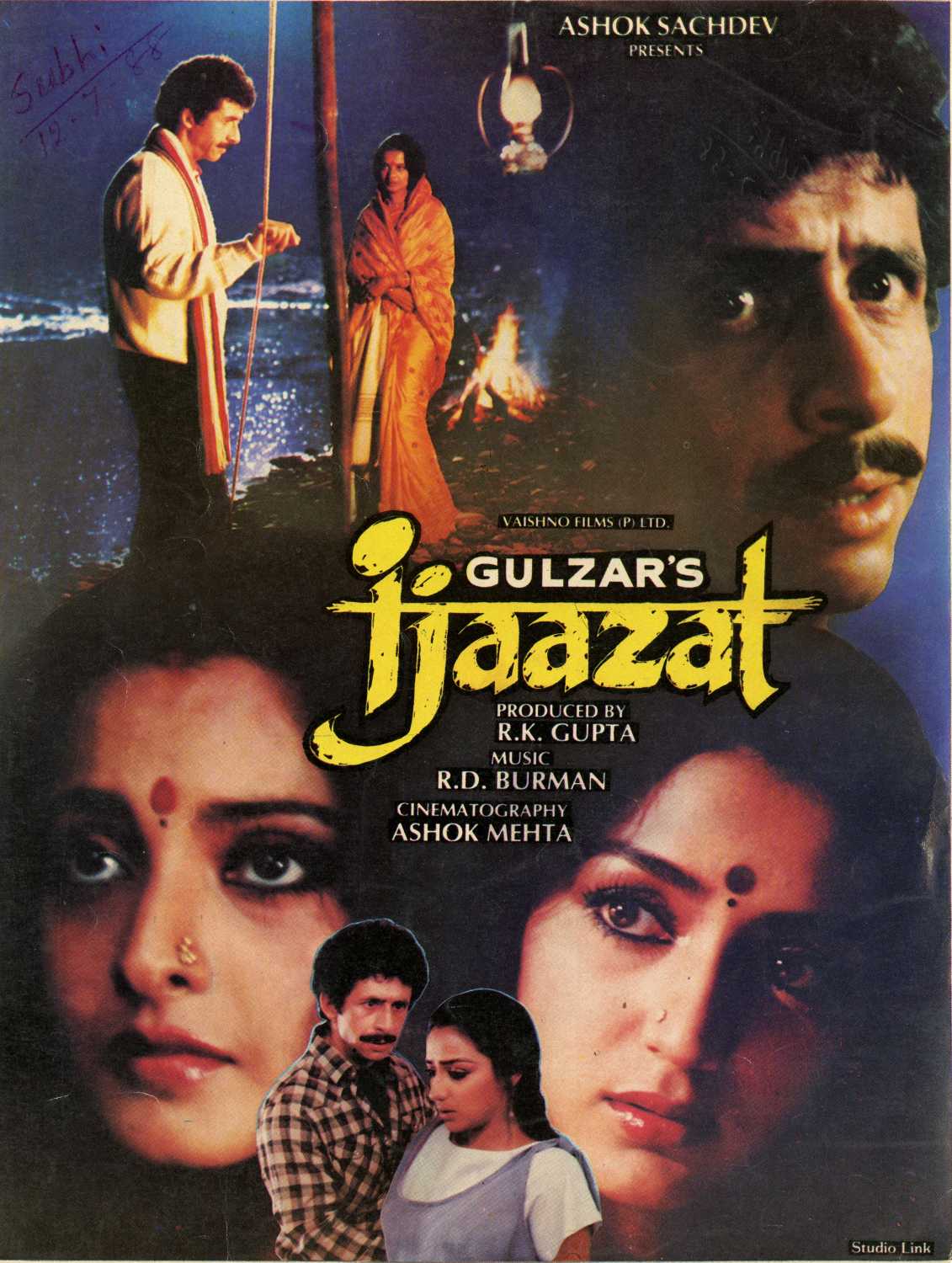
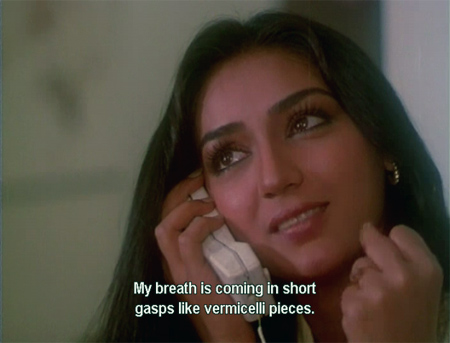
Ijaazat (Permission) is an 1987 Indian Hindi – language musical romance film directed by Gulzar, based on a Bengali story, Jatugriha by Subodh Ghosh. Starring Naseeruddin Shah, Rekha and Anuradha Patel in leading roles, the film followed the story of couple who are separated and who accidentally meet in a railway station waiting room and discover some truths about their lives without each other.

A couple meets accidentally five years after their divorce, and their encounter is interwoven with flashbacks from their marriage. Mahendra (Naseeruddin Shah) arrives at a station waiting room as it begins to rain. His ex-wife, Sudha (Rekha), is already there, but he doesn’t notice her at first. Sudha, seeing him, tries to avoid being seen, but fate intervenes, and the two eventually come face to face. Their conversation slowly reveals the emotional layers of their past, filled with love, misunderstanding, and unresolved pain.
In the first of many flashbacks, Mahendra visits his grandfather (Shammi Kapoor), who reminds him of his vow to marry Sudha and reveals that the wedding date has already been fixed. Torn between his commitment and his love for another woman, Maya (Anuradha Patel), Mahendra meets Sudha to discuss his ongoing relationship with Maya. Sudha, seeking clarity, asks Mahendra to bring Maya in person and state his intention to marry her. However, when Mahendra returns home, he finds that Maya has left, leaving behind only a letter.
Later, Mahendra marries Sudha, but continues to maintain an amicable relationship with Maya, often speaking to her as a friend. Though he genuinely wants to move on and build a normal married life with Sudha, she remains uneasy about Maya’s lingering presence in their lives.
When Maya attempts suicide, Mahendra is overwhelmed with guilt and starts spending more time with her. Unaware of the suicide attempt, Sudha begins to suspect infidelity and feels that marrying Mahendra was a mistake. When she confronts him, Mahendra insists that he will bring Maya home to clear the air. Sudha strongly objects, but Mahendra leaves to bring Maya anyway.
However, Maya, having overheard Mahendra and Sudha’s argument over the phone, quietly leaves before Mahendra can reach her. When Mahendra returns, he finds that Sudha has also left, ending their marriage.
Mahendra, devastated by Sudha’s departure, suffers a heart attack. During his recovery, Maya takes care of him, while Sudha remains out of contact, working as a teacher in Panchgani. Once Mahendra regains his strength, he decides it’s time to bring Sudha back. But before he can act, he receives a letter from her declaring her decision to end the marriage permanently and cut off all ties.
Maya, hurt by Mahendra’s sudden emotional shift and his renewed focus on Sudha, feels alienated. After an argument, she leaves at dawn on her motorcycle. Mahendra chases after her in his car, trying to stop her. Tragically, Maya’s scarf gets caught in the rear wheel of her motorcycle, causing a crash that leads to her death.
In the present day, after learning about Mahendra and Maya’s fate, Sudha is deeply moved. As Mahendra begins to ask about her current life, her new husband (played by Shashi Kapoor) enters the waiting room to collect her.
As he steps out with her luggage, Mahendra asks Sudha for forgiveness. In a quiet, emotional moment, Sudha touches Mahendra’s feet—a gesture asking both for forgiveness and his permission (Ijaazat) to leave him, something she never received when they first separated. Her husband returns, sees Mahendra, and smiles in quiet acknowledgment.
Sudha and her husband walk away from the waiting room and the platform, while Mahendra stays behind, silently watching her go.
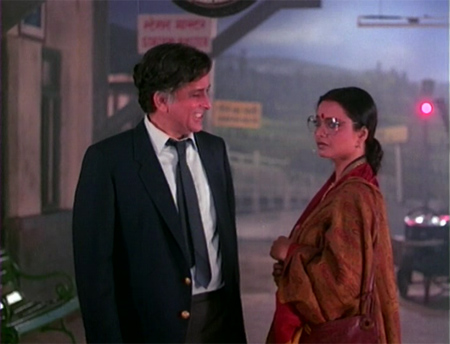
The waiting room in Ijaazat is more than just a setting—it serves as a metaphor for the emotional pause in the lives of Mahendra and Sudha, a space suspended between past and future. The story unfolds over one night, with the promise of movement—of trains, of lives continuing—but that movement is still hours away. In this quiet, rain-soaked pause, memories return.
Sudha brings up Maya, recalling how she always loved the rains. Mahendra has no words. The sawan (monsoon) becomes a symbol—of love, of longing, and of heartbreak. Another heart has been broken, another chapter has closed. Mahendra is left with a new set of memories, not just of Maya, but now of Sudha too—another person from the past, and another goodbye he must carry with him.
Gulzar, who adapted Ijaazat from Subodh Ghosh’s story and wrote its screenplay and dialogues, also penned some of the most hauntingly lyrical songs of his career for the film. Among them, “Mera Kuch Saamaan”, sung by Asha Bhosle, stands out as a free-verse gem—intimate, aching, and unforgettable.
In the song, Maya sings:
*”Saawan ke kuch bheege bheege din rakhe hain / Aur mere ek khat mein lipti raat padi hai.
In Ijaazat, divorce is not judged through the usual lens of right or wrong, guilt or blame. Instead, it is portrayed with warmth, compassion, and a deep emotional maturity. The film acknowledges that a marriage—and its unraveling—is something deeply personal, understood only by the two people who lived it. There are no villains here, no finger-pointing. The breakup is not one person’s fault, but the quiet outcome of love, loss, misunderstandings, and time. Ijaazat gently reminds us that some relationships end, not in anger, but in acceptance.
Filmfare praised Ijaazat as “one of Gulzar’s most sensitive films,” highlighting it as Rekha’s most poignant performance—a woman who chooses to walk away from her husband (Naseeruddin Shah) rather than share him with another (Anuradha Patel). It added, “Mera Kuch Saaman… can anyone not be moved by it?”
Lalit Mohan Joshi, in his book Bollywood: Popular Indian Cinema, called Ijaazat a film that “recreates the tingling sensation of a mature romance.” He admired its exploration of an unusual male-female relationship, a theme rarely addressed in Hindi cinema. Joshi also noted that the film carries a sentimental depth that feels “more touching than the recent teenybopper romance stories.”
Photos courtesy Google. Excerpts taken from Google.
 Writer Sunita