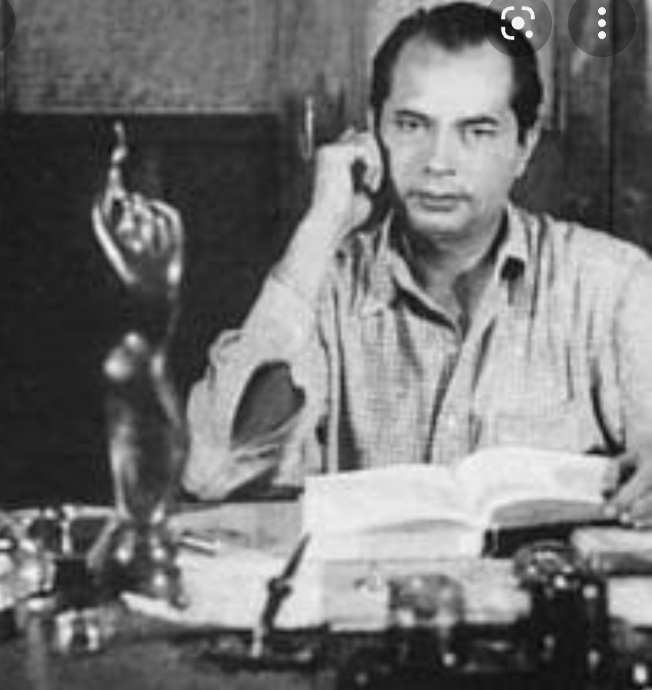
Bimal Roy was an Indian film director. He is particularly noted for his realistic and socialistic films such as Do Bigha Zamin, Parineeta, Biraj Bahu, Devdas, Madhumati, Sujata, Parakh and Bandini, making him an important director of Hindi Cinema. Inspired by Italian neo-realistic cinema, he made Do Bigha Zamin after watching Vittoria De Sica’s Bicycle Thieves (1948). He won a number of awards throughout his career, including eleven Filmfare Awards, two National Film Awards, and the International Prize of the Cannes Film Festival. Madhumati won 9 Filmfare Awards in 1958, a record held for 37 years.
Bimal Roy moved to Calcutta and entered the field of cinema as a camera assistant with New Theatres Pvt. Ltd. During this time, he assisted director P. C. Barua as Publicity Photographer, on the hit 1935 film Devdas, starring K. L. Saigal. In the 1940s and 1950s Roy was part of the parallel cinema movement in post-war India. He collaborated on Anjangarh (1948), one of the last major films of the New Theatres, however, the Kolkata-based film industry was now on the decline.
Roy shifted his base to Bombay (now Mumbai), along with his team in 1950, which included Hrishikesh Mukherjee (editor), Nabendu Ghosh (screenwriter), Asit Sen (assistant director), Kamal Bose (cinematographer) and later, Salil Chaudhury (music director), and by 1952 he had restarted the second phase of his career with Maa (1952), for Bombay Talkies. He was famous for his romantic-realist melodramas that took on important social issues while still being entertaining. He was a filmmaker of great and in-depth understanding of human strengths and weaknesses. In 1959, he was a member of the jury at the 1st Moscow International Film Festival.
Do Bigha Zameen (“Two Acres of Land”) 1953 was the inaugural film of Bimal Roy Productions – and if Bimal Roy intended to make a statement upon his arrival in Bombay, he surely did so with this extraordinary film. He elicited a stellar performance from Balraj Sahni, who plays a peasant (Shambu) caught up in a cycle of debt to the local landlord. Desperate to save his land from being auctioned off, Shambu migrates to the city and works as a rickshaw puller to make ends meet and earn money to get his land back from the moneylender. After a series of misfortunes, he returns to his village only to find his farm taken over by a city developer. The film, boasting of a superb central performance by Balraj Sahni, was a moderate commercial succes s and a huge critical success and won Bimalda awards at Cannes and at the Karlovy Vary Film Festivals. Even back home, when Raj Kapoor saw the film, his reaction was, “How I wished I had made this film.” While speaking of Do Bigha Zamin, Satyajit Ray said, “It is a film that still reverberates in the minds of those who saw it – and it remains one of the landmarks of Indian cinema. He was thus undoubtedly a pioneer.”
Parineeta (Married woman) is a 1953 Indian Hindi language film starring Ashok Kumar and Meena Kumari , based upon the 1914 Bengali novella of the same name by Sharat Chandra Chattopadhyay. This version of the film is considered by many to be the most faithful adaptation of the novella, particularly due to Meena Kumari’s interpretation of the role of Lalita. In 1954 film won Filmfare Best Director Award – Bimal Roy and Best Actress Award – Meena Kumar.
Biraj Bahu is a 1954 Hindi film based on a Bengali novel by Sharat Chandra Chattopadhyay. The film won the All India Certificate of Merit for Best Feature Film.
Naukri (Job) is a 1954 film is about the dreams and aspirations of the educated youth getting shattered as they struggle in the city for employment, in the ensuing years after India attained independence. In Naukri, Bimal Roy tackles yet another social problem, this time involving unemployment.
Devdas is a 1955 film based on the Sharat Chandra Chattopadhyay.
Madhumati (1958), his first and only collaboration with Ritwik Ghatak (who wrote the screenplay), and one of the earliest films to deal with reincarnation. The first Indian film to be released abroad after its release in the Madhumati was the highest – grossing Indian Film of 1958.
Yahudi (Jew), is a was based on the play Yahudi Ki Ladki by Agha Hashar Kashmiri, a classic in Parsi – Urdu theatre, about persecution of Jews in the Roman Empire. The story revolves around the life of a foster relationship. Set in the era of the Roman Empire over 2000 years ago, it focuses upon the persecution of jews at that time in the empire’s centre – Rome. The film was the third-highest grossing film of 1958, owing to box office draw of Dilip Kumar. The film’s lyricist Shailendrs won the Filmfare Award for Best Lyricist at the 6th Ceremony, for the song “Yeh Mera Diwanapan Hai”, sung by Mukesh.
Sujata is a 1959 based on a Bengali short story of the same name by writer Subodh Ghosh, the film explored the situation of caste in India It was entered into the 1960 Cannes Film Festival. Sujata can with some simplification be viewed as concerned with women’s oppression. The film revolves around Sujata, an untouchable girl adopted into an upper-caste family and viewed almost like their daughter (not as their beti, but beti jaisi). Bimal Roy cast Nutan in the title role and she delivered with a performance of immense dignity and control. As the actors who worked with Roy have themselves stated, he exercised directorial authority and yet simultaneously allowed them to discover their own potential. The story, screenplay, music, and all the performances especially that of Nutan received high critical acclaim and even today, her performance in Sujata is considered to be one of the best by any female actress.
Parakh is a 1960 film, based on a story by famed music director Salil Chowdhury, that displays Bimal Roy’s lighter side and is a satirical look at Indian democracy in its early years.
Bandini is a 1963 film explores the human conflicts of love and hate intertwined in the mind of Kalyani (Nutan). The film tells the story of a woman prisoner charged with murder. The story, told in flashback from the woman’s point of view is unraveled in a manner such that by and large she is always there or from where she can overhear the goings on in the past rather than the general practice of telling the whole story. In the film, Bimalda beautifully used imagery and sound to convey the various moods of Nutan. As she is seated in the corner of her gray, grim cell facing the prison’s high wall, she can hear the hoofs of the horse pulling the carriage taking away her lover, or that masterful scene in which Nutan murders her lover’s wife with the hammering of a welder in the background thus heightening the drama! She must make a choice between two very different men, Devendra (Dharmendra), the loving prison doctor, and Bikash (Ashok Kumar), a man from her past. Bandini was the tenth highest grosser of the year and was declared a ‘Semi Hit’ at Box Office India, though it received not just critical acclaim, but also swept that year’s Filmfare Awards, winning six awards in all, including the top awards of Best Film and Best Director, as well as Best Actress, and is still considered a landmark movie of the 1960s, especially being the last feature film of the director Bimal Roy, a master of realism.
Bimal Roy’s last production before he died in 1966 was Benazir (1964) directed by S Khalil. The body of work that he has left behind is remembered most for its portrayal of the everyday, non-sensational aspects of life. His films record the social, economic and moral trends in the India of his day and age.
Bimal Roy discovered and gave a break to many children, such as Asha Parekh, Sona Mastan Mirza, Baby Farida, , & Baby Sonu, who would later become quite famous.
Nitin Bose, who could be termed Roy’s first tutor, talks about his sincerity and dedication of purpose, “There was something in Bimal, in his gentle manner, in his silence which inspired deep confidence. I was totally captivated by his attachment to work. Dedication to work was one of Bimal’s greatest assets.”
Though Bimal Roy earned more than his share of the greatest accolades conferred by the industry in India – for example, Filmfare Award for Best Director three years in succession, for Madhumati, Sujata, and Parakh – and ample international recognition, such awards cannot convey his obvious love of the cinema, the very high standards he set for himself. He is one of the few people to have understood that the ontology of the oppressed is superior to the ontology of the oppressor. The women in Bimal Roy’s films, perhaps not accidentally, are generally stronger characters than men. At the aesthetic plane, a s well, Roy displayed a superb mastery of his craft. One could point, for example, to the manner in which shadows appear in his films, or how the films echo each other in interesting ways.
Bimal Roy’s films continue to be screened at major national and International Film Festivals in India, Europe and North America. His films are being restored and digitised by the National Film Archive of India (NFAI) at Pune. In July 2014, Prince of Wales Museum, Mumbai hosted an exhibition; Bimal Roy: Life & Times, organised in collaboration with his children. The exhibits included screening of the films; Madhumati, Sujata and Bandini, besides film posters, costumes and memorabilia, including an Arriflex camera used to shoot Devdas and Sujata.
The Bimal Roy Memorial Trophy has been awarded every year since 1997, by the Bimal Roy Memorial & Film Society to honor both experienced artists and other contributors from the Indian film industry as well as new and upcoming outstanding young filmmakers.
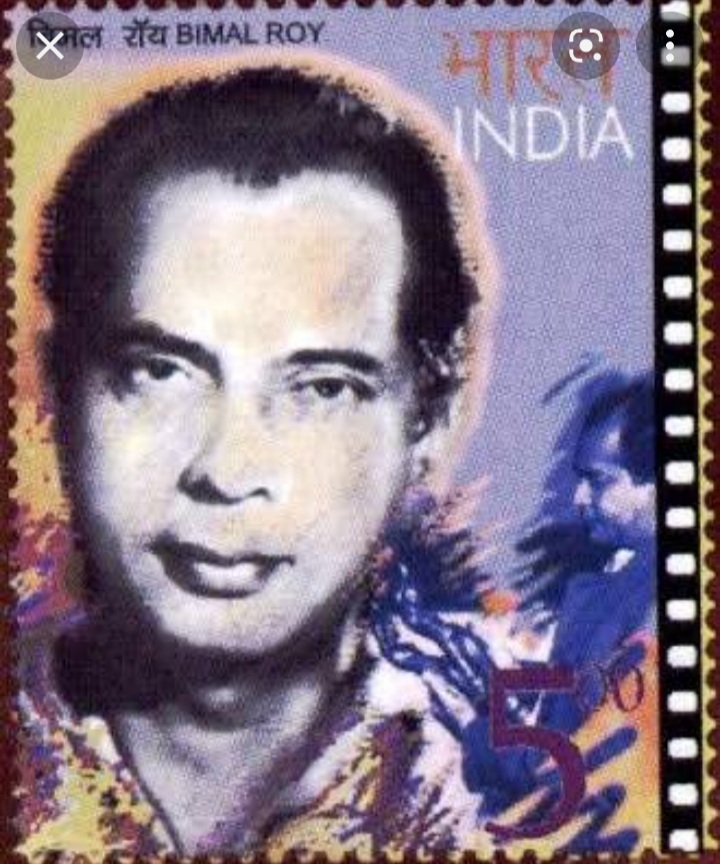
A postage stamp, bearing his face, was released by India Post to honour him on 8 January 2007.
Photos courtesy Google. Excerpts taken from Google.
 Writer Sunita