
Ketan Mehta is an Indian film director who has also directed documentaries and television serials since 1975. During his career, Mehta has made ten feature films, seven documentaries and two television serials. His repertoire of themes includes comedy, satire, romance, violence and rebellion.
After graduating from the Film and Television Institute of India, Mehta joined the Indian Space Research Organisation as a television producer. There, he was given almost total freedom in what to create. In an interview years later, Mehta remarked about how influential this was to his development: “It was an incredible experience. Traveling all over Gujarat, meeting people, making programs on whatever you felt like, whatever you came across. It was real, genuine experimentation with medium, with people. That experience has been vital to films that I’ve made.”
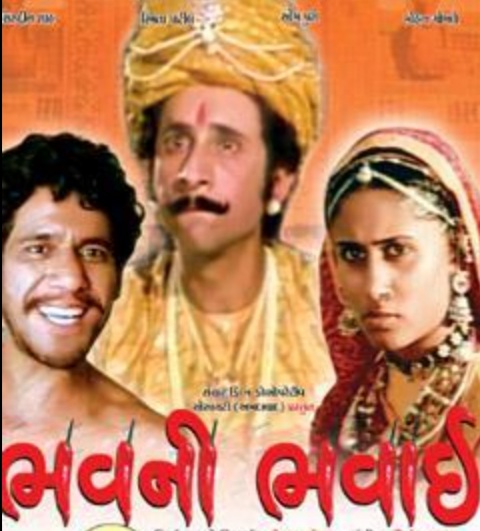
Mehta’s first Gujrati language film, Bhavni Bhavai (The Tale of the Life) is a 1980, tells the story of untouchability through folklore and Bhavai. After graduating from the Film and Television Institute of India, Ketan Mehta was working for a satellite channel. Through his travels in villages, he came across the problems faced by rural population, specifically untouchability. He also came across Dhiruben Patel’s play Bhavni Bhavai, — which back then was performed as a Bhavai — and decided to turn it into a movie. He was also inspired by Achhutno Vesh, a Bhavai performance.
The story begins with a group of Harijans migrating to a city and pausing for a night. As the story approaches the end, one of the Harijans stops the elder and tells him not to lure the children with false ‘happy endings’ and narrates his own alternate ending. In the alternate ending, Ranglo doesn’t arrive to tell the truth and sacrifice proceeds as planned, but there is still no water in the stepwell. Unable to bear the shock of their son’s death, Jeevo’s mother dies and Malo curses the king and commits suicide in the stepwell. Upon Malo’s death, stepwell gets over-flooded, killing king and his ministers with him. The final sequence is interspersed with the footage of violent protests of Indian Independence movement.
Ketan Mehta filmed Bhavni Bhavai with distancing effect and the use of comic characters. The film is dedicated to the inventor of the Bhavai, Asaita Thakar, who was a Brahmin outcast and lived among the lower caste communities. The Bhavai evolved into one of India’s most energetic folk music and dance-dramas. The final sequence of the stepwell and sacrifice was filmed at the World Heritage Site, Rani ki vav in Patan, Gujarat.
The New York Times described it as “Enhanced by interesting costumes and incisive dialogue, the fable combines comedy and social commentary as it moves through its classic tale.” Khalid Mohamed of Times of India, “like a lightening red Bhavni Bhavai, the Gujarati Film is very special – inventive, moving and fine grained – the film is so simple, song filled and entertaining that it is well along its way before you recognise it as a tour do farce it actually is.” American film critic J. Hoberman the movie “the finest film I saw in India” and described it as stunningly photographed and universally accessible.Director Sudhir Mishra has said that Bhavni Bhavai was one of the films that inspired him to take up filmmaking.
Mehta won the prestigious Nargis Dutt Award for Best Feature Film on National Integration, while Meera Lakhia won National Film Award for Best Productioon Design at the 28th National Film Awards. The film was selected for a festival at the Museum of Modern Art and received UNESCO Club Human Rights award at the Three Continents Festival. The film was presented at the New Indian Cinema festival held in London along with 22 other films.
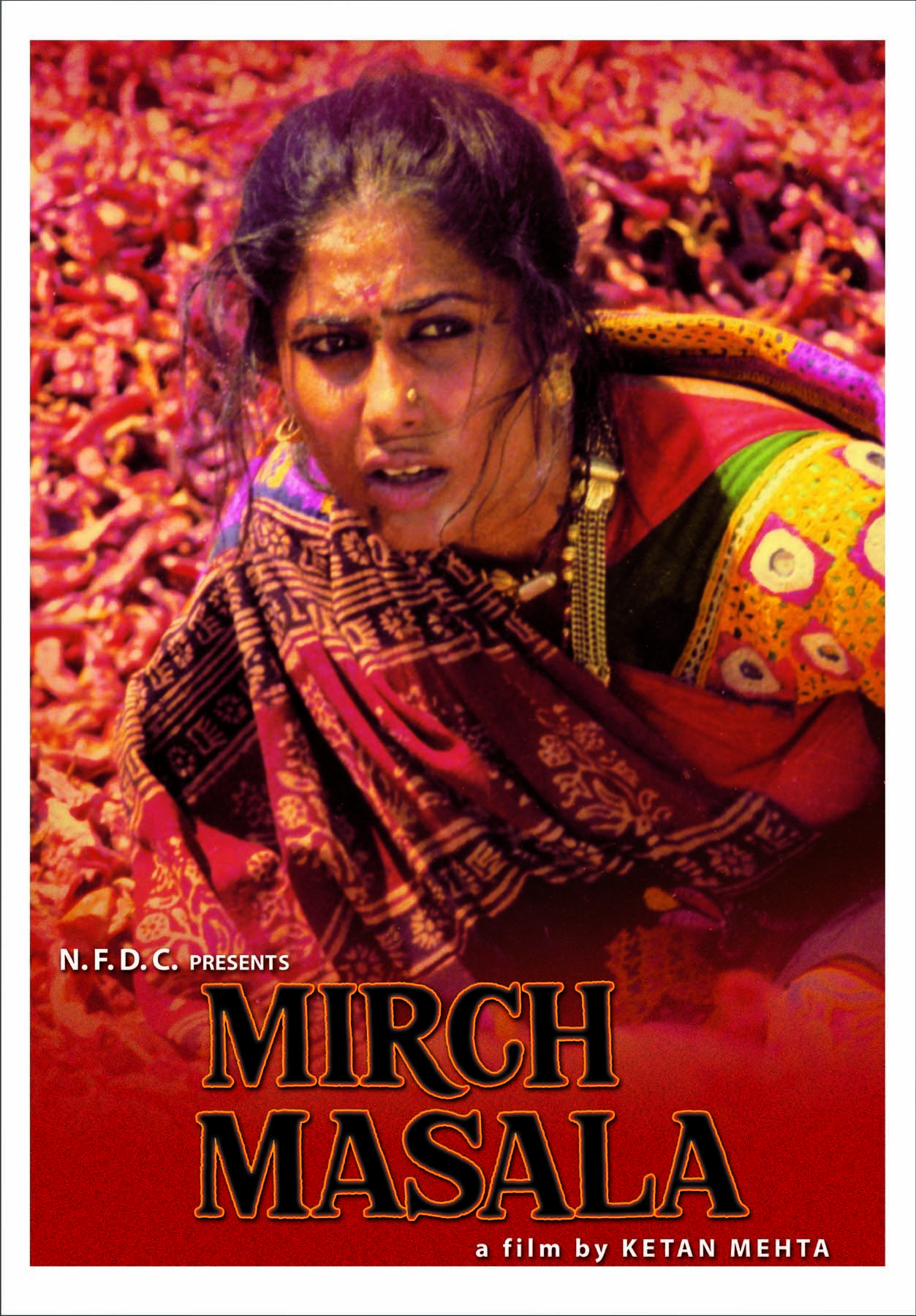
Mirch Masala (Hot Spice) is a 1987 Hindi pschological thriller stars Naseeruddin Shah and Smita Patil in the lead roles. On the centenary of Indian Cinema in April 2013, Forbes included Smita Patil’s performance in the film on its list, “25 Greatest Acting Performances of Indian Cinema”.
Circa British rule in India, a subhedar (Naseeruddin Shah), along with a regiment of soldiers, is sent to collect taxes due from a small town. When the lusty Subhedar feasts his eyes on a young married woman named Sonbai (Smita Patil), he wants to have his way with her, but she slaps him, runs and takes shelter in the enclosed compound of a spice factory where women grind chillies into fine powder. The elderly, but brave, Chowkidar Abu Mian (Om Puri), closes the reinforced door to the factory, and refuses to let the soldiers in. This angers the Subhedar, and he asks the town Mukhiya, to get Sonbai to him, or else he will destroy his town. The terrified Mukhiya and the rest of the townspeople decide to turn over Sonbai to the Subhedar, so that he can leave them in one piece, on the condition that they do not molest any more women. The Subhedhar is angered at this show of defiance, and refuses to agree to any conditions. The villagers and the Mukhiya must now decide whether to hand over Sonhai to him, or let him get her and destroy their village, and molest their wives, daughters, and sisters.
The mukhi brings pressure on Sonbai, but she stands firm. Within the factory, the women who once supported Sonbai now turn upon her. They fear that if she does not yield, the subedar may send his men to indiscriminately molest the womenfolk. Sonbai nearly relents, but is stopped by Abu Mian. She resolves to stand firm. Abu Mian chides the mukhi and the villagers; they may lord it over their wives at home, but are not man enough to face the subedar. The subedar orders his soldiers to charge the factory, and they smash down the door. Abu Mian manages to shoot one of the soldiers, but he is shot dead immediately after. The subedar enters the factory and tries to grab Sonbai. The women of the factory mount a sudden and surprising defense. They attack the subedar with bagfuls of fresh ground red chilli powder in teams of two. The film ends with the subedar on his knees, screaming in pain as the chilli burns his face and eyes.
Mirch Masala won him the Best Film Award at Hawaii. It was released to 52 cinemas in the United States.
Mr. Yogi was an Indian comedy mini television series which aired from 1988 to 1989 on DD 1. It is a story of a USA settled Indian boy trying to arrange his marriage in India. An MBA student from America, Yogesh Ishwarlal Patel ( Mr. Yogi), meets 12 girls and tries to select one of them as his bride in India. The story revolves around Yogi and his search for a perfect bride.
Hero Hiralal is a 1988 Indian film is based on an auto rickshaw driver who falls in love with a film actress.
Maya Memsaab is a 1993 film is based on the famous Gustave Flaubert’s 1857 novel Madame Bovary. A beautiful, wealthy woman’s insatiable appetite for romance leads to tragedy and a police investigation. Maya Memsaab won the National Film Award – Special Mention (Feature Film) in the year 1993.
Sardar is a 1994 Indian biographical drama film on Sardar Vallabhbhai, one of India’s greatest freedom fighters. The film was screened retrospective on 12 August 2016 at the Independence Day Film Festival jointly presented by the Indian Directorate of Film Festivals and Ministry of Defence, commemorating 70th Indian Independence Day. An account of Vallbhbhai Patel’s political life while India was taking first steps as an independent country. Film won National Film Awards for Best Film on National Integration and Best Editing.
Oh Darling Yeh Hai India (Oh darling, this is India) is a 1995 Indian musical film based on Miss India and an aspiring actor spend a night together roaming the streets of Mumbai and unwittingly clash paths with a megalomaniacal gangster planning to take over India.
Aar Ya Paar (Now or never) is a 1997 crime thriller film is adapted from Agatha Chiristie’s 1967 novel Endless Night and James Hadley Chase’s 1954 novel The Sucker Punch and was partly shot in Italy. Shekhar marries Veena, a multi-millionaire, while continuing his affair with her secretary, Anu. When Veena gets to know, she threatens him with dire consequences. Shekhar and Anu then kill her. Later, Shekhar finds out that Anu does not love him, but another man. To make matters worse, the police have evidence linking him to the death of his former wife.
Captain Vyom is an Indian television series aired on DD National in 1998.
Mangal Pandey: The Rising is a 2005 Indian historical biographical fim based on the life of Mangal Pandey, an Indian Soldier known for helping to spark the Indian rebellion of 1857 (also known as The First War of Indian Independence. It premiered in the Marche du Film section of the 2005 Cannes Film Festival.
Time Bomb 9/11 was a Hindi political thriller that aired on Zee TV from 20 June 2005 to 28 November 2005. It used to air every Monday at 10:00pm, and the show had a similar format to “24”. The story focuses on Osama Bin Laden and his terrorist group aiming to destroy the city of New Delhi on 11 September as well as assassinating the Indian Prime Minister. A RAW group led by Field Officer Varun Awasthi has to protect the Prime Minister and more importantly, the city.
Rang Rasiya (Colours of passion) film based on the life of the 19th-century Indian painter Raja Ravi Verma. Made as a bilingual, the film is titled Rang Rasiya in its Hindi version and Colours of Passion in English. Mehta thought that Varma was the most fascinating artist of that era and his character, and paintings. He was fascinated with Ravi Varma right from his days at Film and Television Institute of India. After reading Desai’s novel, Mehta felt inspired to make a film based on the life and times of Ravi Varma, and set about formulating the story of his new film. Given that many of Ravi Varma’s paintings are actually used as icons of worship in Hindu homes, this positioning represents a major stretch of the imagination, a major effort at fictionalization. The film was screened at 2008 The Times BFI London Film Festival.
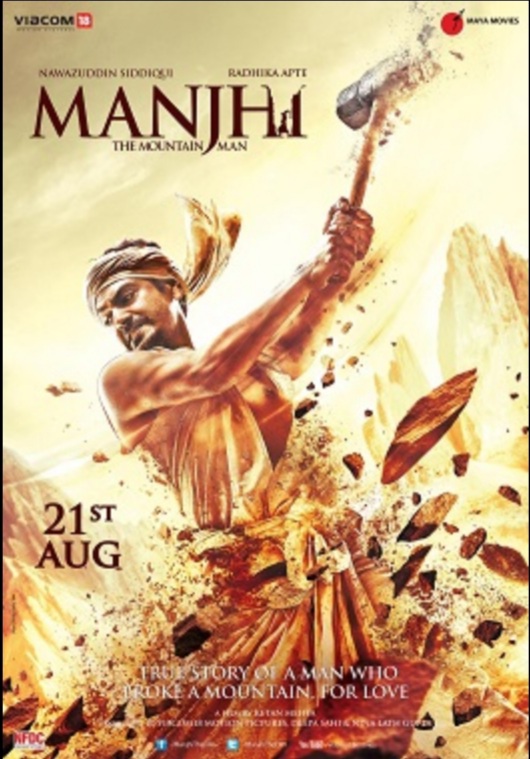
Manjhi – The Mountain Man is a 2015 Indian Hindi language film based on the life of Dashrath Manjhi. Manjhi, widely known as the “Mountain Man”, was a poor labourer in Gehlaur village, near Gaya in Bihar, India, who using only a hammer and chisel, spends twenty-two years carving a road through a treacherous mountain. The film was released worldwide on 21 August 2015. The Bihar State Government declared the film tax-free on 30 July 2015.
Toba Tek Singh is an Indian film based on Saadat Hassan Manto’s short story of the same name. The short film is written and directed by Ketan Mehta. It was released digitally on the video on-demand platform ZEE5 on 24 August 2018. The story takes place just before the India-Pakistan partition in one of the oldest mental asylums in undivided India. Situated in Lahore, it was home to Hindu, Muslim and Sikh patients who were left behind by their uncaring families. Friendships were thick between the patients who had nobody but each other for company. Each had a story that made for an interesting tale but none quite like Bishan Singh. The story of his journey from sanity to madness stemmed from the village he came from, Toba Tek Singh. Now all he does is stay awake every day and night and such has been the case for the last 10 years. But what happens when partition causes him to leave the country he has known to be home in his sane and insane state of mind? It is a story of displacement and how painful it is even for the people who are not in their senses in a worldly way. Irrespective of who you were and what state of mind you were in, partition had nothing but pain for people who experienced it and this is what this film based on the poignant tale by celebrated writer “Saadat Hasan Manto”, examines.
Mehta has also had the honour of serving as a member of the jury in various national and international film festivals. He has served as a consultant on many Government of India bodies including Doordarshan, Directorate of Film Festivals and is currently a Member of the Board of Directors of NFDC (National Film Development Corporation of India). He has been a Content Producer for ISRO and been involved in their satellite project for a number of years.
He is also the President of IIFW – (Independent Indian filmmakers’s worldwide) a global association of Independent film makers and the promoter of Maya Entertainment ltd, India’s leading Computer Animation and Digital visual effects studio.
Photos courtesy Google. Excerpts taken from Google.
 Writer Sunita