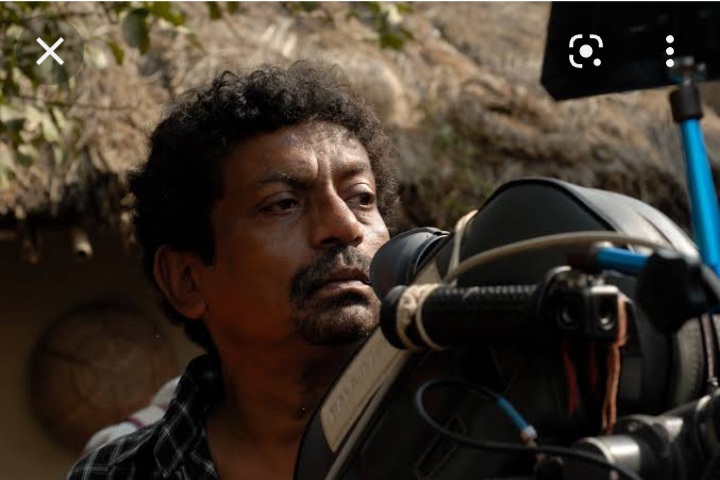
Goutam Ghose is an Indian film Director, Actor, music director and cinematographer, who works primarily in Bengali Cinems. He is the only Indian to have received the “Vittorio Di Sica” Award, Italy, in 1997. His films are critically and commercially successful.
In 2012, the Government of West Bengal honoured him with the Banga Bibhushan for lifetime achievement. Acknowledging his contributions to film, he was awarded the Knighthood of the Star of the Italian Solidarity in July 2006.
He started making documentries in 1973. Took active part in group theatre movement in Calcutta. Also dedicated some time as a Photo Journalist. Made his first documentary – New Earth in 1973 followed by Hungry Autumn. Since then, he has made a number of feature films and documentaries. Ghose was greatly influenced by the movie of Akira Kurosawa, Satyajit Ray, Ritwick Ghatak, Tapan Sinha.
Maa Bhoomi (Our land) is a 1980 Indian Telgu – language Social problem film written and produced by B. Narsing Rao, based on the novel Jab Khet Jage by Krishan Chander on the Telangana Rebellion in Hyderabad State. The directorial debut of Goutam Ghose, depicts a typical life of villagers under feudalistic society in the Telangana region. The film depicts a typical life of villagers under feudalistic society in Telangana region. The film follows the story of a young landless Telangana peasant named Ramaiah (Sai Chand) from Siripuram, Nalgonda, a region under foreign rule. Ramaiah Rebels against the corrupt Nizam leadership in Hyderabad. When his wife has to submit to sexual coercion by the officials, he befriends the Communists and participates in the independence struggle.
Maa Bhoomi was India’s official entry in the “Opera Primo” section at the Karlovy Vary International Film Festival of June–July 1980, and the Cork Film Festival, October 1980, the Cairo and Sidney Film Festivals 1980. The film was showcased at the Indian Panorama of the 1980 Intenational Film Festival of India. Maa Bhoomi won the state Nandi Award for Best Feature Film, and the Filmfare Best Film Award (Telugu). It is featured among CNN-IBN’s list of hundred greatest Indian films of all time. The film was a commercial success and had a theatrical run of over a year.
Dakhal (The Occupation) is a 1981 Indian Bengali film is about a woman belonging to Nomadic Tribe from Andhra Pradesh, known as crow hunters, who elopes and moves to south Bengal and makes a living by occult practices. It deals with the issue of exploitation of tribal people by the deceitful landlord. Andi, who belongs to a the Kagmara clan, a wandering and very poor tribe, is married with a higher caste farmer Joga, and then settled down with him. After their marriage they leased some saline wastelands from a landowner and then reclaimed. They really work hard to make the land fertile and productive. But after that Joga dies and Andi continues to farm their land. Then, after a political shift of power when the ceiling laws come into play by which landowner has to give up most of his lands, retaining just 25 acres, he covets the reclaimed land, which is now highly productive. His henchman tries to vacate Andi, And they began some conspirecy even to the extent of denying her marriage to Joga, setting fire to Andi’s hut and even tricking her own tribesmen into testify against her. Dakhal is the story of Andi’s resistance and her attachment to the land which, by the sweat of their brow, she and Joga have cultivated and made productive after many efforts and sweat. At the 29th National Film Awards it won the awards for Best Feature Film. At the 11th International Human Rights Film Festival in Paris it won the Grand Jury Prize.
The helpless humiliation of lower castes in the ecosystem of a derogatory caste system in India, had been aptly captured in one movie that will be remembered forever — Goutam Ghose’s Paar (“The Crossing “). Only a director like Ghose could do justice to a subject matter which even today rocks Indian society. The helplessness and humiliation of the lower castes portrayed on the faces of Naseeruddin Shah and Shabana Azmi and their constant struggle made Paar an iconic movie. Adapted from author Samaresh Basu’s story Paari, Paar was made in 1984 and explored feudalism and rural exploitation of the untouchables in Bihar.
The film truly becomes an odyssey of agony and determination as the starving couple get an absurd opportunity of making money by taking a herd of pigs across a river crossing. A pregnant woman feeling what a pregnant animal feels while carrying a life inside her womb, is an unforgettable scene. Action adventure conclude with a bang, a couple transports a herd of pigs through the waters of swollen river in an unforgettable 12 minutes sequence. Azmi and Shah entered the waters, Ghose followed with his camers on a boat. On the river’s edges, scores of local turned up to watch. They almost drown amidst the whirlpool of water, wind and rain. Eventually, the couple and every single pig can cross the river. At the end of the film, Naurangia is seen putting his ears to the belly of Rama to hear the heartbeats of the unborn baby. Ghose’s unadulterated representation of Basu’s story truly touches the hearts of the audience and is still relevant in the present eco-system of the country.
Goutam Ghose is a multi-talented person. He has not only co-written, directed, and shot the film, but also composed the background score.
Shah’s indelible performance won him a special jury prize for Best Actor at the prestigious Venice Film Festival in 1984 and UNESCO Award for Best Director. Golden Lion nominated for Best Director. Ghose recalled that the German writer Gunter Grass, who was on the Jury, said that “he would never forget the silent triumph on the faces of the characters when they complete their ordeal and realise that every one of the pigs has made it. The exhaustion and exhilaration are felt by Naurangia and Rama as well as the actors playing them”.
Antarjali Jatra is a 1987 film based Indian film based on a novel, Mahayatra by Kamal Kumar Majumdar. It documents the institution of Kulin Brahmin polygamy in nineteenth century Bengal. The film got National Film Award for Best Feature Film in Bengali in 1988. A father encourages his daughter to marry a dying man in order to inherit his wealth. The cinematography of the film is one of its other 11 strong points. Long shots galore, and the frames sometimes bring out the bare truth along the muddy banks of Ganga, and sometimes they have this brooding, lingering feel. Performances are strong, and Shatrughan Sinha must be mentioned for a role that is so unlike what he had been doing in Bollywood.
Antarjali Jatra is not a happy film, there was hardly anything to be happy about in the period of Bengal when this film is set. Leaving its seriousness aside, the film is striking. Though Goutam Ghose was accused of an abdication of the responsibility of the national artist, and making it with an eye on the film festival circuits. It is still a hard-hitting film.
In the words of the filmmaker : The times in which Antarjali Jatra, is set was one of great societal change, and re-awakening. The Bengal Renaissance of the 19th century challenged many customs and practices that had established themselves in Hindu Society through antiquity. Since the vast majority of Brahmins were illiterate, or even neo-literate, the Hindu scriptures were extremely vulnerable to misinterpretation and misrepresentation. It is in the 19th century that Sanskrit scholarship was secularized by the British rulers, who wanted to understand the ancient laws of the country they ruled. The Brahminical monopoly on the reading of ancient texts being broken, mainly by German and British Indologists, several distorted interpretations of Hindu laws came to be challenged, and specially the perverse rituals that these had perpetrated through the ages. Primary among them was Satidaha-the practice of burning Brahmin widows on the funeral pyres of their husbands or Suttee, as it came to be known to the Western world. – Goutam Ghose. Film won National Film Awards (1988) for Best Feature Film in Bengali.
Padma Nadir Majhi (Boatman of the River Padma) (1993) is an Indo-Bangladesh joint production feature film based the novel of the same name, Manik Bandopadhyay’s Padma Nadir Majhi, critically and commercially successful. Hossain, a Bengali Muslim wants to establish a little Utopia on an island in the Padma delta. He doesn’t care if the people who populate it are Hindu or Muslim. Film won in 1994 National Film Award for Second Best Feature Film and for Best Direction – Goutom Ghosh.
Patang (The Kite) is a 1993 Indian Hindi drama film directed by Goutam Ghose, starring Shabana Azmi, Shafiq Syed, Om Puri and Robi Ghosh. The film is set in small railway station near Gaya, and the life of people in illegal slums near it. The film was shot in Gaya and Manpur in Bihar. At the 41st National Film Awards (for 1993), the film won the award for Best Feature Film in Hindi. Also at the Taormina Film Fest, Shabana Azmi won the Best Actress Award.
Gudia is a 1997 film is based on a play by Mahasweta Devi. It was screened in the Un Certain Regard section at the the 1997 Cannes Film Festival.
Hameed is a ventriloquist who earns his meagre living through this talent, and a life-size doll he has affectionately named Urvashi, in a coastal village in Goa, India. He is approached by an unemployed young man named John Mendez, who wants to learn this skill from him. Hameed confides in John that he should have gone like the other Muslims to Pakistan, but he has remained here because of Urvashi. He agrees to teach John how to be a ventriloquist, with considerable success. Hameed then becomes seriously ill, and decides to pass on Urvashi to John, so that John can continue on this trade. Hameed passes away, and John takes Urvashi to his home. Soon John and Urvashi make a popular couple all over the region, so much that during election time, a politician approaches John to canvas for his political party for a handsome remuneration. John is uncomfortable in doing this, but is compelled to agree. Things do not go well, and John is threatened by the politician and his hoodlums. In this background, John meets with Rosemary Braganza, the daughter of a garage-owner, who is a lot younger than John, but prefers to be with him. John will now to decide to accept a much younger bride and carry on with the task of appeasing the politician and his men, or simply stop his act altogether.
Dekha (Sight) is a 2001 Bengali film is a chronicle of a blind poet who has seen the world, and got a glimpse of love and passion by his ‘vision’; after he afficted with glaucoma and nearly ‘blind’ he collect images from his memory, and meets a born blind youth who sings mystic verses and his own simple compositions. At the 48th National Film Awards, the film was awarded Best Feature Film in Bengali, while Soumitra Chatterjee was awarded the Special Jury Award.
Abar Aranye (In the Forest …Again) (2003) is Bengali film features the characters from Satyajit Ray’s Aranyer Din Ratri, returning to the forest over thirty years later. Ashim, Sanjoy, Harinath and Aparna have grown old in this film; Shekhar has died. They set out on a journey to break off every link with civilisation for a few days. However, the trip turns sour when Ashim and Aparna’s daughter, Amrita, goes missing. It transpires that she is being held for ransom by local tribespeople. Police intervene and the kidnapped girl is returned to her parents, albeit against her own wishes. Film won National Award for Best Director, Best Screenplay for Goutam Ghose and Best Supporting Actress. Film nominated for Montreal World Film Festival and International Film Festival of Marrakech.
Yatra (‘Journey’) is a 2007 Hindi film premiered at the 2006 Montreal World Film Festival. Director Goutam Ghose said of the film: “There are autobiographical elements in the film, like my journey as a filmmaker, what I’ve absorbed from around myself along the way and I’ve used them to tell this story.”
Dashrath Joglekar, a bit of an eccentric, lives an upper middle-class lifestyle in Hyderabad along with his wife, Smita, daughter, Sohini, son, Yaman, and widowed mom. He has authored a number of short stories and a novel ‘Janaza’. The Government of India decides to felicitate him with Hindi Literary Award and invites him to Delhi. He decides to travel by train and meets with a film-maker, Mohan Bhardwaj, who decides to make a movie from ‘Janaza’. Both discuss the novel at great length including the main characters namely Courtesan Lajwanti, who was living with Pulla Reddy, and Satish, a schoolmaster of Rajgaon, Adilabad, and his wife, Sharda. At New Delhi he is received by Program Coordinator Priyanka Sen with whom to travels to pay homage to Mahatma Gandhi at Raj Ghat. That night he receives the award and makes a moving speech, decrying today’s regressive times, a lack of love and respect, and corruption of young minds by violent video games. The next day his family receives a phone call from Priyanka informing them that he is missing and that an F.I.R. has been registered with the New Delhi Police. The Joglekars mus t now try and find out where Dashrath is and why he did not inform them of his whereabouts. 54th National Film Award film won for Best Cinematography – Goutam Ghose.
Ghose has portrayed the role of a Hungry generation poem in Srijit Mukherji’s film ‘Baishe Srabon’ and also penned the poems of the character he played.
Photo courtesy Google. Excerpts taken from Google.
 Writer Sunita