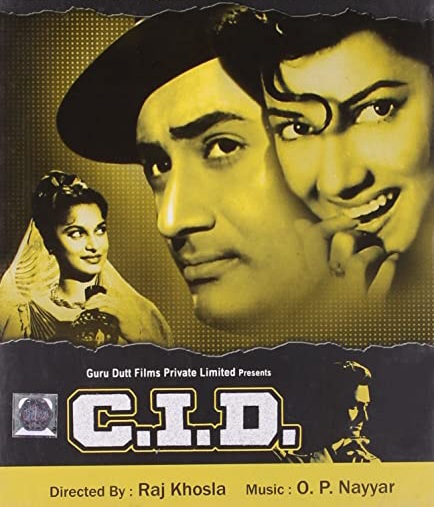
C.I.D. is a Indian crime thriller film directed by Raj Khosla and produced by Guru Dutt. The film has Dev Anand playing a police inspector investigating a murder case. It is considered to be one of the “Best Thrillers to have ever come out of Hindi Cinema”.
The story goes that friends Dev Anand and Guru Dutt promised each other that they would cast each other as director and actor upon making it big. Guru Datt kept only half of his promise as he only produced CID, trusting his assistant Raj Khosla to direct it. Dev Anand played a hard boiled as a CID inspector who is entrusted to discover the culprit behind the murder of a respected journalist.
The film opens with a suspicious phone call ordering the murder of a certain someone but we don’t know who is behind the phone. Soon after, the newspaper editor is murdered. A newspaper editor, Shrivastav, is wounded when he was about to expose the underworld links of a rich and influential man. He calls over his friend, Inspector Shekhar, to talk to him about the threat he receives from the underworld. Srivastav dies by the time Shekhar arrives. He remembers that he saw a suspicious person by the elevator and borrows a woman’s car to chase him. The woman throws the car keys in the mud when it is raining outside and they lose the chase. In the morning, the two return home when they find the keys. Meanwhile, on the crime scene, petty pickpocket Master is found at scene and confesses to seeing the whole murder. Shekhar uncovers some of the gang, and Master identifies the killer Sher Singh, who is put in jail.
Meanwhile, the woman Rekha turns out to be the daughter of the Chief of Police, and trust is formed. Shekhar is taken to the criminal’s house in an attempt to bribe him to release the prisoner, but the attempt fails. The person who offers the bribe is Kamini. She spikes the drink offered to Shekhar, intoxicates him, and the gang leaves him on the street. He is found by Rekha, who brings him home. At Rekha’s birthday party, Shekhar sees Kamini and follows her. Kamini turns out to be a childhood friend of Rekha. The mastermind, Dharamdas, now wants to incriminate Shekhar so that he can be clear of any fear. They take Master to a house and try to persuade him, be fail. The gang kills Sher Singh by sending their people to jail and frame Shekhar for it. This puts the blame on Shekhar for the two murders. He goes to trial and waits for the verdict the next day. By this point, romantic feelings have grown between Rekha and Shekhar. They talk, and Shekha r does not know what to do. He is persuaded by Master to run away, knowing that he will have to prove who the real killer is by getting a chance to investigate.
Shekhar runs away. Dharamdas knows that when Shekhar comes out of hiding, he will have the evidence to expose the mastermind. So, he sends his men to kill Shekhar. They shoot at him, and Shekhar manages to reach the killer’s house unseen. He is confronted by Kamini, but he convinces her she can only plan a crime, not commit one. She feels for him, realizes that Dharamdas is evil and that she should no longer be a criminal, and nurtures Shekhar nearly to health.
Dharamdas returns and barely sees Shekhar escape into a hidden dungeon. Kamini follows, and it is Kamini and Shekhar vs. Dharamdas in a cat-and-mouse chase in a maze of hidden corridors and rooms. Kamini and Shekhar escape, and Shekhar calls the police station, saying that he is surrendering himself. Just before he reaches the gate of the police station, Kamini is shot by Dharamdas’ men, and then Rekha’s father tries to get a full idea of the picture. Shekhar explains that Dharamdas is the mastermind, yet the Chief does not believe him. Shehar explains the whole thing and that if Kamini regains consciousness, she will testify. Yet he still has to prove that Dharamdas is the criminal, so the Chief can see for himself, and so they have confirmation that he is the criminal in case Kamini does not survive.
They plant an article in the newspaper saying that Kamini will testify, knowing Dharamdas will try to kill her in the hospital. They switch Kamini into Room 15, and tell the desk clerk to tell Dharamdas that Kamini is in Room 13, where they will be waiting for him. Dharamdas comes just before Shekhar and the Chief give up, and they wait. They realize that they left the door to Room 15 open, and Dharamdas realises the actual room as well. The Chief and Shekhar come just in time before Dharamdas attempts to kill Kamini. Dharamdas is convicted and Shekhar has to face trial for running away. The Chief promises to recommend bail or drop the charges, and Rekha and Shekhar continue their romantic relationship.
Waheeda Rehman was spotted by Guru Dutt in the Telugu film ‘Rojulu Marayi’ (1955), where she had just one song ‘Eruvaaka sagaroranno chinnanna’, which became quite famous. So her cameo as a grey-shaded character in CID was like a screen test for her, which she passed with flying colours. Shakeela was the actual heroine but it was Waheeda Rehman that people talked about the most. Johnny Walker and Kum Kum as his girlfriend offer a comedy track and social commentary on the honest criminals trying to get by. Mehmood had a role as one of the minor villains in the film. He was the most effective when he had no lines. He looked the part, but sounds a little too hammy. Anyway, the boss takes no chances and has Sher Singh bumped off, and frames Shekhar for both murders. C.I.D. is an entertaining and engaging thriller. Pitting a suave Dev Anand against a shadowy criminal mastermind, the story is told with tempo and light and shade. CID gets its breathing moments with Johnny Walker’s character – a pickpocket who is a petty criminal but can’t fathom selling his soul so a murderer could escape. One of the most remembered songs filmed on him “Yeh Hai Bombay Meri Jaan” (“This is Bombay, my dear…”) has been romanticised in the six decades since its release.
CID’s is one of those musical classics by O. P. Nayyar that has achieved an evergreen status. The first song, “Booj mera kya naam re …,” performed outdoors by a village girl is, again, the film’s only glimpse of traditional India. As a playful song about a woman who asks a man to guess her name. The song contrasts with the film’s final song, performed indoors by the film’s mysterious city girl, who sings in order to distract the villain and communicate to the hero. A close-up of Waheeda Rehman’s face when she drops and then restores her smiling façade demonstrates her subtle acting skills at this early stage in her career. Another circular pattern is built up across the three song sequences that develop Shekhar and Rekha as a couple: “Leke pehla pehla pyar …” (“With my first love…”) is sung by a male and female street performer whom Shekhar pays to “eve-tease” Rekha. The female singer literally encircles Rekha three times, and is filmed repeatedly in a series of circular panning shots as she whirls around her prey. Rekha does not yet recognize that, like the murderer, she too has been caught by Shekhar’s relentless pursuit. When the couple alone perform “Ankhon hi Ankhon me …” (“In just an exchange of glances …”) they circle one another willingly and exchange positions as they song’s lyrics play with images of “secret” lovers who “steal” one another’s hearts: by this point in the film, love and police work follow similar paths of progressive encircling until someone gets caught.
Most creatively of all, the once flirtatious love song “Leke pehla pehla pyar…” is reprised as a tormenting number that moves in and out of Rekha’s fevered mind: she’s now encircled, not by annoying outsiders, but by her own conflicted emotions as the song literally moves in and out of her body. The song, we might say, circles back and reverses its mood and purpose. The four songs that intensify Rekha’s and Shehkar’s romance narrow from a half-dozen to four to two and finally a single divided participant; yet like the overall narrative which itself comes full circle, returning Shekhar to his official position and honor, the film’s love story and careful sequence of songs challenge the crime story’s negative circuit of corruption by offering a series of positive and more seductive loops.
The film was released on 30 July 1956 with a grand ceremony and received critical as well as commercial success. The film was the highest grossing film of 1956. Guru Dutt had reportedly gifted Raj Khosla a swanky foreign car after the success of C.I.D.
Photo courtesy Google. Excerpts taken from Google.
 Writer Sunita