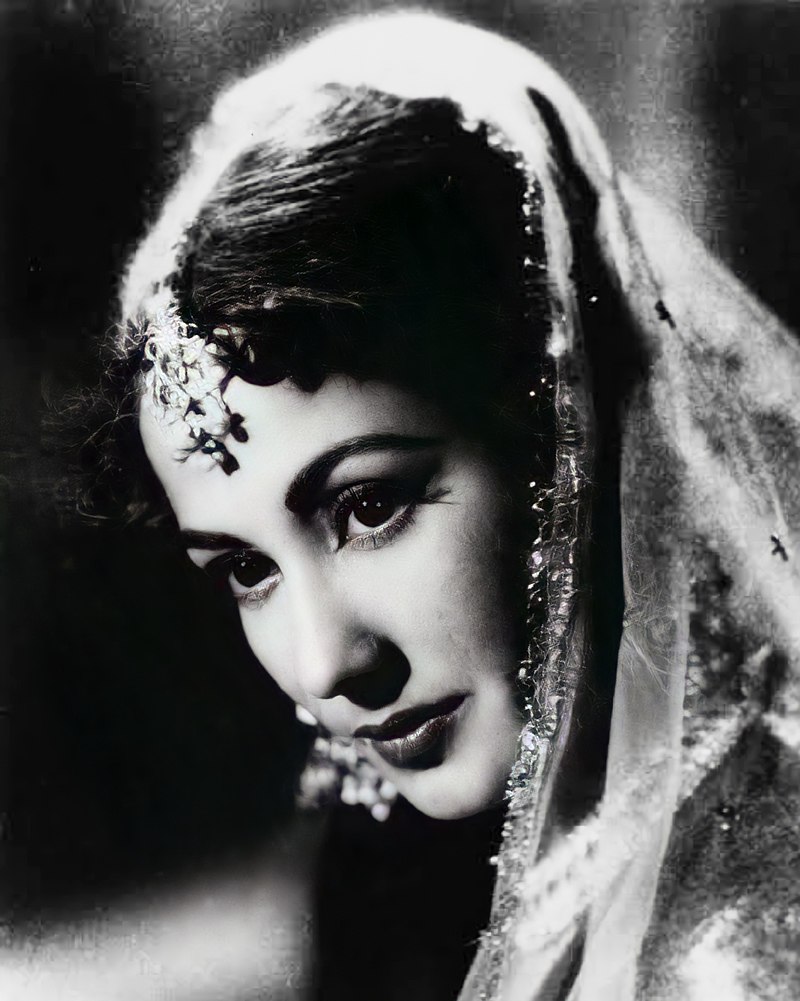
Meena Kumari won four Filmfare Awards in the Best Actress category. She was the recipient of the inaugural Filmfare Best Actress Award for Baiju Bawra in 1954 and had a consecutive win in the second Filmfare Awards (1955) for Parineeta. Kumari made history at the 10th Filmfare Awards (1963), by receiving all three of the Best Actress nominations, and won for her performance in Sahib Bibi Aur Ghulam. In the 13th Filmfare Awards (1966), she won her last Best Actress award for Kaajal.
Meena Kumari (born Mahjabeen Bano) was an Indian actress and poet, who worked in Hindi films. Popularly known as “The Tragedy Queen“, she was active between 1939 and 1972. Kumari was described by critics as a “historically incomparable” actress of Hindi Cinema. In a career spanning 33 years, she starred in over 90 films till her premature death in 1972.
Mahjabeen said as a child that she was not keen on a film career, and would rather attend school. Despite this, her parents started peddling her to film studios for work opportunities. Director Vijay Bhatt cast Mahjabeen in the film “Leatherface” and on her first day she was paid Rs. 25. Leatherface was released in 1939.
Meena Kumari began acting when she was four. She initially worked mostly in Vijay Bhatt productions; Adhuri Kahani (1939), Pooja (1940) and Ek Hi Bhool (1940). Vijay Bhatt rechristened Mahjabeen as “Baby Meena” during the filming of Ek Hi Bhool. More films followed for Baby Meena, namely Nai Roshni (1941), Bahen (1941), Kasauti (1941), Vijay (1942), Garib (1942), Pratiggya (1943) and Lal Haveli (1944).
She became the breadwinner in the Bux family at a very young age. In an interview given in 1962, Meena Kumari explained that the fact she had been supporting her parents from the age of four gave her immense satisfaction. Mahjabeen was admitted into a regular school, but that was not for long, because the demands of work frequently interrupted her curriculum. She never went to school in any meaningful sense, and her education was the result of private tuition, and more significantly the result of individual interest; in every sense she was self-educated.
Meena was cast under the name Meena Kumari in Ramnik Production’s Bachchon Ka Khel (1946). Duniya Ek Sarai (1946), Piya Ghar Aaja (1948) and Bichchade Bala (1948) were some of her early films in which she not only acted but also sang songs. By the late 1940s, she shifted her focus to films belonging to either mythology or fantasy genres. Veer Ghatotkach (1949), Shri Ganesh Mahima (1950), Laxmi Narayan (1951), Hanuman Patal Vijay (1951) and Aladdin Aur Jadui Chirag (1952) performed with credit. Other films such as Magroor (1950), Hamara Ghar (1950), Sanam (1951), Madhosh (1951), and Tamasha (1952) mostly had an ensemble cast.
Meena Kumari’s rise came with her mentor Vijay Bhatt’s musical, Baiju Bawra (1952). Kumari played the female lead in the film. A series of incidents ranging from Hindustan Lever securing rising star Meena Kumari as a model for their products to being featured on the calendar of a popular beauty soap happened after the success of Baiju Bawra. Meena Kumari “shot into stardom” following the release of Baiju Bawra. Kumari became the inaugural best actress winner at Filmfare Award for the film. The category for Best Actress was introduced by the Filmfare Awards Committee for the first time that year.
1953 : Parineeta directed by Bimal Roy, (featuring Ashok Kumar and Meena Kumari in lead) the film won Kumari her second Filmfare Best Actres s Award. It was based on the 1914 Bengali novel by Sharaat Chandra Chattopadhyay. Lalita (Meena Kumari) is an orphaned niece of an impoverished clerk named Gurucharan (Nazir Hussain). Shekhar (Ashok Kumar), is the son of their rich landlord neighbor. Shekhar had a liking for Lalita. Gurucharan has to mortgage his house to Shekhar’s father in order to get one of his daughters married as he is heavily debt-ridden. Shekhar’s father often chides him about his overdue loan and a day comes when completely pressed on all sides, Gurucharan is forced to take advantage of the altruistic offer of an interest-free loan made by a wealthy young man named Girin. This gives rise to an ugly misunderstanding that Lalita has been “sold” to Girin. What happens thereafter forms the gripping conclusion of this great story of perfect love. The beautiful part of this movie is dialogue and communication between Meena Kumari and Ashok Kumar.
“Do Bigha Zamin” directed by Bimal Roy, this film also marks the maiden guest appearance of Meena Kumari. Foot Path – directed by Zia Sarhadi, was Meena’s first film with Dilip Kumar. This movie was featured in Avijit Ghosh’s book, 40 Retakes: Bollywood Classics You May Have Missed. Daaera – was written and directed by Kamal Amrohi, starring Meena Kumari, in lead role.
1954: Chandni Chowk – directed by B. R. Chopra in 1954, a classic Muslim social drama film, success at the box office. The story involves a Nawab belonging to the Chandni Chowk area of Delhi in the early 1920s, who gets “tricked into marrying his daughter to the gardener’s son”.
Baadbaan – directed by Phani Majumdar, had a star cast of Meena Kumari, Dev Anand, Ashok Kumar and Usha Kiran. Baad means storm and Baan means keeping or safeguarding. The film depicts a story rich in incident and emotional conflict and centers on an orphaned child whose parents, fisher folk, are killed in a storm and who is adopted by a rich, kind, broad-minded philanthropist. The real drama sets in when the boy returns from England and falls in love with a lovely young socialite who reciprocates his love. On hearing of his true parentage, however, her father forbids the marriage but relents at seeing his daughter’s unhappiness. The hero’s overwhelming passion for a beautiful fisher girl from the village of his birth to which he returns, bent on improving his people’s lot, and his love for his charming wife make for strong emotional power climaxed tragically by the latter’s death, and his returning to his roots.
Ilzaam – directed by R C Talwar, starring Meena Kumari and Kishore Kumar, also premiered. The urban settled boy Rajan (Kishore Kumar) falls in love with a village happy-go-lucky girl Kamli (Meena Kumari) but his mother is against their relationship. Situations occur when their relationship faces a blue.
1955: In Azaad, directed by Sriramulu Naidu S. M. Meena Kumari pranced gaily with Robinhood Dilip Kumar. It was the second highest-grossing Hindi film that year and included hit song “Aplam Chaplam”.
Adl-e-Jehangir – was a Hindi language historical drama film directed by G. P. Sippy, and it became a commercial success at the box office. The story involved a quasi-historical episode from Emperor Jehangir is known all over India for his sense of justice, and loved by the public for that. Empress Noor Jehan goes on a hunt and accidentally shoots dead a washer man with her arrow. His widow, Rami Dhoban, comes to the palace and rings the bell of justice. When Jehangir learns that Rami demands his justice of “a life for a life”, he puts himself forward to be killed by Rami. Eventually the episode is sorted out through his ministers, with Rami forgiving the Empress and her husband.
Bandish – directed by Satyen Bose starring Meena Kumari, Ashok Kumar, and Daisy Irani was a box office hit. Rukhsana – was directed by R. C. Talwar and starred Meena Kumari and Kishore Kumar.
1956: Mem Sahib – directed by R.C. Talwar, featured Meena Kumari for the first time with Shammi Kapoor. The modern avatar of Meena Kumari was well received by audiences and the film became a box office hit. Ek Hi Raasta – was a film based on the issue of widow remarriage, directed and produced by B. R. Chopra. It starred Meena Kumari with newcomer Sunil Dutt, Ashok Kumar and Daisy Irani. The film proved to be successful at the box office and was screened for more than 25 weeks, which was a “Jubilee Hit”. Bandhan – directed by Hemchandra Chunder, based on the popular Bengali novel Mantra Shakti, starred Meena Kumari and Pradeep Kumar as leads and was awarded with a Certificate of Merit in National Film Awards. Naya Andaz – directed by K. Amarnath, starring Meena Kumari and Kishore Kumar in lead roles, was a musical hit.
Halaku – a historical, was directed by D. D. Kashyap which included Meena Kumari, Pran, Minoo Mumtaz, Raj Mehra and Helen. It was one of the box office hits and celebrated a silver jubilee. Halaku (Pran), the powerful emperor of Iran, rules the country wisely and with an iron hand . When he comes upon one of his subjects, Niloufer (Meena Kumari), he stakes his claim on her and wants her to be his wife, despite of his wife (Minoo Mumtaz), who opposes his marriage plans. Niloufer, who loves Pervez (Ajit Khan), refuses to submit to Halaku, he turns his wrath on both Niloufer, Pervez, and his wife. Notable song is “AAja ke intezar main jaane ko hai bahar bhi, tere vegar zindagi dard banke ke rahey gai…” in the evergreen voice of Mohd. Rafi.
1957: Sharada – directed by L. V. Prasad, was Meena Kumari’s first venture with Raj Kapoor. She won best actress at Bengal Film Journalists’s Association Award for her work. The film gained great critical success and was the ninth highest grossing film at the Indian Box Office in 1957. Miss Mary – a comedy film directed by L. V. Prasad, starred Meena Kumari and Gemini Ganesan. The film was one of the biggest hits of that year.
1958: For Sahara – directed by Lekhraj Bhakri, Meena Kumari received a Filmfare nomination. Yahudi, directed by Bimal Roy starred Meena Kumari, Dilip Kumar. It was based on the play Yahudi Ki Ladki by Agha Hashar Kashmiri, a classic in Parsi – Urdu theatre, about persecution of Jews in the Roman Empire. The film was a box office hit with the famous song “Yeh Mera Diwanapan Hai” sung by Mukesh. Farishta – starred Ashok Kumar and Meena Kumari as protagonists. Savera – was directed by Satyen Bose, with Meena Kumari and Ashok Kumar in lead roles.
1959: Chirag Kahan Roshni Kahan, directed and produced by Devendra Goel, stars Meena Kumari with Rajendra Kumar and Honey Irani. The film was a huge hit at the box office and Meena Kumari received a Filmfare nomination for her performance in the Best Actress category. Char Dil Char Rahen – was directed by Khwaja Ahmad Abbas, with star cast Meena Kumari, Raj Kapoor, Shammi Kapoor, Kumkum and Nimmi. The film received warm reviews from critics. Sharart – was a 1959 romantic drama film written and directed by Harnam Singh Rawail, starring Meena Kumari, in lead role, with the memorable song “Hum Matwaley Naujawan” sung by Kishore Kumar. Film Chand directed by Lekhraj Bhakri focused on the effects of polygamy prior to The Hindu Marriage Act 1955. The film stars Kumari with Balraj Sahni, Pandari Bai and newcomer Manoj Kumar in lead roles. Her other films released in 1959 were Ardhangini, Satta Bazaar, Madhu and Jagir.
1960: Dil Apana Aur Preet Parai was a Hindi romantic drama written and directed by Kishore Sahu. The film starred Meena Kumari, Raaj Kumar and Nadira as leads. The film tells the story of a surgeon who is obligated to marry the daughter of a family friend, while he is in love with a colleague nurse, played by Meena Kumari. It is one of the noted acting performances of lead actress Meena Kumari’s career. The film’s hit the Hawaiian – themed song, “Ajeeb Dastan Hai Yeh”, which has since then attained an iconic status.
Kohinoor – directed by S. U. Sunny cast Dilip Kumar and Meena Kumari to play a prince and princess of different kingdoms and was full of sword fights, songs and dances. This film is also notable for some rare comical and funny scenes by Meena Kumari, who is otherwise known as the tragedy queen. Its tone was light and it lacked the intense characterisations of their earlier films. The film included the melodic songs “Madhuban mein Radhika Nache Re” and “Do Sitaron Ka Zameen Par Hai Milan Aaj Ki Raat”.
1961: Bhabhi Ki Chudiyan was a family drama film, Meena Kumari and Balraj Sahni in the lead roles. The film was one of the highest-grossing films of the year. Zindagi aur Khwab – directed S. Bannerjee, starring Meena Kumari and Rajendra Kumar, was a hit at the Indian box office. Pyaar Ka Saagar – was directed by Devendra Goel with Meena Kumar i and Rajendra Kumar.

Sahib Bibi Aur Ghulam, a film produced by Guru Dutt and directed by Abrar Alvi featured Meen a Kumari in the role of Chhoti Bahu the lonely wife of a Zamindar. It is based on the Bengali novel “Saheb Bibi Golam” by Bimal Mitra. The film follows Chhoti Bahu’s effort to keep her husband—who likes drinking and watching prostitutes perform—at their home by drinking with him. She becomes addicted to alcohol. Kumari’s performance is regarded as one of the finest performances in the history of Indian cinema, making her best known for tragic roles. The film is also noted for its brilliant cinematography by V. K. Murthy and the famous songs “Na Jao Saiyaan Chhuda Ke Baiyan” and “Piya Aiso Jiya Mein”, both sung by Geeta Dutt. The film won four Filmfare Awards, including the Best Actress award for Kumari. This movie was nominated for the Golden Bear at the 13th Berlin International Film Festival, where Meena Kumari was selected as a delegate.
1962: Aarti, directed by Phani Majumdar, stars Meena Kumari in the title role of Aarti. Kumari won a Best Actress award for this film from the Bengal Film Journalists’ Association. Main Chup Rahungi – Meena Kumari and Sunil Dutt in lead roles was one of the biggest hits of the year and Meena Kumari received a Filmfare nomination for Best Actress for her performance. Gayatri (Meena Kumari), daughter of a poor labourer, falls in love with a rich businessman. But the relationship sours and she is left pregnant with his baby. She keeps the identity of the father a secret.
1963: Dil Ek Mandir, directed by C. V. Sridhar, stars Meena Kumari, Rajendra Kumar, Raaj Kumar was a commercial success. Meena Kumari learnt to play the sitar for her role. Akeli Mat Jaiyo – is a romantic comedy with Meena Kumari and Rajendra Kumar. Kinare Kinare was directed by Chetan Anand with Meena Kumari, Dev Anand and Chetan Anand in lead roles.
1964: Sanjh Aur Savera – is a romantic drama film directed by Hrishikesh Mukherhi, starring Meena Kumari, Guru Datt. Benazir – was a Muslim Social film directed by S. Khalil, starring Meena Kumari, Ashok Kumar, Shashi Kapoor and Tanuja. Chitralekha directed by Kidar Sharma, starring Meena Kumari, Ashok Kumar and Pradeep Kumar, was based on the 1934 Hindi novel by the same name by Bhagwati Charan Varma. It is the first colour feature film of Meena Kumari. Gazal featuring Meena Kumari and Sunil Dutt, was a Muslim Social film about the right of young generation to the marriage of their choice. Set in Agra, the film is the story of Ejaz (Sunil Dutt), who is editor of Inquilab. When he listens to Naaz Ara Begum (Meena Kumari) sing, he falls deeply in love with her. However, he soon loses his job. Ejaz and Naaz manage to meet secretly, with help of Naaz’s sister Kausar. This relationship has many people going angry, first Nawab Bakar Ali Khan (Prithviraj Kapoor) her father who wants Naaz to marry Akhtar Nawab (Rehman), her paternal cousin. It had music by Madan Mohan with lyrics by Sahir Ludhianvi, featuring notable filmi-ghazals such as “Rang Aur Noor Ki Baraat”, performed by Mohammed Rafi and “Naghma O Sher Ki Saugaat”. Main Bhi Ladki Hoon stars Meena Kumari with newcomer Dharmendra,
1965: Kaajal directed by Ram Maheshwari, stars Meen a Kumari, Dharmendra, Raaj Kumar. The film was listed in the Top 20 films of 1965. Meena Kumari won her fourth Filmfare award for Kaajal. The film was originally based on the novel “Maadhavi” by Gulshan Nanda. Bheegi Raat, directed by Kalidas, with Meena Kumari, Ashok Kumar and Pradeep Kumar in lead roles was one of the biggest hits of the year. The film Purnima, directed by Narendra Suri, featured Meena Kumari and Dharmendra in lead roles.
1966: Phool Aur Patthar, directed by O. P. Ralhan, starred Meena Kumari and Dharmendra as contrasting characters who come together; he played a tough criminal (or Patthar, literally a Stone) whose inner good being (or Phool, literally a Flower) is drawn out by Kumari’s character of a pure woman. A criminal young man decides to reform himself for a left away widowed woman. But their relationship faces challenges. This movie went on to become a golden jubilee hit, catapulting Dharmendra to stardom and was the highest-grossing movie of the year. Meena Kumari’s performance in the film ensured her a nomination in the Best Actress category in the Filmfare awards for that year. The film Pinjre Ke Panchhi was directed by Salil Choudhury, with Meena Kumari, Balraj Sahni in main roles.
1967: Manjhli Didi was directed by Hrishikesh Mukherjee and stars Meena Kumari along with Dharmendra. The film was India’s entry to the 41st Academy Awards for Best Foreign Language Film. The film Bahu Begum was directed by M. Sadiq, starring Meena Kumari, Pradeep Kumar and Ashok Kumar. This film is known for songs, “Hum Intezaar Karenge Tera Qayamat Tak”, and “Duniya Kare Sawaal”. The film is a Muslim period drama set in the erstwhile Era of Lucknow woven around a mythical story of Bahut Begum’s manor. Noor Jehan, directed by Mohammed Sadiq, was a historical film starring Meena Kumari and Pradeep Kumar. It dramatised the epic love story of Empress Nur Jehan and her husband, the Mughal Emperor Jehangir. The film Chandan Ka Palna was directed by Ismail Memon, starring Meena Kumari and Dharmendra. After the Eclipse, a 37 minutes color documentary directed by S. Sukhdev and shot in the suburbs of Varanasi featured Meena Kumari’s voice along with the voice of actor Shashi Kapoor.
1968: Baharon Ki Manzil a Suspense Thriller, stars Meena Kumari, Dharmendra. The film was one of the major hits of the year. The film Abhilasha cast includes Meena Kumari, Sanjay Khan and Nanda. Saat Phere was directed by Sundar Dhar, with Meena Kumari, Pradeep Kumar.
1971: Mere Apne written and directed by Gulzar, was his first directorial venture. The film stars Meena Kumari, Vinod Khanna and Shatrghan Sinha in lead. Dushman, directed by Dulal Guha, stars Meena Kumari, Rehman and Rajesh Khanna with Mumtaz in lead roles. The film became a “super-hit” at the box office.
1972: Gomti Ke Kinare stars Meena Kumari, Sanjay Khan and Mumtaz.

The idea of Pakeezah came into existence in 1954, followed by its muhrat in 1956. Meena Kumari was determined to complete the film and, well aware of the limited time left for her to live, went out of her way to complete it at the earliest. Despite her rapidly deteriorating health, she gave the finishing touches to her performance. Pakeezah had a grand premiere on 3 February 1972, at Maratha Mandir theatre, in central Bombay, and the prints being carried on a decked-up palanquin. The film was finally released on the following day, 4 February 1972. Pakeezah enjoyed a successful run of 33 weeks and even celebrated its silver jubilee. She posthumously received her twelfth and last Filmfare nomination for Pakeezah. Bengal Film Journalists’ Association Awards bestowed the Special award to Meena Kumari for Pakeezah in 1973.
It tells the story of Sahibjaan (Meena Kumari), a Lucknow-based courtesan. While asleep on a train, Sahibjaan receives a note from a stranger praising her beauty. Later, evacuating from a broken boat, she takes shelter in a tent and finds out its owner, a forest ranger named Salim (Raaj Kumar), wrote the letter in Urdu dialogue “Aapke paon dekhe, bahut haseen hain. Inhein zameen par mat utariyega … maile ho jaayenge” (“I saw your feet. They are really beautiful. Please do not keep your feet on the ground, it will make them dirty”) attained popularity among the audience. Sahibjaan and Salim plan to get married, causing conflicts with Sahibjaan’s professional background. Pakeezah is also known for being Kumari’s last film to be released during her lifetime; her performance in it has been regarded as one of the best of her career. Pakeezah has often been included in listings of the Best Works of Indian Cinema, including a poll conducted by the British Film Institute in 2007. Kumari played the roles of Nargis and her daughter Sahibjaan, the central characters of the film. She was also involved as the costume designer and helped with casting. Dinesh Raheja in 2002, commended the film’s lavish production designs, saying; “its splendour fills the eye, stirs the senses. And it ultimately showcases the heart beating at the film’s core.” He commented that Kumari’s “understated performance and moist eyes sparkling with unshed tears have a hypnotic effect”.
Meena Kumari was also a playback singer. She sang as a child artist for films like Bahen till 1945. As a heroine, she rendered her voice to songs from films like Duniya Ek Sarai (1946), Piya Ghar Aaja (1948), Bichchade Balam (1948) and Pinjre Ke Panchhi (1966). She also sang for Pakeezah (1972), however, the song was not used in the film and was later released in the album Pakeezah-Rang Ba Rang (1977).
Meena Kumari was an Urdu poet under the pseudonym Naaz. Historian critic Philip Bounds and researcher Daisy Hasan write regarding Meena Kumari’s poetry: “Poetry was the medium through which Kumari distanced herself from her public image and criticized the industry that had brought her to public attention in the first place. In that sense, her poems tell us as much about Bollywood as they do about herself.”
I write, I recite – an album consisting of Meena Kumari’s poems under the label of L P Vinyl Record was released in 1971, for which Mohammed Zahur Khayyam gave music. The poetry in the album (nazms) has been written, recited and sung by the poet herself. The album was re-released on 19 September 2006. Tanha Chand (Lonely Moon), a collection of Meena Kumari’s poems, was compiled by Gulzar and published after her death in 1972.
Meena Kumari, the Poet: A Life Beyond Cinema consisting of the late actress’s poems and nazms was also published in 2014.
Meena Kumari was credited for never using products like glycerin shed tears, but always shed her genuine ones while acting. At the peak of her career, Meena Kumari was the highest-paid actress of her generation, and was the first to buy an Impala car. Indian Film Critic Bhawana Somaaya says: “There was a time when top heroes were not willing to work with Meena Kumari, because she played the powerful roles. Pakeezah is just like poetry on celluloid, I cannot imagine anybody else in this movie except Meena Kumari.” Vinod Mehta shares: “Meena Kumari became so powerful that she would make or break stars, Kumari adopted an attitude of guardian, artistic mentor towards the newcomers who worked opposite her like Rajendra Kumar in Chirag Kahan Roshni Kahan and with Sunil Dutt in Ek Hi Raasta.” Meena Kumari helped Dharmendra enormously in the initial stages of his career, and established Dharmendra’s acting career in Indian Cinema. The legendary Kathak master Pandit Lachhu Maharaj praised Meena Kumari’s dancing skills and remarked on the unique way in which she would take a turn. He said, “The way in which she would turn, the angles of her shoulders, come naturally to her and cannot be taught.” Ashok Kumar said: “Meena was a natural actress. She was very choosy, but once she accepted a role, she put her heart into it and it’s not surprising that she’s still remembered for her sensitive portrayals. Sometimes when saying a dialogue I’d add a line not in the script and even as I worried about how Meena would react, she’d surprise me with just the right response.”
Vinod Mehta (writer of Meena Kumari – The Classic Biography) was told by a director: “Even Dilip Kumar found it difficult to keep his calm in front of her”. Madhubala was also a fan of Meena Kumari and said: “She has the most unique voice. No other heroine has it.” Satyajit Ray described Kumari as “undoubtedly an actress of the highest calibre”. Music Director Naushad said “Hindi film industry may produce great actresses but there would never be another Meena Kumari”.
Tajdar Amrohi shares: “When the shooting of Pakeezah started again in 1969, the first song shot was “Mausam Hai Ashiqaana”. With this song, Meena Kumari set a new fashion trend of girls wearing Lungi.
On 24 February 2016, Meena Kumari’s original publicity material and memorabilia, including paintings and portraits of her films, were displayed at the Womanhood Festival at Osianama Liberty, Mumbai, India.
She is also the only actress to be nominated posthumously. Meena Kumari got a posthumous nomination for Pakeezah at the 20th Filmfare Awards, 1973.
The day Meena Kumari died, her 1952 film Baiju Bawra was re-released at Bombay’s Super cinema, drawing house full audiences, which wept copiously remembering the actress.
In 1979, Meena Kumari Ki Amar Kahaani (English: The immortal story of Meena Kumari), a film dedicated to the late actress was released. It was directed by Sohrab Modi and featured exclusive interviews of various film personalities such as Raj Kapoor and Rajendra Kumar. The following year, Shaira (alternatively titled Sahira) (English: Poetess) was released. It was a short documentary on Meena Kumari and was directed by S Sukh Dev along with Gulzar.
A postal stamp of face value 500 paise was issued in her honour on 13 February 2011 by Indian Post.
In May 2018, Ajeeb Dastaan Hai Yeh, a play depicting the life of Meena Kumari was staged at Rangayan auditorium of Jawahar Kala Kendra in Jaipur.
On 1 August 2018, search engine Google commemorated Meena Kumari with a Doodle on her 85th birth anniversary. Google commented: “Kumari captivated audiences with her beautiful, expressive eyes and portrayed strong yet vulnerable women who made their own way through life, often devastated by romance. Today, her screen appearances are studied for flawless moments and the complex emotions she could evoke without uttering a word”.
Photos courtesy Google. Excerpts taken from Google.
 Writer Sunita