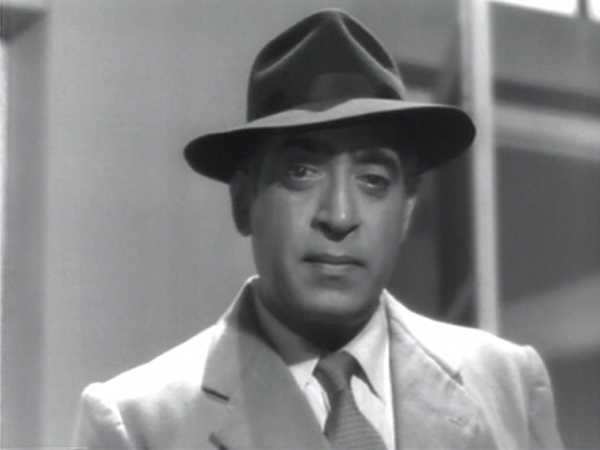

Remembering Krishan Niranjan, known as K. N. Singh in Indian Cinema, a classy character actor and one of the iconic villains in Hindi cinema. He played the polished, sophisticated villain in nearly all his 250-odd films over a long career stretching from 1936 to the late 1980s. He was always immaculate in his dress — a suit, overcoat, hat, and cigarette completed his villainish get-up.
He was a dangerous villain of Indian film industry. He had always put himself perfectly in his terrific, horrible acting as a villain in his movies but in real life, he was such a great personality and opposite of his character as a villain. For his terrific and notorious acting in his every flick, he is well known among the people of India as their own K.N.Singh.
His father, Chandi Prasad Singh was a renowned criminal lawyer of British India. K. N. Singh was from a royal family of that time. His father always wanted him to be like him, a great lawyer, as he was the eldest son of his family. Singh was expected to follow in the footsteps of his father and become a lawyer. However, his father’s skillful defence, which saved an obviously guilty man from the gallows, turned him away from the profession. But in his early age, he was proficient in sports and had an enthusiasm and passion for being an army officer. Krishan Niranjan Singh had proved himself in the sports like Javelin throws and shot put. The multi-talented magical man K. N. Singh had got a chance to stand for India as a champion in Berlin Olympics in the year 1936, but unfortunately, due to some personal reasons, he could not attend the Berlin Olympics, which was a great loss in his sports career.
K N Singh was never tutored in the art of acting. He was discovered by the actor Prithviraj Kapoor in Calcutta in the 1930s. Prithviraj Kapoor, introduced him to director Debaki Bose, who offered him a debut role in his film Sunehra Sansar (1936) and that successful debut was followed by Raj Kapoor’s Barsaat (1949) and Awara (1951).
K. N. Singh enjoyed limited success until the release of Baghban (1938), in which he played the antagonist. K. N. Singh praised for their performances, with a special commendation that he would make a “good character actor”. Baghban was a golden jubilee hit. K. N. Singh became the legendary actor of Indian film Industry. The movie Baghban was the milestone of his career and in which he had portrayed himself as India’s best villain of that era.
Through the 1940s and 1950s, Singh appeared in several iconic movies of the era, including Sikandar (1941), Jwar Bhata (1944) (Dilip Kumar’s film debut), Humayun (1945), Jaal (1952), CID (1956), Howrah Bridge (1958), Chalti Ka Naam Gaadi (1958), Amrapali (1966) and An Evening in Paris (1967).
With Raj Kapoor’s Awara K. N. Singh became star villain. In this film K. N. Singh gots as powerfuls roles as villain, who kidnaps city famous judge Prithviraj Kapoor’s wife as a revenge for sentencing him for a life-term. When Prithviraj Kapoor’s wife returns back, Kapoor discards her suspecting infidelity. As a result she lives in slums and gives birth to Kapoor’s child who became Raj Kapoor. The film depicted that it is not necessary a judge’s son will become judge or a thug’s son will become thug. The movie was huge hit in India and aboard making K. N. Singh a star villain. Few know that Awaara was India’s biggest hit in Russia and the movie was dubbed in Russian language. In this film only K. N. Singh did the dubbing himself as he had completed his graduation with Latin language. Awaara made K. N. Singh not only star villain but immortal in annals of Indian cinema.
By the late 1950s, his distinct style and underplayed performance made him one of the highest paid villains in Indian cinema. Whether it was Guru Dutt’s ‘Baazi‘ (1951), Shakti Samant’s ‘Howrah Bridge‘ (1958) or Vijay Anand’s ‘Teesri Manzil‘ (1966), Singh sent shivers down people’s spines.
K. N. Singh epitomized the character of a villain on the Hindi movie screen. That, like everything else, was on his own terms. He would decide how villainous or how mean his character would be. No one dared speak to him disrespectfully, on screen or off.
Singh’s attention to small nuances set him apart from many others. Underplaying the character, he always took care to induce menace in his gait and unspoken gestures. Always polished, his mere entry signaled a change of situation without any screaming, shouting. He also researched his roles meticulously. For his role of a Victoria driver in Inspector (1956), he spoke with many real life drivers, to understand their lives.
Towards the latter half of his career, Singh no longer remained the magnificent persona he had once been. To his credit, he accepted any roles he was offered and continued to act till the mid-late eighties. Some sources claim that some of his cameo performances in the 1970s and the 1980s were to ensure that other actors turned up on time to the sets, since they would not dare be late with him on the sets already.
He always played the gentleman villain from the start, brining into play his princely origins. Smoking a pipe and impeccably dressed, he nevertheless struck terror into the heart of the audience with he mere twitch of his eyebrow. Singh ruled for a long time as the sophisticated, suave, immaculately clad villain who sent a chill down the spine every time he raised an eyebrow.
He has the distinction of working with three generations of the Kapoor family. He acted with Patriarch Prthiviraj Kapoor in Bidyapati (1937), with Raj Kapoor in Awara (1951) and Rishi Kapoor in Rafoo Chakkar (1975).
It’s said that apart from his superb acting skills, one other reason filmmakers used to cast him was that his impactful presence made other actors come on time. As opposed to playing angry mobsters, he mostly played a white collared gentleman villain, dressed in a fine suit and smoking a pipe, with a calm cold delivery. He is known for his roaring voice and expressive eyes.
His suave style, baritone voice and menacing eyes became legendary – so much so that on one occasion (in his own words) “Even off-screen I was a bad man. One day on my way back from shooting, I had to deliver an envelope at an address given to me by my friend. I pressed the doorbell and, from the moving curtains, I could see a woman hurrying to open the door. When she saw me standing in front of her, she screamed out in fright and ran inside leaving the door open.
Singh played prominent roles in movies such as Jhoota Kahin Ka (1970), Haathi Mere Saathi (1971) and Mere Jeevan Saathi (1972). His last prominent role was in the 1973 film Loafer.
He broke the image of the stereotypical villain in popular Indian cinema. Unlike the conventional baddie — with his tough looks, loud and nasty talk, and horrible laugh — he always maintained a poised, cultured and soft exterior.
Every time Singh entered the screen, it was clear that he was up to no good. And he did not have to rave or rant, use abusive language or wear garish clothes to achieve this menacing effect. One penetrating look, a couple of hissed-out commands and everyone on the scene would cringe. It was the moment of the villain.
With advancing years, Singh became less active, particularly from the mid 1970s onwards. Many of his roles from the late 1970s onwards were mere cameo appearances, arranged with the sole purpose of ensuring that actors turned up on time – such was his stature that actors would never turn up late when K.N. Singh was on the set. His last appearance was in Woh Din Aayega (1986).
The legendary actor always remains in the heart of every Indian through his magical acting and humble nature. Singh found himself portraying a “gentleman” type of villain
Photos courtesy Google. Excerpts taken from Google.
 Writer Sunita