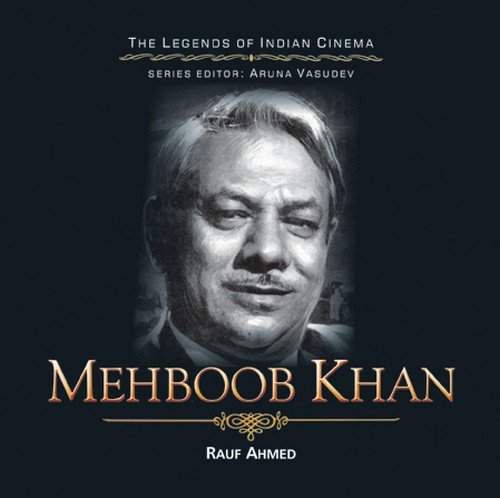
Mehboob Khan (born Mehboob Khan Ramzan Khan) was a pioneer producer – director of Indian Cinema, best known for directing the social epic Mother India (1957), which won the Filmfare Awards for Best Film and Best Director, two National Film Awards, and was a nominee for the Academy Awards for Best Foreighn Language Film. He set up his production company – Mehboob Productions, and later a film studio – Mehboob Studios in Bandra, Mumbai in 1954. He also created the dacoit film genre with Aurat (1940) and Mother India, and is also known for other blockbusters including the romantic drama Andaz (1949), the swashbuckling musical Aan (1951), and the melodrama Amar (1954).
Mehboob started as an assistant director in the Silent Film era and as an extra in the studios of the Imperial Film Company of Ardeshir Irani, before directing his first film ‘Al Hilal’ a.k.a. Judgement of Allah (1935), when he started directing films for the Sagar Film Company. Notable films he directed for Sagar Movietone and National Studios included Deccan Queen (1936), Ek Hi Raasta (1939), Alibaba (1940), Aurat (1940) and Bahen (1941).
In 1945, Khan set up his own production house – Mehboob Productions. In 1946, he directed the musical hit Anmol Ghadi, which featured singing stars Surendra, Noor Jehan and Suraiya in leading roles. The film was a musical hit and still remembered for its music by Naushad, with hits like “Aawaaz De Kahaan Hai”, “Jawaan Hai Mohabbat Haseen Hai Zamana” and “Mere Bachpan Ke Saathi Mujhe Bhool Na Jaana”. The film also featured playback singer, Mohammed Rafi’s first notable song, “Tera Khilauna Toota Balak”, and became the highest-grossing film at the Indian box office in 1946.
Andaz (Style) is a 1949 Indian Hindi language romantic drama film, stars Dilip Kumar, Nargis and Raj Kapoor. Andaz is also memorable because it was the only time that two legends, Raj Kapoor and Dilip Kumar, came together for a film onscreen for the first and last time. Mehboob also adeptly explores the varying aspects of love in this eternal triangle. In one scene, Dilip appears in Nita’s mirror as the manifestation of her subconscious, capturing the ambivalence of her feelings for him. This landmark film on love, platonic and otherwise, is enhanced by its music and the stars. Dilip Kumar projects a seething intensity. Raj Kapoor and Nargis bring to vivid life the sheer ebullience of young love, especially in Yun toh aapas mein which Mehboob picturised in tight closeups of the two facing each other. Andaz, often cited as one of India’s first modern films. It is also conservative in its portrayal of the disaster that can strike if women keep male friends. But director Mehboob Khan’s vision is thankfully deep. The sympathy rests with the woman throughout. The two males come across as deluded fools or megalomaniac boors. At the time of its release, Andaz was the highest-grossing Indian film ever, until its record was broken by Raj Kapoor’s Barsaat that same year.
Aan (Pride), is a 1952 Indian adventure film. It was India’s first technicolor film, as it was shot in 16mm Gevacolour and was blown up in Technicolor. It stars Dilip Kumar, Premnath, and Nimmi. Mehboob launch a newcomer and selected the unknown Nadira and promoted her as his new star discovery. It was the most expensive Indian film at the time. When a first edit of the film was shown to the film’s financiers and distributors, they objected that Nimmi’s character died too early. This was due to Nimmi’s vast popularity as an actress. Therefore, a lavish and extended dream sequence was filmed and edited in to give Nimmi more prominence and screen time in the film.
Aan was the first Indian film to have a worldwide release in many countries with the English title – Savage Princess. It was subtitled in 17 languages, and released in 28 countries. Its distribution in the United Kingdom and Europe was handled by Alexander Korda. The film had a lavish London premiere, attended by Mehboob Khan, his wife Sadar Akhter, and Nimmi. The English version was entitled Savage Princess. The premiere was also attended by the British Prime Minister Lord Attlee, among other Indian and British elites at the time.
Although Nimmi was not the romantic lead, she made a big impact on audiences, and her character, Mangala, emerged as the most popular in the film. This was to such an extent that, when the film was released dubbed in French in 1954, it was retitled Mangala, fille des Indes (Mangala, the Girl of India) and Nimmi was promoted as the main star of the film in the theatrical posters and trailers for the French language release. Nimmi further revealed in a 2013 interview, that at the London premiere of Aan, she received four serious offers from Hollywood, including from Cecil B. DeMille who greatly admired the production design and Mehboob’s vision as a director. He was in fact, so impressed by the film, that he personally wrote a letter of commendation to Mehboob Khan praising the film and the performances of Nimmi, Dilip Kumar and Nadira in particular.
Aan was also released in Japan in January 1954, as the first Indian film to ever release in Japan. Aan was accepted by audiences there, and it earned a considerable profit in Japan. In 1995, This Movie was telecast aboard TV Premier on Bangladesh Television on the occasion of a Personal visit of Dilip Kumar & Saira Banu in Bangladesh. It was the highest-grossing Indian Film ever at the time, domestically and overseas.
Amar (“Immortal”) is a 1954 Hindi romantic film dealing with the controversial subject matter of rape. The film revolves around the titular upper-class lawyer (Dilip Kumar), his feminist fiancé, the social workder Anju Roy (Madhubala), and Sonia (Nimmi), a poor milkmaid. Amar got positive reviews. Baburao Patel, the editor of Filmindia, called it “a brilliant picture with a gripping human story superbly directed and acted with flawless perfection. A masterpiece of film craft.” Swatantrata magazine was highly impressed by Khan’s direction and commented that “Mehboob can really be proud of this achievement.” The magazine also defended Kumar’s anti-hero role, quoting Jawaharlal Nehru as “films must amuse and at the same time educate.” Deepak Mahaan of The Hindu lauded the film for its characterization of strong female protagonists and photography of rape scenes without any nudity. Rachit Gupta of Filmfare mentioned Madhubala’s portrayal of Anju among her finest performances.
Mother India is a 1957 Indian epic film, starring Nargis, Raaj Kumar, Rajendra Kumar and Sunil Dutt. A remake of Khan’s earlier film Aurat (1940), it is the story of a poverty-stricken village woman named Radha (Nargis), who in the absence of her husband, struggles to raise her sons and survive against a cunning money-lender amidst many troubles.
The film earned the highest revenue for any Indian film at that time. Mother India became a definitive cultural classic and is regarded as one of the best films in Indian cinema. The film won the All India Certificate of Merit for Best Feature Film, the Filmfare Best Film Award for 1957, and Nargis and Khan won the Best Actress and Best Director awards respectively. It was also nominated for the Academy Award for Best International Feature Film, becoming the first Indian film to be ever nominated.
The production team had planned to release Mother India to commemorate the tenth anniversary of India’s Independence on 15 August 1957, but the film was released over two months later. It premiered at the Liberty Cinema in Mumbai on 25 October 1957, during Diwali; it ran continuously at Liberty for over a year. It was released in Kolkata the same day and in Delhi a week later. It had reached all regions of India by the end of November. Government ministers and other officials were invited to the premieres, and a special screening was held in Rashtrapati Bhavan (the presidential quarter) in New Delhi on 23 October 1957; the event was attended by President Rajendra Prasad, Prime Minister Jawaharlal Nehru and his daughter Indira Gandhi. Chief Minister of West Bengal Bidhan Chandra Roy and Governor Padmaja Naidu attended a screening in Kolkata. Impressed with the film’s nationalistic message, Chief Minister of Bombay State Morarji Desai granted it an exemption from the entertainment tax in the state.
Mother India was dubbed in several European languages including Spanish, French and Russian; it did substantial business in Greece, Spain and Russia and was released in the Eastern Bloc countries. Technicolor arranged one screening of the film in Paris on 30 June 1958, under the name Les bracelets d’or (“The Gold Bracelets”). It was successful in the Latin American countries of Peru, Bolivia, and Ecuador. Mother India was also acclaimed across the Arab World, in the Middle East, parts of Southeast Asia, and North Africa and continued to be shown in countries such as Algeria at least ten years after its release. The initial international version with English subtitles was 40 minutes shorter than the Indian release.
Several of his films, especially his earlier work on Humayun (1945), the story of a Mogul emperor who ruled India, and Taqdeer, (in which he introduced Nargis), were written by Aghajani Kashmeri. Kashmeri was responsible for picking and training Nargis in Hindustani and Urdu dialogue delivery. His last film as a director was 1962’s Son of India.
In 1961, he was a member of the jury at the 2nd Moscow International Film Festival. He remained the president of the Film Federation of India.
Mehboob Khan was known for having been influenced by Hollywood, and his films often featured lavish sets in the style of the Hollywood at that time. The oppression of the poor, class warfare and rural life are recurring themes in his work. Khan gave the film a contemporary touch, blending the individual with the universal.
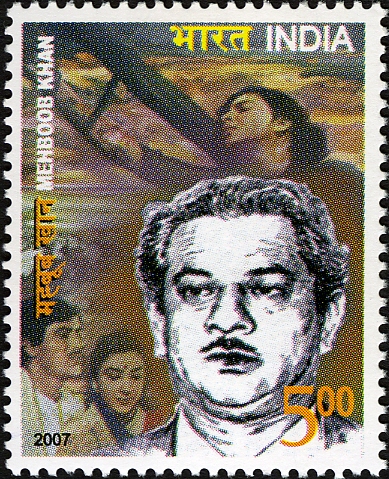
In 1963, Khan awarded Padma Shri, the fourth highest civilian honour by Government of India. Mehboob Khan was awarded the title of Hidayat Kar-e-Azam by the Indian government. As a part of his birth centenary celebrations, the Indian Postal Department released a commemorative stamp of Mehboob Khan at a function held at the Mehboob Studios in September 2007.
Photos courtesy Google. Excerpts taken from Google.
 Writer Sunita