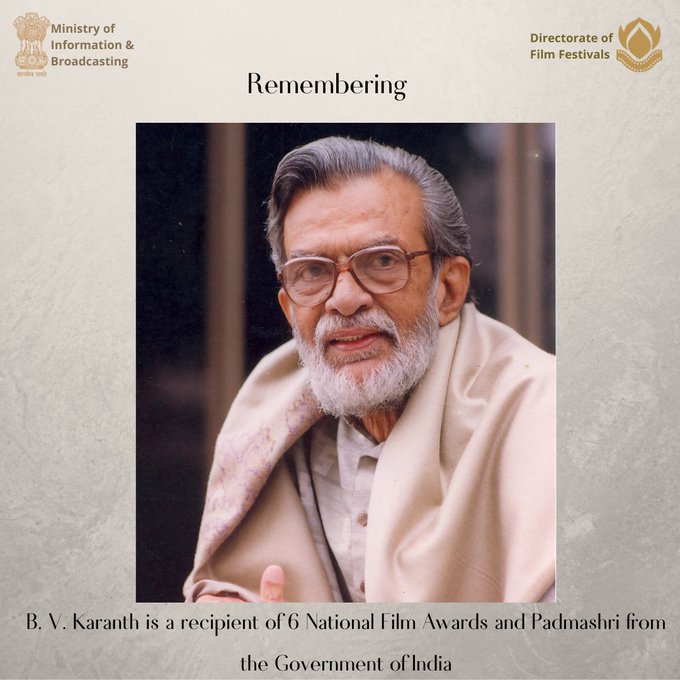

Babukodi Venkataramana Karanth was director, musician, actor, writer and more of modern Indian theatre both in Kannada as well as Hindi, and one of the pioneers of Kannada and Hindi new wave cinema.
He was an alumnus of the National School of Drama (1962) and later, its director. He has directed many successful plays and has directed award-winning works in Kannada Cinema. The Government of India honoured him with the Padma Shri.
Karanth involved in theatre early in life. He appeared on stage for the first time at the age of eight, in a play called ‘Nanna Gopala’, directed by veteran director P. K. Narayana.
Soon after, he joined the Gubbi Theatre Company, which was started by renowned thespian Gubbi Veeranna who was responsible for putting Kannada theatre on the map. Veeranna sent Karanth to Banaras to gain a Master of Arts degree, where he also underwent training in Hindustani music under Guru Omkarnath Thakur.
Karanth graduated from the National School of Drama (NSD), New Delhi, in 1962, winning an award as the best all – round student then headed by Ebrahim Alkazi. Between 1969 and 1972, he worked as a drama instructor at the Sardar Patel Vidyalaya, New Delhi.
In 1974, Karanth set up “Benaka”, one of Bangalore’s oldest theatre groups, with his wife, Preme Karanth. Benaka was an acronym for Bengalooru Nagara Kalavidaru. Benaka stages several hugely popular plays like Hayavadana all across Karnataka and even overseas. At Benaka, Karanth also took a special interest in children’s theatre and directed several plays with children.
Vamsha Vriksha (The Family tree), is a 1971 Indian Kannada-language film directed by Karanth and Girish Karnad. was based on a proud Brahmin scholar looks after his widowed daughter-in-law and grandson until she falls in love with her English lecturer and remarries. She loses custody of her son and her son, who becomes her student refuses to acknowledge her as his mother, which aggravates her guilt feelings. Eventually the old patriarch discovers that he himself was illegitimate and foregoes his wealth to prove to the heroine, on her deathbed, that she was right to insist on inventing her own notion of tradition. The film won the National Film Award for Best Direction. It also won three Filmfare Awards in 1972.
Chomana Dudi (Choma’s Drum) – 1975 – Kannada language film is based on the Southern part of Karnataka, where the untouchable caste of Mari Boleya is forbidden from owning or tilling her/his own land. Choma has a dream; get a piece of land from his landlord and become a farmer rather than be a slave to his landlord. He carries a burden of five children and is a debtor to an estate owner. Tragedy grips Choma’s life one by one as the death of his sons, conversion of another son to Christianity and finally when he finds his daughter, whom he was always proud of, with the estate clerk. Choma reacts to all these tragic events through his drum. He beats his drum in various rhythms according to the moods of his eventful life. Film won the Swarna Kamal, India’s National Award for the best film.
Tabbaliyu Neenade Magane or Godhuli (The Hour of the Gods) is a 1977 Indian drama film co-directed by Girish Karnad and B. V. Karanth, starring Kulbhushan Kharbanda, Om Puri and Naseeruddin Shah. It portrays the story of a modern agriculturist who returns from US after studying agriculture and brings his American wife to the village. The film was made in Hindi and Kannada versions. Godhuli was included the 1984 International Film Festival of India (IFFI). At the 25th National Film Awards, S. P. Ramanathan won the Best Audiography. It won the Filmfare Award for Best Screenplay at the 27th Filmfare Awards for Girish Karnad and Karanth.
Ghatashraddha (The Ritual) is a 1977 Indian Kannade language film directed by Girish Kasaravalli. The film won three awards at the 25th National Film Awards, for Best Feature Film, Best Music Direction (B. V. Karanth and Best Child Artist.
Karanth’s other major contribution towards theatre came in 1977, when he became the director of the National School of Drama, Delhi. Playwright-director and successor to Karanth, Prasanna remembers the effect Karanth had on NSD as phenomenal. “Karanth turned the NSD upside down. He did wonderful things that were never done before,” he said in an interview. “He believed that in a country like India, with incredible talent and traditions of theatre, NSD had to take theatre out to inaccessible areas. So he started an extension programme and we were all sent out. I was camp director of a workshop in Bihar. He did a 40-day workshop in Gandhigram (in Madurai), Tamil Nadu,” Prasanna said
In 1981, he was invited by the Madhya Pradesh government to head the Rangamandal repertory, under the Indian government. Here, again, he completely turned things around by bringing the state’s folk theatre to the masses. Scores of people would line up to watch plays in local dialects Bundelkhandi, Malavi and Chhattisgarhi, and these had folk performers and crews for the first time. Karanth was largely responsible for starting the new theatre movement in Madhya Pradesh.
In 1989, the Karnataka government invited him to set up a repertory in Mysore, which he named ‘Rangayana’ and headed until 1995.
With the integration of Alarippu and National school of Drama-New Delhi, Karanth had contributed three great plays in Telugu. Collaborated with Surabhi theatre of Andhra Pradesh, Karanth conducted three workshops respectively ‘Bhishma’ in 1996, ‘Chandipriya’ in 1997 and ‘Basthidevatha yadamma’. It is his dedication that Karanth spent his time during the workshops in corner villages of Andhra Pradesh to brought up the dramas.
Karanth entered the Kannada theatre scene in the late 1960s and early ’70s. His entry brought about a sea change in Kannada theatre which then was steeped in the old, formal proscenium style. His plays like Jokumara Swamy, Sankranti, Huchu Kudure and Oedipus to name a few, which were directed in the early 1970s, were hailed as trendsetters. These plays touched upon all aspects of theatre like language, music, song, stylisation.
The innovative use of music was one Karanth’s biggest contributions to theatre. One of Karanth’s strengths was his ability to draw on classical, traditional and folk forms and fuse them in his compositions. His plays were less famous for design as for their musical content, which became part of the prose of theatre.”
Karanth directed over 100 plays and has left an indelible impression in the theatre field that has recognition across India and abroad. The majority of his contribution was in Kannada followed by Hindi. He has also directed plays in other Indian languages including Urdu, Punjabi, Gujarati, Sanskrit, Telugu, Malayalam. Hayavadana (by Girish Karnad), Kattale Belaku, Huchu Kudure, Evam Indrajit, Oedipus, Sankranti, Jokumara Swami, Sattavara Neralu, Huttava Badidare and Gokula Nirgamana are some of his most popular plays in Kannada. Of the forty or so plays he directed in Hindi, Macbeth (using the traditional Yakshagana dance drama form), King Lear, Chandrahasa, Hayavadana, Ghasiram Kotwal, Mrichha Katika, Mudra Rakshasa, and Malavikagni Mitra are some of the more popular ones. Karanth also revelled in directing children and directed several children plays like Panjara Shale, Neeli Kudure, Heddayana, Alilu Ramayana and The Grateful Man.
Tughlaq (Hindi ) by Girish Karnad. Tr. by B. V. Karanth. Rajkamal Prakashan Pvt Ltd, 2005
In 2012, Films Division produced a 93-minute film on B. V. Karanth called BV Karanth:Baba. The film bases itself on B. V. Karanth’s autobiography in Kannada called Illiralaare, Allige Hogalaare (I can’t stay here, I won’t go there) compiled by well known Kannada writer Vaidehi. .
B.V. Karanth donned multiple hats in his lifetime and will always be remembered for his invaluable contribution to each of those fields.
All of these plays ran for at least 200 shows and really exemplified Karanth’s genius. His plays may not have been stylistically impressive but his use of music, to bring out emotion and subtext, left the audience spell-bound. They would centre on human nature and emotion, mixed with mythology and folklore.
Karanth travelled all over the country, sometimes with his wife, and set up workshops and other outreach programs to encourage folk theatre. It was a mission that he carried forward after stepping down as director.
In his lifetime, Karanth built a versatile and prolific portfolio — he directed close to 150 plays in Kannada, Hindi, Tamil, Telugu, Gujarati, Malayalam and Urdu.
Lakshmi Chandrashekhar, a leading theatre artist and critic, put it best when she said,“Karanth offered ‘complete’ theatre, where colour, music, dance, narrative and strong intellectual content merged. He brought people back to the theatre.”
Karanth who is known as “Rangabhishma’ has left a formidable legacy bringing revolutionary changes not only to Kannada theatre but Indian theatre in general. The genius contribution to music is unique. He gave a magical touch to Indian music and created a new genre called “adaptive music” beyond the framework of classical music to which his plays stand as testimony.
Karanth directed over 100 plays and has left an indelible impression in the theatre field that has recognition across India and abroad. The majority of his contribution was in Kannada followed by Hindi. He has also directed plays in other Indian languages including Urdu, Punjabi, Gujarati, Sanskrit, Telugu, Malayalam as well as in English and also directed children’s plays.
He served as director of the Delhi National Drama School from 1977-81. Then came to Mysore and, in 1989, brought about a revolutionary change in the theatre scene of Karnataka with the establishment of a repertory under the auspices of the government. Mysore Rangana and Rangayana Director, Amanda Kariyappa has written to the government that Padma Shri BV should celebrate his birthday as “Indian Music Day”.
Hayavadana ( Horse face) by Girish Karnad, Evam Indrajit, Sankaranti, Oedipus, Jokumaraswamy, Panjarshale, Gokula Nirgamana, Sattavara Neralu are his Kannada productions. He served as an assistant director in Vamshavruksha, Tabbaliyu Ninade Magane while Chomanaduri which he directed bagged the National award. His caliber of producing innovative music is evident in films like Hamsageete, Chomandudi, Aadishankara, Phaniyamma. He was also bestowed with various awards including the Sangeet Nataka Academy Award, Padmashri, Kalidas Samman by the Madya Pradesh government and the Gubbi Veeranna Award instituted in the name of the legend.
Disciples of Karanths across India have been following the trend set by the musical giant who had produced unique music like Shrinivas Bhat who had assisted Karanth in almost all his works. Bhat himself is a leading music director in the state and considers that the contribution of BV Karant to the field of theatre music was unique.
He not only set songs to tunes but also speech and expressions. He ensured that anyone could sing. If you listen to his songs, they don’t sound like songs. But they have all the ingredients of music”.
He had an experimental mindset. He believed that society was the real school for theatre. He argued that those who want to work in theatre should first have varied and rich experiences in life. They should see and observe society at close quarters. He sent all the young people who came to learn theatre on fieldwork.
Rangayana is hosting ‘Bharathiya Rangasangeetha-Natakotsava’ on its premises in Mysuru from September 19 to 26 to mark the birth anniversary of renowned theatre personality B.V. Karanth. The eight-day theatre festival will take place at the newly established B.V. Karanth Ranga Chavadi on Rangayana premises.
Rangayana director Addanda C. Cariappa told reporters here on Wednesday that industrialist M. Jagannath Shenoy would inaugurate the festival on September 19, birth anniversary of Karanth, at 5 p.m. On the occasion, a bust of Karanth would be unveiled in the garden of Rangayana. A seminar titled ‘Karanth Rangavalokana’ would be held on the concluding day of the festival. NSD Bengaluru director Veena Sharma Bhoosnurmath, senior actors Sundar Raj, Srinivas Prabhu, and Suresh Anagalli and others would participate. Also, this year, in collaboration with Mysuru Rangayana and the Department of Kannada and Culture, Bharatiya Ranga Sangeetha Dina would be celebrated in all districts, on September 19.
His translations from Sanskrit into Hindi include Swapna Vasavadatta, Uttararama Charita and Mrichchakatika . He has also translated a large number of plays from Kannada to Hindi and vice versa. His translation of Girish Karnad’s play Tughlaq into Hindi/Urdu has attained cult status.
In 2010, at the 12th Bharat Rang Mahotsav, the annual theatre festival of National School of Drama, Delhi, a tribute exhibition dedicated to life, works and theatre of B. V. Karanth and Habib Tanvir was displayed.
Photos courtesy Google. Excerpts taken from Google.
 Writer Sunita