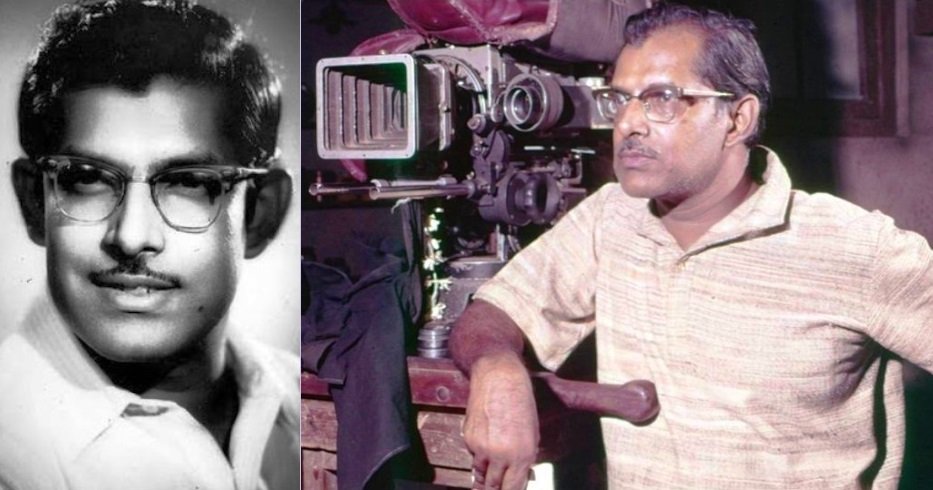
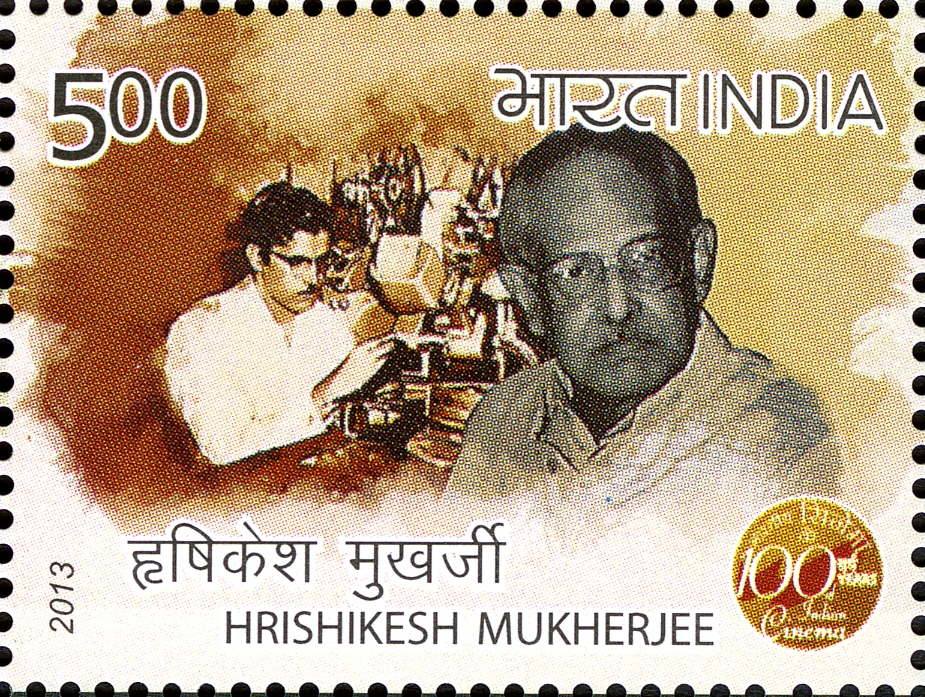
Hrishikesh Mukherjee was an Indian film director, editor and writer regarded as one of the greatest filmmakers of Indian cinema, known for a number of films.
Popularly known as Hrishi-da, he directed 42 films during his career spanning over four decades, and is named the pioneer of the ‘middle cinema’ of India. Renowned for his social films that reflected the changing middle-class ethos, Mukherjee “carved a middle path between the extravagance of mainstream cinema and the stark realism of art cinema”.
Mukherjee chose to begin working, initially as a cameraman, and then film editor, in B. N. Sircar’s New Theatres in Calcutta in the late 1940s, where he learned his skills from SubodBh Mitter (‘Kenchida’), a well known editor of his times. He then worked with Bimal Roy in Mumbai as film editor and assistant director from 1951, participating in the landmark Roy films Do Bigha Zamin and Devdas.
His debut directorial venture, Musafir (‘Traveller’) (1957), the screenplay and story were written by Mukherjee and Ritwik Ghatak respectively. The house becomes a character in the film as the three related family stories are unfolded with a set of some other common characteristics and characters, like the landlord Mahadev Choudhary (David), tea shop boy (Mohan Choti), a neighbouring housewife and her daughter, Muni (Baby Naaz), and a postman, and last, but not the least the shadow of someone who makes a dramatic appearance only in the last story – Dilip Kumar drunkard violinist, Raja. The first of the three stories deals with Ajay who marries an orphaned young woman, Shakuntala Varma against family sanction, trying to prevail upon her husband to make up with his family; the second, dealing with aspirations and unemployment has Bhanu, his widowed sister-in-law, and aging father; and the third, and the longest, again involves a young widow, Uma her disabled son, Raja, and father-in-law, and her unexpected but pre-ordained encounters with her first lover, Pagal Babu Raja (Dilip Kumar) in whose death is latent hope for the child… symbolically deployed with the flowering of a bud. 1957 National Film Awards film won Certificate of Merit for Third Best Feature Film in Hindi.
Anari is a 1959 Comedy film stars Raj Kapoor, Nutan, Motilal and Lalita Pawar. This was among the few movies in which Lalita Pawar played a positive role and Motilal a role with shades of grey. Raj Kumar is an honest, handsome, and intelligent young man. Working only as a sole trader painter, he is unable to earn a living, including paying rent to his kind-hearted and talkative landlady, Mrs. D’sa. One day, Raj finds a wallet containing money and returns it to the owner, Mr. Ramnath. Ramnath admires Raj; satisfied with his honesty, he employs Raj to work in his office as a clerk. Raj meets Ramnath’s maidservant Asha and they fall in love with each other. This all ends when Raj finds out that Asha is really Aarti, the niece of his employer. Unfortunately, his landlady Mrs. D’sa dies suddenly consuming medicine manufactured by Mr. Ramnath. The police conduct a post-mortem and as a result, conclude that someone poisoned Mrs. D’sa. The police take Raj for questioning as the prime suspect, is arrested, and held in jail. In the trial, however, Ramnath admits full responsibility for the tainted medicine, clearing Raj of the charges. Aarti tells Raj she promised Mrs. D’sa she would take care of him, someone who is “as big an idiot as the world is clever,” giving a sense that they will marry. Film won in 1959 Filmfare Awards for Best Actor, Best Music Director, Best Supporting Actress, Best Lyricist and Best Male Playback for song “Sab Kuchh Seekha Ham Ne”, and President’s silver medal for Best Feature Film in Hindi.
Anuradha is a 1960 Hindi-language film stars Balraj Sahni and Leela Naidu (Miss India) in lead roles. The film’s music was composed by Pandit Ravi Shankar, in one of his rare forays into Hindi Cinema. The film was based on a short story written by Sachin Bhowmick, first published in the Bengali monthly magazine Desh. A lonely housewife, who gave up her promising singing career to marry an idealistic village-doctor, begins to regret her decision.
A noted radio singer and dancer Anuradha Roy (Leela Naidu) falls in love with an idealistic doctor, Dr Nirmal Chowdhary (Balraj Sahni). Her father is against this relationship as he feels that there is a wide gap between his status as a wealthy man and that of the doctor of humble origins and meagre means. Anu decides to marry Dr Nirmal against her father’s will. Anu marries him and follows him to the village. Her father had plans to get her married to the London-returned Deepak (Abhi Bhattacharya). Deepak is magnanimous when he comes to know of Anu’s love with Dr Nirmal. He promises to help her in the future in case she needs any help.
After her marriage, Anu is blessed with a daughter. Anu gets busy with the household chores and quits singing. Ten years later, Anuradha is a homebody with a life characterised by drudgery. Her husband is forever preoccupied with his patients. He has little time for his wife. He forgets to take her to the village festival she had been excitedly looking forward to. After many years, her father visits her and requests her to relocate to the city. He is unable to see his daughter in financial distress. But Dr Nirmal refuses the offer.
Deepak meets with an accident while travelling with his girlfriend. Dr Nirmal successfully operates on his girlfriend and Deepak lands up in Dr Nirmal’s home where he is tended by Anu with lots of care and affection. He realises the hardships the once-rich girl has to endure in a remote village. He suggests that she leave Nirmal and move to the city to lead a life of luxury and comfort. Dr Nirmal agrees to this proposal. The ending may appear trite but if a woman really loves a man, she may just leave everything and follow him. The film went on to win the National Film Award for Best Feature Film and was nominated for the Golden Bear at the 11th Berlin International Film Festival in 1961.
Chhaya (Shadow) is a 1961 film star cast Sunil Dutt and Asha Parekh. Nirupa Roy won the Filmfare Best Supporting Actress Award.
Asli-Naqli (Real and Fake) is a 1962 film stars Dev Anand, Sadhana. The film became a box office hit. The film is refreshing with brilliant acting by all the cast and is very competently directed by Hrishikesh Mukherjee. Renu lives a poor lifestyle with her family. Shattered and devastated with the deaths of her father and brother, Renu decides to take up the mantle of feeding her family, hiding her dad’s death from her ill and fragile mother, and goes along pretending that her father is still alive. Things brighten up when a homeless young man, Anand, enters her life, both fall in love with each other and want to get married. But once again fate plays a cruel joke on Renu as she subsequently finds out that Anand is not who he claims to be, but is in fact, a playboy, the grandson, nicknamed ’Prince”, of one of the wealthiest man in town, Dwarkadas, and Anand is scheduled to get married to Rekha – the only heir to a multi-million rupee estate.
In the expression of love, while filming the song “Ek But Banaunga”, Mukherjee took care that Dev Anand and Sadhana maintained a distance of at least 20 feet between them. At one time when they come nearer, there is a blackboard on a stand between them. When Dev Anand turns around the blackboard to Sadhana’s side, the latter puts a slate between them. In the backdrop of rains outside, with Mohammed Rafi’s magic all around, someone takes away a goat from the rain-sheltered veranda and one is transported to the dream world of love. At times Dev Anand is outside in the veranda with the bamboo mesh o f a window between them. Dev is worshipping Sadhana with folded hands and in the end Sadhana comes near with her hands raised in blessing. Similarly, while picturising the song “Tera Mera Pyaar Amar”, Mukherjee demonstrates the love between Dev Anand and Sadhana by putting them in different places as the song unfolds. In the early part of his career, Hrishikesh Mukherjee was a cinematographer and all through the film, there is brilliant camera work.
There is a scene in which Nazir Hussain praises the workmanship of an artifact to Dev Anand when the latte r is disturbed. In a single scene, Motilal, the character actor gives a brilliant performance by advising Dev Anand to let things go, rather than to control them. He asks Dev Anand in the club to hold sand in his palm and tells him: “If you would try to hold on to the sands, these would escape through your fingers. But if you keep your palm open, they would stay undisturbed.” In the scene when Sadhana is teaching English to the slum dwellers, she asks Dev Anand to spell and pronounce ‘No’ and gets into a funny argument about English pronunciations.
Anupama (Incomparable) is a 1966 film stars Dharmendra, Sharmila Tagore, Tarun Bose. One of the best Indian movie on father and daughter relationship. The film begins with a haunting and memorable rendition in the soulful ethereal voice of Lata Mangeshkar, “Dheere Dheere Machal, Ae Dil-e-bekarar, Koi aata hai..Yoo tadap ken a tadpa mujhe baarbar, koi aata hai..” The lyrics by Kaifi Azmi set the tone for the maddening love Mohan, impeccably portrayed by Tarun Bose, has for his bride Aruna played by Surekha Pandit. Their love remains short-lived as she dies during childbirth in the subsequent scenes. These opening sequences establish and evoke empathy by consolidating the irreplaceable love between Mohan and Aruna, and Mohan blaming the newly-born child for killing his one true love. Mohan is incapable of loving his daughter, Uma as she reminds him of his late wife. In her growing up years, Hrishi da, deftly depicts a father’s and husband’s conflicted state of mind – expressing joy at her growing daughter Uma (Sharmila Tagore), and feeling sadness, a grave void at the loss of his love. He ignores his daughter through the day, spending most of his time at his office. The daughter is specifically encouraged to avoid coming in front of him, but actually in the nights, when he returns from work totally inebriated state, he showers her with gifts.
Sharmila grows up to be a shrinking violet, who blossoms when a sensitive novelist (Dharmendra) enters the scene and encourages her to break free. Sharmila finally asserts her identity and reaches the railway station to elope with Dharmendra. But without her knowledge, her father is also at the station, hiding behind a pillar, and weeping rivulets. His long repressed love for his daughter has finally won out against his resentment. The music for the movie was composed by Hemant Kumar and the lyrics were written by Kaifi Azmi. The movie includes many popular songs such as “Dheere Dheere Machal” picturised on Surekha & Tarun Bose. “Ya Dil Ki Suno” and “Kuch Dil Ne Kaha” are other memorable songs from this movie. The film was critically acclaimed and was nominated for four Filmfare Awards and won Filmfare Award for Best Cinematography, Black and White category.
Gaban (Embezzlement) is 1966 Hindi film based on Munshi Premchand’s classic novel by the same name. Honest Munshi Dayanath works in the administrative office of the Allahabad High Court in 1928 British India, and lives an impoverished lifestyle along with his wife, a grown slacker son, Ramanath, and two younger sons. Without knowing Ramanath’s background, Munshi Dindayal arranges his daughter, Jalpa’s marriage, and she moves in with this family. Unable to pay jeweler Gangaram for jewelry purchased for this wedding, Ramanath steals his wife’s jewelry, and then gets in debt when he gets her a Chandrahaar. In order to pay for this, he works as a Clerk, collecting money for the regime as well as accepting bribes. Circumstances compel him to embezzle Rs.800/- which he is unable to return. Afraid of being arrested, he flees to Calcutta, gets embroiled indirectly in the freedom struggle, gets arrested and will only be set free if he testifies against non-violent freedom-fighters.
Majhli Didi is a 1967 film based on the Bengali language story, Mejdidi (Middle Sister) by Sarat Chandra Chattopadhyay. Majhli Didi stars Meena Kumari. It remains one of Hrishikesh Mukherjee’s highly rated films. At the 16th Filmfare Awards, it won Best Screenplay Awards, Best Art Directioon, Black and White. It was India’s entry to the 41st Academy Awards for Best Foreign Language Film.
Aashirwad (Blessing) is a 1968 film is notable for Ashok Kumar & Veena life time performances and its also inclusion of a rap-like song performed by Ashok Kumar, “Rail Gaadi” & “Nav Chali”. Adorned with such wonderful songs such as “Rail Gaadi” sung by Ashok Kumar himself, “Ek Tha Bachpan” and finally the memorable “Jeevan Se Lambe Hai Bandhu Yeh Jeevan Ke Raste” (sung by the bullock-cart driver who carries Jogi Thakur near his village in the night), the movie is an emotional journey through a man’s life who stands by his principles only to be finally overcome by love for his daughter. Film won Filmfare Best Actor Award for Ashok Kumar. It Won National Film Award Best Award for Ashok Kumar and National Film Award for Best Feature Film in Hindi.
Satyakam is a 1969 film based on a Bengali novel of the same name by Narayan Sanyal. The name of the film is taken from ancient Hindu saint Satyakama Jabala. It won the 1971 Filmfare Best Dialogue Award. The movie also won National Film Award For Best Feature Film in Hindi.
Anand is a 1971 film is considered his masterpiece. This classic film gave a complex but compassionate look at the balance between hope, fear, life and death and saw Rajesh Khanna’s greatest performance as a terminally ill man who wishes to live life to the full before he dies. The story of a terminally ill man who wishes to live life to the fullest before the inevitable occurs, as told by his best friend. Film is unabashed about death, not in an insensitive way but more as a seed of thoughtful transcendence. The irrevocable destiny of protagonist Anand is revealed within minutes into the film. Mukherjee uses the hero’s finality as the main plot point to subvert the story of an untimely death, to a narrative of optimism, interfaith and harmony. Mukherjee shot the film in 28 days. Gulzar wrote the poem “Maut Tu Ek Kavita Hai”, which is narrated by Amitabh Bachchan. Film won National Film Awards for Best Feature Film in Hindi. Movie also won 19th Filmfare Awards for Best Film, Best Story, Best Editing, Best Actor, Best Supporting Actor, Best Dialogue. In 2013, it was listed in Anupama Chopra’s book 100 Films To See before You Die.
Bawarchi (The Chef) is a 1972 Hindi musical comedy film was a remake of Rabi Ghosh starrer Bengali film ‘Galpo Holeo Satt’ (1966) by Tapan Sinha. The story is centered around the squabbling Sharma family, headed by their eccentric Daduji, which has a dubious reputation of the inability to retain a cook for more than a few months due to their ill treatment of their domestic helps. The family’s disrepute spreads to such an extent that no person wants to be employed as a cook in their home, named Shanti Niwas. Then one day a young man named Raghu (Rajesh Khanna) offers to work as a cook, and is hired. Raghu, however, lives up to this challenge and becomes the apple of the eye of every inmate of Shanti Niwas. He even defuses the internal squabbles and re-unites the family.
The film was ranked the eight highest-grossing film of the year 1972. In an interview, Khanna quoted “In ‘Bawarchi’ I did exactly the opposite of what Hrishida had made me do in ‘Anand’. He allowed me to interpret the role and perform my way. I had done enough intense roles, and ‘Bawarchi’ gave me the opportunity to interpret and perform the role the way I wanted. So I let myself go.” Harindranath Chattopadhyaya’s line which was also used as a dialogue in film : “It is so simple to be happy but so difficult to be simple.”
Mukherjee’s style here is typical, in that the film contains no violence, and focuses rather on “the milieu of the Indian middle-class who have larger-than-life foibles and whose major concern is to survive the day […:] which bahu will cook, which brother will use the bathroom first, who will get up first to make the morning tea, [etc.]” Khanna won BFJA Awards for Best Actor (Hindi) for his performance in this film.
Abhimaan (‘Pride’) is a 1973 film is based on the troublesome marriage between two Hindustani classical music maestros. The film is perhaps best remembered for its songs. The film was a major hit at the box office. Film won the Filmfare Best Actress Award and Filmfare Best Music Director Award. The songs “Tere Mere Milan Ki Yeh Raina” and “Meet Na Mila Re Man Ka” were listed at the 16th and 23rd spots, respectively, on Binaca Geetmala’s Annual List for 1973. This film was very popular in Sri Lanka more than in India and was screened continuously for 590 days in the same cinema, Empire, Colombo.
Namak Haraam (Traitor) is a 1973 film stars Rajesh Khanna and Amitabh Bachchan. Rajesh Khanna received BFJA Awards for Best Actor (Hindi) in 1974 for this film and Amitabh Bachchan had won Filmfare Award for Best Supporting Actor. “Diye Jalte Hai”, “Nadiya Se Dariya” and “Main Shayar Badnaam” are the most memorable melodies, picturised on Rajesh Khanna. And Kaka, as he was called by friends and fans alike, won the hearts of millions by his meaningful acting and face impressions. The film proved out to be a box office superhit and was the 5th highest grossing film of 1973.
Chupke Chupke (Quietly) is a 1975 film based on newly wedded husband plays a practical joke on his wife’s family with full support from his wife and friends. The story, in short, is about a newly married man Parimal who has to visit his wife’s sister and brother-in-law. The relatives could not make it to the wedding so this meeting is of utmost importance. The brother-in-law is a pompous but adorable man, so Parimal decides to pull a prank. He lands up at their house and disguises himself as the new driver Pyare Mohan, and the comedy of errors ensues.
Mili is a 1975 is a story about a girl who suffers from pernicious anemia, a disease considered untreatable during the period the film was produced. Her lively, inquisitive and cheerful demeanour spreads happiness in everyone’s life. She becomes an inspiration to her new neighbour Shekhar who is a depressed alcoholic. With her cheerful ways she changes Shekhar and he falls in love with her, unaware of her ailment. When he learns of it, he thinks of going away as he cannot bear to see her die. A reproach from their neighbour Aruna Irani makes him reconsider his decision. As he loves the girl, he offers to marry her and take her abroad for her treatment. The film begins and ends with a scene of a jet aircraft taking off, ostensibly carrying the couple to Switzerland where they hope to find a cure.
In the following years he made numerous films. Some of his films include: Guddi (1971), Alaap (1977), Gol Maal (1979), Khubsoorat (1980) and Bemisal (1982). His last film was Jhooth Bole Kauwa Kaate. He has also directed TV serials like Talaash.
He was the first to introduce Dharmendra in comedy roles, through Chupke Chupke, and gave Amitabh Bachchan his big break with Anand in 1970, along with Rajesh Khanna, he also introduced Jaya Bhaduri to Hindi Cinema in his film Guddi. Having worked with his mentor, Bimal Roy as an editor, in films like Madhumati, he was much sought after as an editor as well.
Mukherjee was honoured with the Dadasaheb Phalke Award by Government of India, in 1999. Mukherjee was chairman of the Central Board of Film Certification and of the National Film Development Corporation. He was also awarded the Padma Vibhushan, the second highest civilian award for his contribution to Indian cinema by government of India in 2001 . The International Film Festival of India honoured him with a retrospective of his films in November 2005. He holds the distinction of working with almost all the top Indian stars since independence of India in 1947.
Hrishikesh Mukherjee’s cinema could make you cry. You sniffle when Sharmila Tagore’s emotionally withdrawn father surmounts his long-festering resentment towards his daughter and comes to the railway station to secretly rejoice in her eloping with her lover in Anupama or when Ashok Kumar opens his heart, overcomes his distaste and makes his daughter-in-law’s son, the product of rape, light his son’s pyre in Satyakam.
Most of his captivating characters inhabit a middle-class, urban, educated milieu and lightly wear an air of high morality and intrinsic geniality. Mukherjee was a soft-spoken, well-educated professional, who learnt the ropes of filmmaking from venerable institutions like Kolkata’s New Theatres and director Bimal Roy. He assisted Roy on classics like Do Bigha Zameen and Devdas.
His films were shorn of affectation so were his heroines. Mukherjee established the girl-next-door look with Jaya in Guddi but his heroines were archetypal even when he worked with glamour icons like Sadhana (sari-wrapped and beguiling in Asli Naqli), and Sharmila Tagore (no outlandish eyeliner in her Mukherjee films). Jaya continued her look in subsequent Mukherjee films like Abhimaan (1973), an astute observation of the attendant ego hassles which rise when a married couple is in the same profession.
By no means is he any glamorous director, yet Hrishikesh Mukherjee is one of the most popular and beloved filmmakers in Indian cinema. His magic lay not in the glamor or largeness so often associated with cinema, but in its simplicity and warmth.
Photos courtesy Google. Excerpts taken from Google.
 Writer Sunita