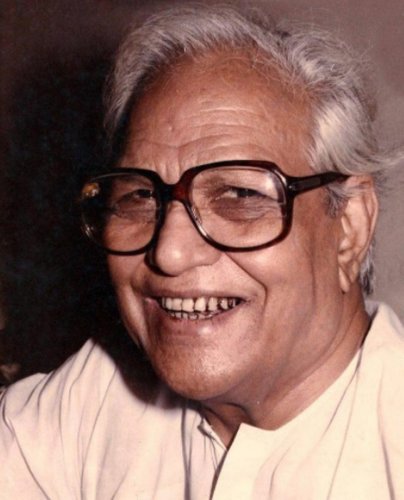
Asrar ul Hassan Khan, better known as Majrooh Sultanpuri, was an Indian Urdu poet and lyricist in India’s Hindi language film industry. He wrote Hindustani lyrics for numerous Hindi film soundtracks.
He was one of the dominating musical forces in Indian cinema in the 1950s and early 1960s, and was an important figure in the Progressive Writers’ Movement. He is considered one of the finest avant-garde Urdu poets of 20th century literature.
He was a struggling Hakim when he happened to recite one of his ghazals at a mushaira in Sultanpur. The ghazal was a hit with the audience and Majrooh decided to drop his fledgling medical practice and began writing poetry seriously. Soon he was a ‘regular’ at mushairas and a “shagird” i.e. disciple of the then top name in Urdu Mushairas viz Jigar Moradabadi. While Majrooh is popular as a film lyricist and is widely known in that capacity, be it known that he also created one of the best-known verses of Urdu poetry.
In 1945, Majrooh visited Bombay to attend a mushaira at the Saboo Siddique Institute. Here his ghazals and poetry were highly appreciated by the audience. One of the impressed listeners was film producer A. R. Kardar. He contacted Jigar Moradabadi who helped him to meet Majrooh. However, Majrooh refused to write for films because he didn’t think very highly of them. But Jigar Moradabadi persuaded him, saying that films would pay well and would help Majrooh to support his family. Kardar then took him to music composer Naushad who put the young writer to test. He gave Majrooh a tune and asked him to write something in the same metre, and Majrooh wrote ‘Jab Usne Gesu Bikhraye, Badal Aaye Jhoom Ke‘…. Naushad liked what he wrote and Majrooh was signed on as the lyricist of the film Shah Jehan (1946). The songs of the film became so immensely popular that singer K. L. Saigal wanted Jab Dil Hi Toot Gaya to be played at his funeral.
Majrooh subsequently did films like Naatak (1947), Doli (1947) and Anjuman (1948) but his major breakthrough came with Mehboob Khan’s immortal love triangle, Andaz (1949), where he penned hit songs like Tu Kahe Agar, Jhoom Jhoom Ke Naacho Aaj, Hum Aaj Kahin Dil Kho Baithe, Toote Na Dil Toote Na and Uthaye Ja Unke Situm. Another film of his, where his songs proved extremely popular, was Arzoo (1950). Ae Dil Mujhe Aisi Jagah Le Chal from the film remains one of the finest songs filmed on Dilip Kumar.
He was sentenced to two years imprisonment due to his politically-charged poems in 1949. Having to start his film career afresh, Majrooh finally broke though again with the Guru Dutt films Baaz (1953) and especially, Aar Paar (1954). With such successful songs like Babuji Dheere Chalna, Kabhi Aar Kabhi Paar, Yeh Lo Main Haari Piya and Sun Sun Sun Sun Zaalima among others. Singer Geeta Dutt singled out Yeh Lo Main Haari Piya as among her ten best songs ever in a list she put together in 1957.
The Guru Dutt – Majrooh Sultanpuri – O. P. Nayyar team went even one better with Dutt’s following film, Mr. & Mrs. ’55 (1955). The songs are one of the reasons for the success of the film and numbers like Thandi Hawa Kaali Ghata, Udhar Tum Haseen Ho, Jaane Kahan Mera Jigar Gaya Ji and Chal Diye Banda Nawaz were hummed in every nook and corner of the country.
Although Majrooh Sultanpuri worked with all the top music directors of the day – Anil Biswas, Naushad, Madan Mohan, O. P. Nayyar, Roshan, Salil Chowdhury, Chitragupt, N. Datta, Kalyanji-Anandji and Laxmikant-Pyarelal to name some, his associations with S. D. Burman stands out resulting in some outstanding songs.
With S. D. Burman, his work in films is unforgettable. The list of hit songs he has written is huge as all these films had some extremely finely composed songs set to his writing. Few could match Majrooh and S.D. Burman in light, romantic songs like Chhod Do Aanchal (Paying Guest), Aankhon Mein Kya Ji (Nau Do Gyarah), Achha Ji Main Haari Chalo Maan Jaao Na (Kala Pani) and Deewana Mastana Hua Dil (Bombai Ka Babu). But in the same films Majrooh showed just how beautifully he could write serious songs such as Chand Phir Nikla (Paying Guest), Hum Bekhudi Mein Tumko Pukare (Kala Pani) and Saathi Na Koi Manzil (Bombai Ka Babu).
Majrooh and Nasir Hussain first collaborated on the 1957 film Paying Guest, which Nasir wrote. After Nasir turned director and later producer they went on to collaborate in several films, all of which had huge hits and are some of Majrooh’s best remembered works. Films like Teesri Manzil (1966) – produced by Hussain and directed by Vijay Anand. Majrooh also was instrumental in introducing R. D. Burman to Nasir Hussain for Teesri Manzil. Baharon Ke Sapne, (1967), Pyar Ka Mausam (1969), Carvan (1971), Yaadon Ki Baaraat (1973), Hum Kisise Kum Naheen (1977) and Zamane Ko Didhana Hai (1981). He continued writing ever so youthful songs even for the next generation – for Hussain’s son, Mansoor Khan, in the latter’s films like Qayamat Se Qayamat Tak (1988) and Jo Jeeta Wohi Sikander (1992). With the song Pehla Nasha from the latter, it’s difficult to believe just how beautifully Majrooh Saab captured that heady, ecstatic feeling of floating in the clouds that one feels when one falls in love for the first time as a teenager. After all, he was well over 70 when he penned this song! Age is clearly a state of the mind, he proved.
In the year 1964, the partnership of Majrooh Sultanpuri and Laxmikant-Pyarelal started through the film Dosti. Laxmikant–Pyarelal got more out of the veteran Mahrooh in Dosti (1964). Majrooh won his only Filmfare Best Lyricist Award for the song “Chahunga Mein Tujhe Saanj Savere” for this film.
Majrooh Sultanpuri and Laxmikant-Pyarelal worked for nearly 40 films. Few hit songs {Ye Aajkal Ke Ladke} Dillagi 1966, “Payal Ki Jhankar” Mere Lal, , 1966, “Bade Miyan Deewane” and “Dil Wil Pyar Wyar” Shagird, 1967, “Hui Shaam Unka”, “Chhalkaye Jaam” and “Chalo Sajana” Mere Hamdam Mere Dost, 1968, “Patthar Ke Sanam”, “Mehboob Mere Mehboob Mere”, “Tauba Ye Matwali Chal” and “Batadu Kya Lana” all from Patthar Ke Sanam 1968. “Ek Tera Saath”, Wapas, “Je Hum Tum Chori Se” Dharti Kahe Pukar Ke, 1969. “O Ghata Sawari” and “Sa Re Ga Ma Pa” Abhinetri. In 1971, two songs from classic Jal Bin Machhli Nritya Bin Bijli “O Mitwa O Mitwa”, “Kajara Laga Ke” and Mukesh classic “Taron Na Sajkę”. “Rook Jana Nahin” and “Roz Sham Aati Thi”, Imtihan 1974.
Raj Kapoor commissioned a song (“Ek Din Bik Jayega Maati Ke Mol”) from Majrooh for his 1975 film Dharam Karam which he paid him Rs.1000 for the song.
Majrooh Saab was the first film lyricist to be awarded the Dadasaheb Phalke Award for his invaluable contribution to Indian Cinema. He has also been a recipient of the Iqbal Samman from the Madhya Pradhesh Government, the Sant Gyaneshwar Puraskar of the Maharashtra Government and an award from the Maharashtra State Urdu Academy for Ghazal, his collection of Urdu Ghazals.
His lyrics seem to effortlessly blend with the tunes, the words soothingly flowing over the notes that even after decades’ people would still croon these numbers. His contributions to the Indian music scenario have been immense and particularly due to his enormous success in this field not many people know that he was also an outstanding poet. Indeed it was his talent as an Urdu poet that made him such a master lyricist. No wonder his over five decades of lyrical work had eclipsed his significant poetic contributions. He was a versatile poet and lyricist. He always at ease with the changing dynamics, always at home from pop and rock-n-roll to ghazals and qwaalis. He was an individual who with his sheer power of words ruled the music scene of the Hindi film industry.
The Municipal Corporation of Sultanpur built a garden “Majrooh Sultanpuri Udyaan” in his memory near diwani chauraha.
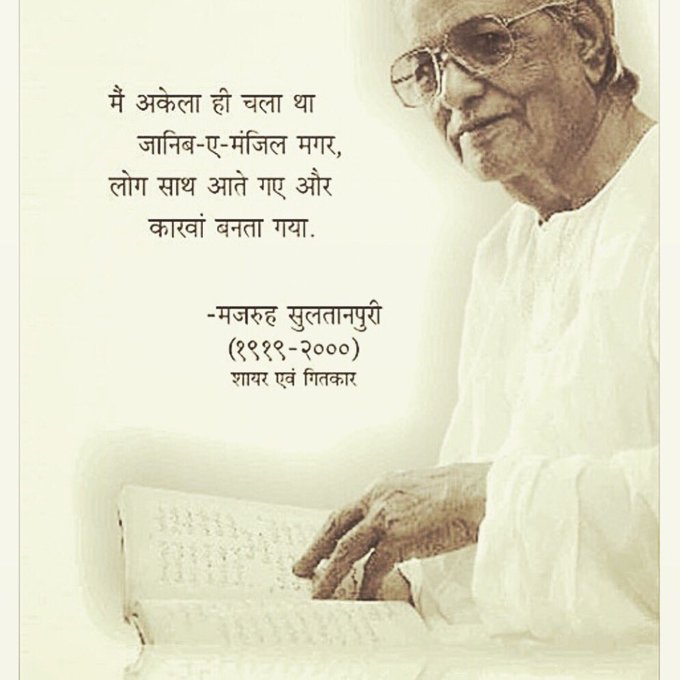
While Majrooh is popular as a film lyricist and is widely known in that capacity, be it known that he also created one of the best-known verses of Urdu poetry: “Main akela hee chala tha janibe manzil magar, log saath aate gaye aur carvan banta gaya!” (I set off alone towards the destination but people joined in and soon it became a caravan!)
Photos courtesy Google. Excerpts taken from Google.
 Writer Sunita