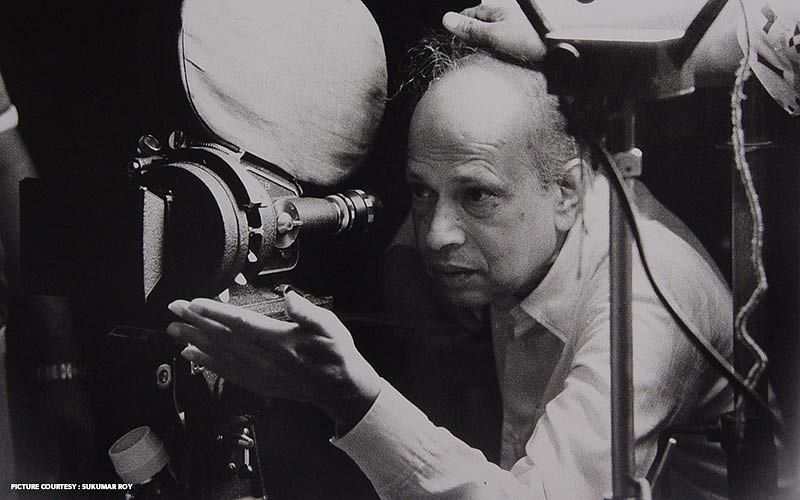
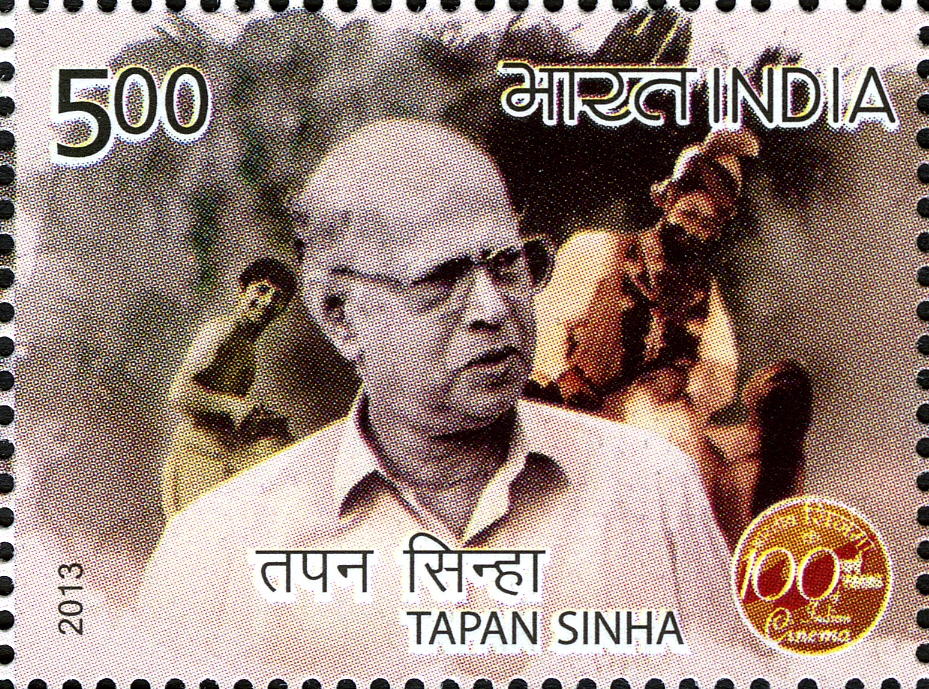
Tapan Sinha was one of the most prominent Indian film directors of his time forming a legendary quartet with Satyajit Ray, Ritwik Ghatak and Mrinal Sen. He was primarily a Bengali filmmaker who worked both in Bengali cinema and Hindi cinema.
Sinha started his career in 1946, as a sound engineer with New Theates film production house in Kolkata.
Charles Dickens’s novel, A Tale of Two Cities and the cinematic adaptation featuring Ronald Colman inspired Sinha to get involved in film-making. Tapan Sinha went to London in the 1950s to learn film-making. On reaching London, he contacted CryHearsth, Manager of Pinewood Studios. Through his help, he managed to obtain his first assignment. He got to work in director Charles Cryton’s unit as a Sound Engineer. Cryton, who made some British comedies like The Lavender Hill Mob etc. was then working for a film called ‘The Hunted‘. Sinha started as a sound recording engineer and gradually shifted to directing.
Tapan Sinha was greatly influenced by contemporary American and British Cinema, in his youth. Among his favourite directors were John Ford, Carol Reed, and Billy Wilder. He used to think that he had to make films on the lines of his favourites. Rabindranath Tagore’s work had been a great source of inspiration to him as well. Different Tagore works had special significance to him in various moments of his life.
Sinha’s first film, Ankush, is based on the Narayan Ganguly’s story Sainik, which had an elephant as the central character. His next Uphaar featured Uttam Kumar, Manju Dey and others. His Aadhar Periye is based on a story by Chittaranjan Maity.
Kabuliwala is a 1957 Bengali based on the eponymous 1892 short story by the Bengali writer Rabindranath Tagore. Kabullliwallah who is dreaded by children turns out to love children. The Rabindra Sangeet ‘Khoro Bayu Boy Bege Chari Dik Chaye Meghe’ is used in the film. Film explores the deep emotional attachment a homesick Kabulliwalah develops with a little Bengali girl who reminds him of his daughter he left behind back home. It is the celebration of simple humanism in these films that touched a chord with the audience instantly. Film won National Film Award for Best Feature Film and Best Feature Film in Bengali.
Jhinder Bondi (Prisoner of Jhind) is a 1961 Bengali historical film was based on a novel of same name written by Saradindu Bandyopadhyay, though the ending has been totally altered from that in the novel, whose base plot was adapted from the 1894 novel The Prisoner of Zenda by Anthony Hope. The first film in which Uttam Kumar and Soumitra Chatterjee starred together. Soumitra was, for the first time, cast as the villain, “Mayurbahan”. He had worked in barely a handful of films until then, aside from starting off as the struggling Apu buffeted by waves of tragedy. The film was a success, and yet did not typecast Soumitra with the permanent mark of a villain, as it might have been apt to do with other actors.
Hansuli Banker Upakatha is a film based on the novel by Tarashankar Bandopadhyay, in 1962. Set in 1941, the movie explores life in rural Bengal, the realities of the Zamindari system that was responsible for much of the social inequalities in Bengal, as well as the changes in social perceptions with time.
Nirjan Saikate (The Desolate Beach) is a Bengali film was released in 1963. This movie is an adaptation of the novel by the same name from eminent Bengali writer Samaresh Basu, who wrote this travelogue under his pen name ‘Kalkut’. The writer is himself the protagonist. He is on his way to Puri by train. In the course of the journey he gets acquainted with a group of 4 Bengali widows accompanying their niece, also going to Puri. The writer was going to just get out of his day to day Kolkata life whereas these ladies were actually going to calm down their niece who had just suffered a breakup with her lover. The rest of the story revolves around these people and their attraction and involvement with the writer. The writer is amused with them and for his part tries to calm the girl. The story guides us around the different relationships the writer develops with each of the character he meets. The movie tries to show the social taboos for widows and teaches the philosophy that life is ahead of us and not behind. There is a pretty good description of Puri, Konark and Rambha. At the time this movie was shot it was possible for Tapan Sinha to shoot inside the Konark sun temple, also the bullock cart way to Konark is an extra for the viewer. In 1965 at the 3rd IFF, film won Best Actor Award (Female) shared the leading 4 ladies of this film – the 4 widows and Silver Peacock Award – 2nd best film. In Sydney Film Festival film won Audience Award.
Jatugriha is a 1964 Bengali social film based on the novel of the same name by Subodh Ghosh. Shatadal meets Madhuri after a long time in a railway station and their story is narrated through a series of flashbacks. They actually were a happily-married couple. Satadal was a successful engineer who lived with his wife Madhuri. But day-by-day, their relationship runs into emotional stress due to childlessness. Madhuri cannot bear a child and her husband Shatadal is fond of children. Finally, the couple decided to break up. When they meet in the station, they realize their fondness for each other has not died. Sinha’s speciality lay in making his images speak with use of symbolism. The estranged couple meet by chance in the waiting room of a railway station after years of separation. As the past becomes alive again, they deliberate whether to reunite but decide against it. As they leave by separate trains, heading in opposite directions, the shot cuts to the waiter in the kitchen hanging up their tea cups in two separate hooks, far away from each other but looking very much a pair. A remarkable closing shot that summed up the tragedy of marital discord.
Atithi (The Guest) is a 1965 Bengali film based on a short story by Rabindranath Tagore. It tells a simple story about a teenage boy who prefers the life of a wanderer to the confines of a domestic life. At the 13th National Film Awards, it won the National Award (Certificate of Merit) for the Second Best Feature Film. It also won BFJA Awards for Best Indian Films, Best Screenplay – Tapan Sinha and Best Actress in a Supporting Role. It was India’s competitive entry at the Venice International Film Festival in 1966, where it was nominated for the Golden Lion. Film was a commercial as well as a critical success. When asked about the film’s success, Tapan Sinha said in an interview, “The greatest achievement was the hearty felicitations of millions of people – both from the intellectual circles and the common man.”
Galpo Holeo Satti is a 1966 Bengali film has become immensely popular in Bengal and is often considered a cult classic in Bengali. All lyrics are written and all music is composed by Tapan Sinha.
A new servant arrives in a family which is suffering from internal tension. The new servant, whose identity is itself under suspicion, gradually becomes lovable to all of the family members including the old ailing family head. The story unravels how this new man in their life helps each of the family members to find out new meaning in their individual lives as well as find out the happiness of a close-knit family. They have lost the peace in their life, getting angry over others over silliest reasons. Then this man appears like an angel. With his mastery at doing household work, intellectual ideas, and even cultural abilities he makes everyone happy and all the good things start happening magically. In the end, when the whole family is happy and reunited, he leaves all of a sudden without notifying anyone. He remains a mystery till the end.
Hatey Bazarey (The Market Place) is a 1967 award-winning art film stars Ashok Kumar, Vyjayanthimala (in her first Bengali venture). 13th Asia Pacific Film Festival film won Best Film. Presidential Award 1968 film won Best Film.
Apanjan (“One’s own people”) is a 1968 Bengali film set against the backdrop of the political violence that rocked India, and West Bengal in particular, in the late 1960s, it tells the story of an aged widow in a village who goes to Calcutta to stay with relatives, but faces only exploitation. She moves to a slum, and finds her “own people” in a group of educated, unemployed youth, who are caught up inexorably in the prevalent violence. The film was a commercial success, and also won the National Film Award for Best Feature Film in Bengali, as well as several BFJA Awards.
Sagina Mahato is a 1970 Bengali film stars Dilip Kumar and Saira Banu. The film is based on the true story of the labour movement of 1942–43, told through with fictional characters, and the mock trial of Sagina Mahato, the trade union leader of a factory in Siliguri. Dilip Kumar gave a sterling performance as a tea garden coolie who rises to become a leader and is exploited by political vested interests. It was entered into the 7th Moscow International Film Festival. The film was shot on locations in Kurseong, near Darjeeling. The film was remade as a Hindi film titled Sagina in 1974, by Sinha with the same. Film won several BFJA Awards.
Ekhoni (Right Now) is a 1971 Bengali film based on an award-winning novel of the same name by Ramapada Chowdhury. Film was one of the earliest films to address the problems of urban youth, and to replace the individual hero by a collective protagonist. At the 19th National Film Awards, it won the National Award for Best Screenplay . It also won two BFJA Awards.
Safed Haathi (‘White elephant,) is an Hindi film in 1978, story was written by Sinha himself. Film won National Film Awatd for Best Children’s Film. It got a ‘Special Jury Award’ in the Sixth Competitive Festival “The Child In Our Time” 1983 in Mifed, Milan, Italy. It also participated in several prestigious, International Film Festivals held at Berlin, Moscow, Tashkent, Cannes, Adelaide, Sofia, Cairo, Gijon, etc. where it received high acclaim for its contemporary theme, preservation of flora and fauna and emphasis on qualities of chivalry, adventure and integrity of character in children.
Banchharamer Bagan is a 1980 Bengali film is adapted from his celebrated stage play Sajano Bagan. The film was critically acclaimed and is regarded as a classic to this day. The film revolves around the struggles of lonely aged persons. An elderly man becomes a one-man army against the corrupt society. There is an old peasant’s garden, which the Zamindar desperately want to occupy. Despite the continuous machinations and traps put forward by the Zamindar, the aged, frail peasant Bancharam, in some way or the other, continues to live in his garden, and manages to maintain it as well.
Adalat o Ekti Meye Begali film departs from Sinha’s usual style. Urmila, a young teacher on a holiday, is raped by a gang of wealthy young men. The culprits are arrested, but Urmila is shunned by her friends, fiancé and even parents.
Atanka is based on a true story about a teacher who witnessed a murder, and his subsequent harassment and torture and harassment by the group of hoodlums who committed the crime. Aadmi aur Aurat is another such ode to pure human compassion through the struggle of a simple villager to help an unknown pregnant woman reach the town hospital in time for delivery. Aadmi Aur Aurat was remade in Bengali as Manush by the director himself. Sinha made another telefilm Didi.
Sinha’s Wheelchair is about a young woman who is molested late one evening in jer office. While fighting off the three men, she sustains injuries and is bedridden for a while. She is fortunate enough, however, to receive proper medical care and also emotional support, and in the end, she can look forward to a better life.
Sinha’s 5 part feature film Daughter of this Century marked a new beginning in Indian Cinema. The film was based on stories by noted writers over a span of century that highlighted the negligence and indifference towards the women folk of our country. Five actress played the central roles. The director wanted to convey the message that in spite of tremendous scientific advancements, attitudes towards women have not changed much in the span of a century.
Aaj Ka Robin Hood (Today’s Robin Hood) is a Hindi adventure film directed and produced by Tapan Sinha. The film was a great success in the box office. The film won the 1988 Berlin International Film Festival award under UNIDFF Jury Commendation.
Ek Doctor Ki Maut (Death of a Doctor) is a 1990 Hindi-language film which depicts the bureaucratic negligence, reprimand and insult of a doctor and his research, instead of recognition. After years of painstaking research at the cost of his personal life, Dr. Dipankar Roy discovers a vaccine for Leprosy, The news is flashed over television and overnight, an insignificant junior doctor receives international recognition. Professional jealousy and abuse of power threaten Dr. Roy, even as the Secretary of Health reprimands him for breaking the news to the press. He is asked to report to the Director of Health. Professional colleagues Dr. Arijit Sen and Dr. Ramananda invite him to a lecture but, it is merely a pretense to humiliate him. Dr. Roy suffers a mild heart attack, but he refuses to go to the hospital. His wife and a few others like Dr. Kundu and Amulya stand by Dr. Roy, but the harassment continues; a letter from a British foundation, John Anderson Foundation, is suppressed and Dr. Roy is transferred to a remote village. The last straw is two American doctors receiving credit for discovering the same vaccine. Dr. Roy is shattered. However, in the end, Dr. Roy gets an invitation from the John Anderson Foundation inviting him to be a part of an eminent group of scientists working on other diseases. Dipankar Roy realizes that his research was fruitful. He also decides to accept the invitation as he just wants to work for the betterment of mankind. Film won National Film Award for Second Best Feature Film, Best Director (Tapan Sinha), Sprecial Jury Award (Pankaj Kapoor – Dr. Dipankar Roy) and Filmfare Best Screenplay Award for Sinha)
Antardhan is a Bengali thriller film was released in 1992. Professor Sushobhan Mukherjee and his wife go to visit his ill health brother. When they return find their only daughter In a is missing. Sushobhan files FIR in police. Investigations reveals that Ina had gone out with one Barun Lahiri who is actually imposter, involves with a criminal gang. Barun entraps Ina and uses her to entertain their clients. An officer of investigating team takes bribe and makes a false report. Sushobhan himself searches his daughter and goes to Orissa. Finally police rescue Ina from Barun’s den.
Ajab Gayer Ajab Katha (The Strange Story of a Strange Village) is a Bengali film based on a novel Nabiganjer Daityo of Sirshendu Mukhopadhyay. This film was released in 1998. This was the last complete movie made by director Tapan Sinha. Birchandra, the king without kingdom lives alone in his palace at Nabiganj village. He is least bothered about his kinghood and hidden royal treasure. Few villagers take undue advantage of his indifference. One unknown bodybuilder Kinkar come in the village who lost his memory. Birchandra give him shelter. Local teacher Dukkhoharan and old priest of the village realises that some of criminals may attack Birchandra for king’s treasure that is hidden below his palace.
Raja Sen’s documentary on Tapan Sinha is entitled ‘Filmmaker for Freedom‘. Sinha made a detective TV serial Hutumer Naksa. Sinha’s final venture, the children’s filme Anokha Moti, was incomplete.
In January 2010, the railway minister Mamata Banerjee, laid the foundation stone of the Tapan Sinha Memorial Metro Hospital, at Tollygunge, Kolkata. His work Highly influence and impact and popular culture by Bengali Filmmaker Tarun Majumdar. While in London, he was exposed to the works of Italian directors Federico Fellini, Vittorio De Sica and Roberto Rossellini. Tapan Sinha has also served as a member of the jury in the popular film festivals at Tashkent and San Francisco among others. Tapan Sinha has been selected for the Dada Saheb Phalke Award for the year 2008 for his outstanding contribution to Indian cinema.
Tapan Sinha belongs to the genre of those film directors who had single-handedly altered the course of Bengali cinema. Breaking through the fetters of the clichéd romantic films. Tapan Sinha ushered in a new wave in the Bengali film industry by creating films as exquisite as the very best of lyric poetry, at a time when the audience was gradually growing tired of the oft repeated story lines. His films display a keen awareness of the human situation, embracing and influencing both the ordinary and the discerning viewers. The repertoire of Tapan Sinha’s films present a unique cohesion of the mainstream cinema with thought provoking art films and thereby stands witness to his creative genius.
Sinha chose stories that reflected society in all its varied colours. His speciality lay in making his images speak with masterful use of symbolism. His films not only received both critical and popular acclaim, they did well financially and went on to inspire other filmmakers. Sinha largely drew his story ideas from celebrated literary works or real-life incidents, which is why his characters were so very identifiable. Crafted passionately with a tight script, a perfect choice of actors, locations and music and coupled with excellent camerawork and outstanding editing, these lyrical and sensitive films from Sinha have stood the test of time. His speciality lay in making his images speak more than a thousand words with masterful use of symbolism. Sinha saluted the indomitable human spirit to fight against all odds, making his seemingly ordinary protagonists emerge as extraordinary and inspiring individuals.
Mrinal Sen said, “We differed in many ways and I did not agree with him all the time, but that does not mean that I do not consider him one of the finest directors in India. I have also never found a human being as good and as powerful as Tapan Sinha.”
Saluting Indomitable Human Spirit: Tribute to Tapan Sinha.
Photos courtesy Google. Excerpts taken from Google
 Writer Sunita