
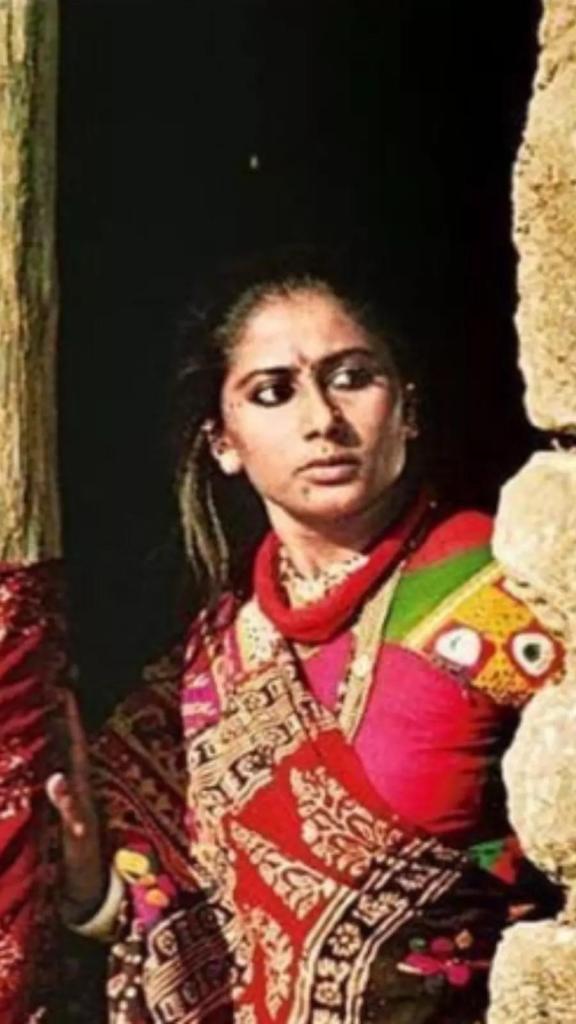
Smita Patil was a renowned Indian actress known for her work in film, television, and theatre. Over a career spanning just over a decade, she appeared in more than 80 films across multiple languages, including Hindi, Bengali, Marathi, Malayalam, and Kannada. During her career, she earned two National Film Awards and a Filmfare Award for her outstanding performances. In recognition of her contributions to Indian cinema, she was honored with the Padma Shri, India’s fourth-highest civilian award, in 1985.
Smita Patil began her career in the early 1970s as a television newsreader on Mumbai Doordarshan, the newly launched Indian government-run broadcaster. Her first film role came in the FTII student film Teevra Madhyam, directed by Arun Khopkar. She was then discovered by acclaimed filmmaker Shyam Benegal, who cast her in his 1975 children’s film Charandas Chor. Patil’s first major role was in Benegal’s Manthan, where she portrayed a Harijan woman who leads a revolt within a milk cooperative.
Bhumika (1977), directed by Shyam Benegal, is a haunting and masterful film based on the memoirs of a renowned Marathi actress. It explores the often tragic dilemma faced by female entertainers in 20th-century India—the “public” woman navigating a complex social world. The film stars Smita Patil, Anant Nag, and Amrish Puri.
Bhumika tells the life story of Usha (played by Smita Patil), the granddaughter of a famous female singer from the traditional Devadasi community of Goa. Patil’s portrayal is widely regarded as one of the finest performances not only in Indian cinema but in world cinema, earning her the National Film Award that year.
Within the narrative, her depiction of various film roles traces the evolution of acting styles in Hindi cinema over three decades and highlights her extraordinary histrionic skills. By portraying an actress navigating the turmoil of sudden fame and stardom, Bhumika brought Smita Patil’s immense talent to the attention of audiences and critics worldwide.
Jait Re Jait (Win, Win) is a 1977 Marathi-language film directed by Dr. Jabbar Patel, starring Mohan Agashe and Smita Patil in the lead roles. The film explores the life and traditions of the Thakkar tribe in Maharashtra, presenting a poignant tale of love and loss in a society far removed from urban life.
The story follows Chindhi (Smita Patil), who chooses to follow her heart, embarking on a challenging journey that ultimately demands a great personal sacrifice. The film sensitively portrays her struggles amid the tribal setup, capturing the trials and aspirations of its protagonists. Jait Re Jait delves into life’s ultimate battles and the price one pays to overcome them, marking a significant moment of glory for Marathi cinema.
Smita Patil delivers one of her finest performances in this film. Jait Re Jait won the Silver Medal for Best Feature Film in Marathi at the National Film Awards, and Patil received the Filmfare Award for Best Actress in 1978 for her powerful portrayal of Chindhi.
Gaman (Departure) is a Hindi film released in 1978, directed by Muzaffar Ali and starring Farooq Sheikh and Smita Patil in the lead roles. The film addresses the challenges and futility of urban migration through the story of a migrant from Uttar Pradesh who moves to Mumbai in search of a better life. Struggling to establish himself, he takes up work as a taxi driver while navigating the hardships of the bustling city.
Aakrosh (Anger) is a 1980 Hindi film directed by Govind Nihalani. The story follows a public prosecutor who uncovers the brutal realities faced by India’s scheduled tribes while defending a tribesman accused of murdering his wife. The narrative centers on a peasant oppressed by landowners and their foremen as he struggles to survive as a daily laborer. Smita Patil plays the wife, who is brutally raped by the foreman, who then conspires to have her husband arrested to conceal his crime. Smita Patil’s haunting portrayal, especially her half-lit face, lingers in the viewer’s memory long after the credits roll.
Chakra is a 1981 Hindi film directed by Rabindra Dharmaraj, starring Smita Patil, Naseeruddin Shah, and Kulbhushan Kharbanda. The film tells the harrowing story of a migrant family seeking refuge in the slums of Dharavi, Bombay, gradually being drawn into the city’s dark and gritty underworld.
Smita Patil plays Amma, a fiercely resilient woman who arrives in Bombay with her young son, Benwa, after fleeing their village in Karnataka. Her husband was murdered after killing a moneylender who had attempted to molest her, and he was later shot dead while trying to steal materials to build a hut. Amma’s character is the heart and soul of the film—fiery, strong, and shrewdly resourceful, she manages to find moments of happiness amidst squalor while fiercely preserving her dignity. Patil’s masterful performance makes it seem as if she was born for this role, carrying the film on her shoulders with unforgettable intensity.
During the making of Chakra, Patil visited the Bombay slums to immerse herself in the environment of her character. As Aroon Purie of India Today noted, “The prima donna for playing the oppressed with her beauty-amidst-dirt looks and her dark expressive eyes, which can project the hopeless exploitation of a thousand years and a raw promiscuous sexuality without a blink, is Smita Patil.”
For this powerful role, Smita Patil won the National Film Award for Best Actress in 1981, as well as the Filmfare Award in 1982.
Sadgati (Salvation) is a 1981 Hindi television film directed by the legendary Satyajit Ray, based on the short story of the same name by Munshi Premchand. The film is a powerful and searing critique of the entrenched social injustices faced by the Dalit community in India. It tells the story of Dukhiya (Om Puri), a poor village cobbler, who lives with his wife Jhuria (Smita Patil). When Dukhiya visits the village Brahmin to fix the date for his daughter’s marriage, the harsh realities of caste oppression unfold with devastating consequences.
Bazaar (Market) is a 1982 Hindi film directed by Sagar Sarhadi. Set in Hyderabad, the film sheds light on the harsh reality of bride buying in India through the tragic story of a young girl sold by desperate parents to affluent expatriate Indians in the Gulf. Najma (Smita Patil) has been living for several years in a modest Bombay flat as the mistress of Akhtar (Bharat Kapoor), whose promises of marriage remain unfulfilled. Their lives change when Shakar Ali Khan, a middle-aged acquaintance of Akhtar’s who has made his fortune in Dubai, arrives. Eager to find a young, virginal bride, Khan convinces Akhtar and Najma to accompany him to Hyderabad, promising to cover all expenses. After some persuasion, Najma agrees, hoping that Khan’s wealth will finally allow her to marry Akhtar. For her powerful portrayal of Najma, Smita Patil was nominated for the Filmfare Award for Best Actress.
Arth (Meaning) is a 1982 film starring Shabana Azmi, Kulbhushan Kharbanda, and Smita Patil. Patil’s role as “the other woman” opposite Shabana Azmi is widely acclaimed for its depth and nuance. The film explores the complex theme of a married man involved in an extramarital relationship—a subject that has been tackled before and after the film with varying success.
Pooja (Shabana Azmi) is emotionally and financially dependent on her husband, Inder Malhotra (Kulbhushan Kharbanda), an ambitious and adventurous film director. Inder, however, is secretly involved with Kavita Sanyal (Smita Patil), a successful actress. Smita Patil’s compelling performance earned her a nomination for the Filmfare Award for Best Supporting Actress.
Umbartha (The Doorstep) is a classic Marathi film that follows the journey of Sulabha Mahajan, played by Smita Patil, a woman who challenges the conservative expectations of her husband and mother-in-law to carve out her own identity. The film tells the story of Sulabha, a gold medalist in sociology, who seeks to move beyond the traditional role of a housewife in a joint family. She accepts a position as Superintendent of a Women’s Reformatory Home in a remote village, far from her home.
Smita Patil delivers a powerful performance in this socially relevant and thought-provoking role. The film poignantly captures Sulabha’s daily struggle to balance her responsibilities at home with her commitment to reforming a corrupt system, a battle that often leaves her frustrated and helpless. Despite numerous moments that could break her spirit, her rock-solid dedication and compassion shine through. With an actress of Smita Patil’s caliber, Umbartha elevates the character to new heights.
For her exceptional portrayal, Smita Patil won the Marathi Rajya Chitrapat Puraskar for Best Actress.
Ardh Satya (Half Truth) is a 1983 film that delves into the struggles of a policeman battling both external evils and his inner demons. The story follows Sub-Inspector Anant Velankar (Om Puri), an upright, strict, and idealistic officer who adheres to the rules even in the most challenging situations. Velankar’s life takes a turn when he meets Jyotsna (Smita Patil), a college professor who offers him emotional refuge from the pressures of a career he was forced into by his abusive father (Amrish Puri).
On the job, Velankar faces off against Rama Shetty (Sadashiv Amrapurkar), a powerful local mafia boss with deep connections in the police and political establishments. Smita Patil’s portrayal of Jyotsna is compelling—she acts as an outsider who challenges Velankar’s worldview and the corrupt system he is part of. Jyotsna stands firm in her beliefs and constantly pushes Velankar to confront the realities around him and within himself.
Giddh (The Vultures) is a 1984 Hindi film directed by T. S. Ranga, starring Smita Patil, Om Puri, and Nana Patekar. The film received the Special Jury Award at the 32nd National Film Awards for its poignant and in-depth portrayal of the helplessness faced by people struggling against the oppressive Devadasi tradition.
Set in Karnataka, the story centers on Hannumakka (Smita Patil), a devadasi—an initiate or devotee of the village goddess Yellamma, who is both worshipped and feared. Om Puri plays Bachiya, a jack-of-all-trades and a kind of pimp who stays close to Hannumakka and her sister, who has a daughter named Lakshmi. The film explores the villagers’ struggle with poverty and the efforts of Hannumakka, Bachiya, and the village teacher to protect Lakshmi from falling into a life of prostitution—either directly or indirectly through initiation as a devadasi to the goddess Yellamma.
Hannumakka’s character powerfully expresses the pain and dissatisfaction of a woman trapped in the devadasi system.
Mandi (Market Place), directed by Shyam Benegal and released in 1983, is a black comedy featuring a stellar ensemble cast, an intelligent script, and a challenging social theme. The film centers around the lives of women in a red-light district and deftly critiques societal hypocrisy and politics surrounding morality.
Smita Patil plays Zeenat, a courtesan who, unlike many others in the kotha (brothel), is allowed to spend her days practicing classical music and Kathak dance, preserving her art rather than succumbing to the more lascivious demands of the customers. Her character embodies grace and dignity within a harsh environment, highlighting the complexity and humanity of women often marginalized by society
Debshishu is a 1985 Hindi-language film directed by Utpalendu Chakrabarty, starring Smita Patil and Om Puri. Notably, Smita Patil worked on this film without remuneration, reflecting her commitment to its powerful and realistic message. The film explores themes of poverty, illiteracy, and natural calamities, and the profound toll they take on the human spirit.
The story follows a rural couple struggling to survive on the road along with many others after their village is devastated by a flood. The wife gives birth to a deformed baby, who is condemned as a ‘child of the devil’ by the local pundit (Hindu priest). Under the priest’s pressure, the couple is forced to abandon their child and are subsequently exiled from their community. Their harrowing journey leads to a bizarre and heart-breaking conclusion, highlighting the brutal social stigmas and hardships faced by the marginalized.
Chidambaram is a 1985 Malayalam film written, directed, and produced by G. Aravindan. The title refers to the temple town of Chidambaram in Tamil Nadu, with “Chit” meaning mind and “Ambaram” meaning space, symbolizing the film’s exploration of inner consciousness.
The film delves into the complex relationships between men and women, focusing on themes of guilt and redemption through the lives of three people living on a cattle farm. The lead roles are played by Bharath Gopi, Smita Patil, Sreenivasan, and Mohan Das.
The story centers on Muniyandi (Sreenivasan), a laborer who respects the farm’s office superintendent, Shankaran (Bharath Gopi). Muniyandi brings his wife Shivakami (Smita Patil) to the farm after their marriage, and she soon befriends Shankaran. However, when Muniyandi catches Shankaran with Shivakami, he is shattered and tragically commits suicide. Consumed by guilt, Shankaran leaves the farm and seeks escape through alcohol, spirituality, and various means, but finds no relief from his torment.
Eventually, Shankaran arrives in the temple town of Chidambaram, where he discovers Shivakami working as a shoe keeper at the temple. The film’s poignant narrative and profound themes earned it the National Film Award for Best Feature Film and five Kerala State Film Awards.
Mirch Masala (Hot Spice), released in 1987, saw Smita Patil reuniting with director Ketan Mehta to portray the feisty and fiery Sonbai. Patil’s powerful performance as a spirited spice-factory worker who bravely stands up against a lecherous petty official received widespread acclaim. On the centenary of Indian cinema in April 2013, Forbes recognized her role in Mirch Masala as one of the “25 Greatest Acting Performances of Indian Cinema.” The Washington Post described her work in the film as an “enigmatically feisty last performance,” highlighting its lasting impact and intensity.
As her reputation grew, commercial filmmakers like Raj Khosla, Ramesh Sippy, and B. R. Chopra began offering Smita Patil roles, acknowledging her as an “excellent” actress. Her fan base expanded alongside her rising stardom. Patil’s glamorous roles in popular films like Shakti and Namak Halaal demonstrated that an actor could successfully navigate both serious, parallel cinema and mainstream Hindi “masala” films.
However, her sister Manya Patil Seth revealed that Smita was never truly comfortable in big-budget commercial movies. She once wept after performing a rain dance with Amitabh Bachchan in Namak Halaal, feeling conflicted and believing she wasn’t doing the right kind of work.
Director C. V. Sridhar was the first to pair Smita Patil opposite Rajesh Khanna in Dil-E-Nadan (1982). Following the success of this film, the duo starred together in several other notable films, including Aakhir Kyon?, Anokha Rishta, Angaarey, Nazrana, and Amrit. With the release of Aakhir Kyon?, Patil’s popularity and her on-screen pairing with Khanna reached their peak. The film’s songs, “Dushman Na Kare Dost Ne Woh” and “Ek Andhera Lakh Sitare,” became chartbusters.
Each of these films addressed different social issues, and the performances of Patil and Khanna were widely praised by critics. In 1986, Amrit, directed by Mohan Kumar, became the fifth highest-grossing film of the year. Nazrana, co-starring Sridevi, was released posthumously and also achieved commercial success, ranking among the top 10 films of 1987.
Patil gradually transitioned to more commercial cinema. In an interview, she reflected on this shift: “I remained committed to small cinema for about five years… I refused all commercial offers. Around 1977–78, the small cinema movement started gaining momentum and they needed names. I was unceremoniously dropped from a couple of projects. It was subtle, but it affected me deeply. I told myself, ‘Here I am, and I have not bothered to make money. I have turned down big commercial offers because of my commitment to small cinema—so what have I got in return?’ If they want names, I’ll make a name for myself. So I started taking whatever came my way.”
Smita Patil worked with some of India’s most esteemed directors, including Govind Nihalani, Shyam Benegal, and Mrinal Sen. She delivered powerful performances in numerous Hindi and Marathi films, earning her the title of the queen of Indian cinema. For a time, she also worked as a television newsreader and was an accomplished photographer, showcasing her multifaceted personality.
Dominating the Indian film industry during the 1970s and 1980s, Patil’s characters often embodied an intelligent and strong femininity that stood out against the predominantly male-centric narratives of the time. A committed women’s rights activist, she became renowned for portraying women as capable, empowered, and complex individuals, making a lasting impact both on and off the screen.
Smita Patil is one of the few truly versatile Indian actresses who has carved a special place in the hearts of audiences. She was indeed the pride of Bollywood, known for delivering superb performances that continue to be admired and celebrated to this day.
Apart from her acting career, Smita Patil was a passionate feminist and an active member of the Women’s Centre in Mumbai. She was deeply committed to advancing women’s issues and lent her support to films that explored the roles of women within traditional Indian society as well as the challenges faced by middle-class women in urban environments.
In 1984, Smita Patil served as a jury member at the Montreal World Film Festival, highlighting her stature and recognition in international cinema.
In 1986, the Priyadarshni Academy established the Smita Patil Memorial Award as a tribute to the veteran actress, honoring her enduring legacy and contributions to Indian cinema.
In 2011, Rediff.com ranked Smita Patil as the second-greatest Indian actress of all time. According to Suresh Kohli of the Deccan Herald, “Smita Patil was, perhaps, the most accomplished actress of Hindi cinema. Her oeuvre is outstanding, investing almost every portrayal with a powerhouse of realistic performance.”
In 2012, the Smita Patil International Film Festival for Documentaries and Shorts was inaugurated in her honor, celebrating her lasting impact on Indian cinema.
On the occasion of 100 years of Indian cinema, India Post released a postage stamp featuring Smita Patil’s image on 3 May 2013, paying tribute to her remarkable contribution to the film industry.
Photos courtesy Google. Excerpts taken from Google.
 Writer Sunita