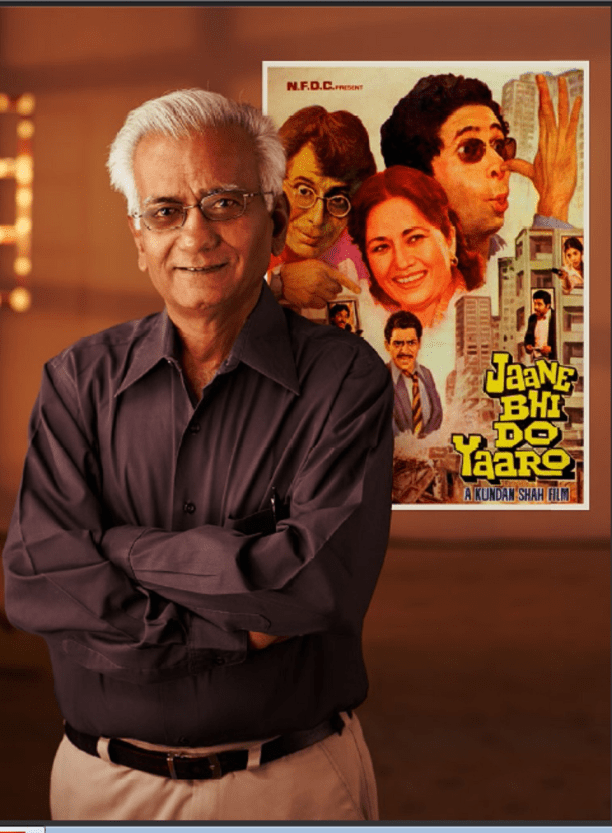
Kundan Shah was an Indian film director and writer. He is most known for his comedy classic Jaane Bhi Do Yaaro (1983) and his 1986–1987, TV series Nukkad with Saeed Akhrar Mirza.
Shah studied direction at the Film and Television Institute of India in Pune and he developed an interest in the comedy genre.
Jaane Bhi Do Yaaro (Let It Go, Friends) is a 1983 Hindi language satirical black comedy film based on the rampant corruption in Indian politics, bureaucracy, news media and business. Kundan Shah won the 1984 Indira Gandhi Award for Best Debut Film of a Director for his work. The film was part of the NFDC Retrospective at India Internation Film Festival in 2006. Film is reflected in a recent comment by Indian Express that the film’s high recall value even after 37 years, is due to “it(s) superb satirical depiction of the essential, timeless, human condition: supreme self-interest versus some moral/ethical anchor. What made the depiction particularly powerful was its setting: India of the early ’80s”. A digitally restored print of the film was released on 2 November 2012 at selected theaters. The film opened to an enthusiastic welcome from the media and discerning filmgoers.
Shah then started to work in television. He was one of the directors of the popular sitcom Yeh Jo Hai Zindgi, which started telecast in August 1984.
He became a partner of Iskra, a company founded by Saeed Akhtar Mirza, Aziz Mirza and others. In 1985–1986 he directed the TV series Nukkad (Street Corner) with Saeed Akhta Mirza. Series aired on DD National in 1986–87. It was directed by Kundan Shah and Saeed Akhtar Mirza. Nukkad dealt with the struggles of the lower income labor class in cities. A disenfranchised bunch of people, a nondescript street corner in Bombay and a story of luckless (bu t not love-less) lives. The serial received tremendous response from the viewers and some of the characters such as Khopdi, Kaderbhai and Ghanshu Bhikari became household names. The first season of Nukkad, aired in 1986–87 had 40 episodes. A sequel series titled Naya Nukkad premiered in 1993.
Wagle Ki Duniya (‘Wagle’s World’) is an series that aired on DD National from 1988 to 1990. It was was based on characters created by noted cartoonist, R. K. Laxman, especially “the common man” about the issues of common middle-class Indian man. The series was set around everyday struggles, of nervous sales clerk, Srinivas Wagle, who lived with prudence of a middle class person of the time.
After directing several serials, Shah took a long break of 7 years from cinema.
Shah made his comeback to cinema in 1993. He directed the famous Kabhi Haan Kabhi Naa (Sometimes yes, Sometimes no) and wrote the screenplay for the film. A dreamer falls for a girl who is in love with someone else and tries to create a rift between her and the man she loves. The film was another comic love story but it also displayed new aspects to it s credit – it was the first time that the hero in the film was an absolute loser. The film was much acclaimed. In 1994, Shah won the Filmfare Critics Award for Best Best Movie for the film. He was the first filmmaker to win this award.
In 1998, Shah directed another acclaimed film, Kya Kehna (So well said). Due to delay, the film released in 2000 and became the surprise hit of the year. The film dealt with the socially controversial issue of single parenthood and premarital pregnancy. Preity Zinta gave a critically appreciated performance in the lead role of a teenage single-mother who tries to overcome the values of her society. Upon its theatrical release, it was positively reviewed by critics. Zinta’s performance and Irani’s story writing was highlighted. The film was a box office success and emerged as one of the highest-grossing Bollywood films of 2000, and was declared a “super hit” in India. The film’s success was unexpected At Filmfare Awards, Irani won the Best Story category and Zinta was nominated for Best Actress. Mimmy Jain of The Indian Express, in a positive review, commended Shah for making “a sensitive film, on a sensitive subject”, calling Kya Kehna ” a film that should have been made years ago”.
Hum To Mohabbat Karega (I Will Love He Always) is a 2000 Indian Hindi thriller-comedy film. This film was inspired by the 1981 Hollywood film Eyewitness. Raju is a waiter in a hotel and often works as a friend for his superior Kutti. He likes TV reporter Geeta Kapoor. Geeta is searching for her brother, who went missing on a top-secret mission for the same channel she works with. Destiny fulfills their dreams in a way they had never imagined in their wildest dreams.
Dil Hai Tumhaara (My Heart Is Yours) is a 2002 Hindi romantic film was promoted as a star vehicle for Zinta. Zinta’s performance was praised by critics and earned her nominations for Best Actress at a number of award ceremonies. Manish Gajjar from the BBC described the film as engaging, and liked the “emotional story” where “Shah explores the sensitive issue of a mother-daughter relationship”
Photo courtesy Google. Excerpts taken from Google.
 Writer Sunita