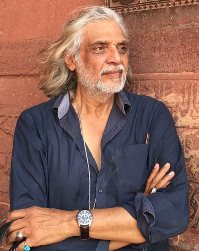
Muzaffar Ali is an Indian filmmaker, fashion designer, poet, artist, cultural revivalist, and social worker. Ali worked in advertising before turning to film. His first films were Gaman (1978) and Umrao Jaan (1981).
Gaman (Departure) is a Hindi film released in 1978. The film deals with the issue of the futility of urban migration, using the story of a migrant from Uttar Pradesh to Mumbai, who tries to find a foothold in his new life as a taxi driver.
In order to improve their lifestyle, Ghulam Hasan (Farooq Shaikh), who hails from Lakhimpur Kheri, a town in Uttar Pradesh, decides to relocate to Bombay, on the insistence of his close friend Lalulal Tiwari (Jalal Agha). He leaves behind his ailing mother and wife (Smita Patil). Lalulal helps him get a job cleaning taxis. Ghulam subsequently learns how to drive, and is hired to drive a taxi. In spite of his best efforts, he is unable to save enough money to visit Lucknow and his family. Lalulal has problems of his own, in spite of being settled in Bombay for several years. Having a sweetheart, Yashodra (Gita Siddharth), he is unable to even rent a decent apartment, and lives in a shanty tenement, which is slated to be demolished by the Bombay Municipal Corporation. Ultimately, Lalulal and Yashodara are murdered by the latter’s family, as the family wants Yashodara to support them instead of marrying Lalulal. Ghulam decides to return to Lucknow, but procrastination prevents him from doing so. Closing shots show him driving his taxi in the city of dreams.
Muzaffar Ali directs with impeccable details. He explores the underbelly of a city through the eyes of Ghulam, a compassionate soul who is disturbed by the death of even the unknowns. Ramprasad hails from his city and guides Ghulam by initiating him into driving a taxi. The simple village youth looks at his future with hope even as he observes the struggle of Lallulal and his lady love Yashodhra (Gita Siddharth). The harsh reality of life in Bombay is best captured by a casual “Colaba mein 4143 ka accident ho gaya aaj.” The dead driver is identified by the car’s registration number. For Ghulam it is shattering because the accident takes away Ramprasad, his mentor. In a symbolic gesture the camera pans on an aircraft that takes off and disappears into the horizon even as Hariharan breaks into a poignant “Ajeeb Saneha Mujh Par Guzar Gaya Yaro…..”
Muzaffar Ali delves on different facets of life in Bombay to illustrate the diversity, the rich and the poor sharing their pain and ecstasy, through the medium of a taxi. A rich businessman looking for carnal pleasures, the skyscrapers mocking at the neighbouring shanties, a Parsi passenger giving a comic but and telling discourse on the degeneration of values, the backseat conversations, mostly pompous and sometimes self-deprecating, educating Ghulam on the challenges of life in a city, are some of the rich vignettes in this compelling narration. Ghulam’s predicament is so movingly highlighted by Suresh Wadkar’s soulful “Seene Mein Jalan Aankhon Mein Toofan So Kyon Hai”. The lyrics capture the essence of a city life so beautifully, not to forget the “three rupees and fifteen paise” fare that he demands from a petite Protima Bedi. A taxi ride in three rupees and fifteen paise!
Ghulam stays in touch with his ailing mother and a pining wife through letters. Even as he shares the dark side of the city with them, the two ladies of his life wish he return to the tranquil surroundings of their village. Khairun’s grief of being away from her husband is driven home by Chhaya Ganguly’s “Raat Bhar Aap Ki Yaad Aati Rahi”. Shattered by the murders of Lallulal and Yashodhra, a grief-stricken Ghulam decides to return to his family. But his dilemma is captured conclusively by the train that he watches roll past before returning to his taxi. There is not one flawed performance in this classic gift to meaningful cinema by Muzaffar Ali, Farooq Sheikh and Smita Patil.
The film’s music was by Jaidev, who won the National Film Award for Best Music Direction in 1979 for his work, and for the Song “Aap ki Yaad Aati Rahi”, Chhaya Ganguly won a National film Award for Best Female Playback Singer. Shahraya wrote songs for the film.
Umrao Jaan is a 1981 Indian period musical drama film based on the 1905 Urdu novel Umrao Jaan Ada, the film tells the story of a Lucknow courtesan and her rise to fame.
In the year 1840, a girl named Amiran is kidnapped from her family in Faizabad and sold to Khanum Jaan, the madam of a brothel in Lucknow who teaches young courtesans. Renamed Umrao Jaan, Amiran turns into a cultured woman trained to captivate men of wealth and taste. Umrao catches the eye of Nawab Sultan and the two fall in love, but the relationship comes to an end when Nawab reveals he must marry in order to please his family. Umrao then becomes infatuated with bandit chieftain Faiz Ali, who woos and wins her heart. She elopes with him, but is forced to r eturn to Lucknow after Ali is killed by local police. Some time later, British forces lay siege to Lucknow and the residents evacuate the city. Umrao’s party of refugees stops in a small village, which Umrao recognizes as Faizabad. The residents fail to recognize her, however, and ask her to dance for their pleasure. Afterwards, she reunites with her family, who believed her to be dead. Her mother is happy to welcome Umrao back, but her brother forbids it and orders Umrao to never return. She returns to Lucknow to find the brothel looted and deserted.
Rekha’s National award-winning performance as Umrao Jaan remains the crowning glory of her career. Her range as an actor is on full display; she portrays shyness, love, affection, seduction, compassion, and pain with utmost ease. Her dance, mannerisms, and expressions in the song sequences continue to be discussed among actors, film scholars and critics. The painter in Ali accentuated Rekha’s beauty through some mesmerising visuals, juxtaposing pathos with beautiful costumes and jewellery of mid-19th century Lucknow.
The immaculate set design and backdrops stand out in Umrao Jaan, for which it won the National Award for Best Art Direction. The attention to detail can be seen in the colourful lanterns, carpets, curtains, furniture and the interiors of the brothels, which brought alive the Nawabi era. Umrao Jaan is remembered to this day primarily for its melodious and soulful ghazals. Regarded as one of the best soundtracks in Hindi cinema, Khayyam won the National Film Award for Best Music Direction. Asha Bhonsle, as the playback voice of Umrao Jaan, immortalised the songs through her heart-wrenching renditions. She received her first National Award for the film’s song, ‘Dil cheez kya hai’. Songs like ‘In aankhon ki masti ke’ has kept the legacy of yesteryear music and classics like Umrao Jaan alive.
Aagaman is a 1982 Hindi language film directed by Muzaffar Ali and produced by Uttar Pradesh Sugarcane Seed and Development Corporation unde r the banner of Integrated Films. The plot involved the politics and working techniques of Uttar Pradesh sugarcane co-operative societies. In November 2012 the film was shown at the 43rd International Film Festival of India.
In a village of Awadh, sugarcane planters are exploited by mill owner (Bharat Bhushan). A young man (Suresh Oberoi) returns to this village after receiving a degree in law from a reputed university of Lucknow. Seeing the poor condition of planters, he urges them to stop selling their sugarcane to the mill owner and instead start their own co-operative mill. The mill owner, his landlord-agent (Saeed Jaffrey) and son discourage the villagers from doing so. The mill owner’s son urges the people to form a planter’s union and continue selling their crop to the mill. Initially, the villagers trust him, but after continuous persuasions from the young man and realising that only self-sufficiency can improve their condition, they unite and set up their own mill. In the end, the young man marries a village girl (Deepa), who was very active in the movement.
In an article published in 2012, Business Standard noted that “To Muzaffar Ali goes the credit of portraying Awadh truthfully on cinema.”. Sumit Mitra of India Today called it a disappointing film and criticised Ali’s film-making technique and cinematography. He added that “Ali’s approach to direction is more that of film club enthusiast than film maker” and the lyrics used were “totally out of context”. Mitra criticised the promotional nature of the film by saying that the state owned co-operative societies have dominated the market, but praised Saeed Jaffrey’s acting.
Anjuman (Congregation) is a 1986 Hindi drama film directed, story, screenplay, and produced by Muzaffar Ali. Set in Lucknow, it deals with exploitation of women and problems of local “chikan” embroidery workers.
The sensitive Anjuman (Shabana Azmi) does chikan work to augment her extended family’s income. She is courted by a phoney poet, Banke Nawab (Khan), who has control over the chikan workers, but she falls in love with her wealthy but weak neighbour Sajjid (Farooq Shaikh). Encouraged by her doctor friend Suchitra Sharma (Rohini Hattangadi). Anjuman demands fair treatment for the chikan workers but the pressure on her to marry the exploitative Banke grows. She finally says ‘No’ during the wedding ceremony and has to face the wrath of Banke who incites a riot among the Muslims in the town. Anjuman then becomes a feminist labour activist and earns the admiration of her beloved Sajjid.
Jaanisaar is a 2015 Hindi language film, is a love saga of a revolutionary courtesan of Avadh, India, Prince brought up in England, set 20 years after the first war of Indian Rebellion of 1857.
The Story Revolves around Prince Amir Haydar, Noor and Mir Mohsin Sahab. Raja Amir Haydar, A Prince from a Princely State of India Son of Nawab Raja Abbas Haydar after the death of his Father. He is sent to London by the Britishers and comes back to India after completion of his Studies. Noor, A Dancer who fights against the Britishers Secretly in the Organization made by Mir Mohsin. Jaanisaar marks the comeback of director Muzaffar Ali, who is known for his cult film Umrao Jaann (1981). The film was initially titled Raqs: The Dance Within, but was later changed to Jaanisaar. Muzaffar Ali said in an interview− “People would often ask me what ‘Raqs’ means, so I thought of calling the film something that was more familiar, like ‘Jaanisaar’. There were also some problems with registering the name. ‘Raqs’ is already registered with a body, I wasn’t aware of. So, we had to rename the film.” Regarding the story-line, Ali commented− “I feel our own people need to learn certain parts of our history to become more responsible citizen. History is written into two ways — written by conqueror and the other one is the human history. I felt this story has to be told. The country needs to know this story.” The debut of Pernia Qureshi, who is a notable fashion stylist and costume designer by profession. Regarding her appearance in the film, Muzaffar Ali remarked, “Pernia is different. I needed a strong dancer and at the same time a fresh face. She really danced her life out into the film. She did a very good job of a revolutionary dancer.” Playback singers for Jaanisaar include notable Indian and Pakistani artists such as Shreya Ghoshal, Abida Parveen and Sukhwinder Singh and famous folk singer Malini Awasthi. The music has been composed by Muzaffar Ali & Ustad Shafqat Ali Khant.
Muzaffar Ali on turning his Sufi festival – Jahan-e-Khusrau – into a cultural retreat, moving it from Humayun’s Tomb to Tijara Fort Palace for an immersive experience, his new musical ballet and the artistic expression or lack thereof in the current times. At House of Kotwara, filmmaker, poet, painter and fashion designer Muzaffar Ali’s home located just off Gurgaon-Faridabad Highway, folk singer Malini Awasthi is perched on a vivid auburn Mughal carpet alongside her accompanying musicians. She is crooning a ghazal by Bedam Shah Warsi – Parde uthe huye hain, unki idhar nazar hai – a piece not usual for her Awadhi and Bhojpuri folk concerts wherein, sometimes, in all the excitement, a lot of the soul gets l ost. But in Ali’s ink-blue living room, with almost every wall adorned by a mammoth oil on canvas and books on art in every nook and cranny, Awasthi sounds like a sovereign artiste – the world of Sufi folk slowly finding home with her as she brings out the melody paired with poetry of the times gone by.
“The creative ecosystem within me was going through a sea change,” said Ali. “My kind of film was in the doldrums, so painting became a way of expressing myself. It happened very organically and naturally.” “Painting was my earliest form of creative…
Muzaffar Ali is essentially a painter, filmmaker and designer with a discerning eye and a vision for aesthetics and humanity. He was deeply inspired by Sufism while making his feature film ‘Zooni’ in Kashmir on the 16th-century poetess queen, Habba Khatoon. Muzaffar Ali has also made scores of television serials, documentaries and short films, mainly centered on Awadh, craft, culture, exploitation of women and Sufism. In 1991, he turned back to his roots in Kotwara and Lucknow, establishing the ‘Dwar Pe Rozi’, Employment at Doorstep movement through craft under the aegis of Kotwara Welfare Trust. Paintings are an organic extension of Muzaffar Ali’s aesthetics which has guided his intellectual and spiritual quest. For him, paintings are a dialogue of sensibilities that know no boundaries. He held his first solo show of paintings at the Academy of Fine Art in Calcutta in 1968 and has continued his journey moving with ease between sketches, watercolours, crayons, oils, installations and collages. He was awarded the Yash Bharti Award in 1994, Padma Shri in 2005 and the Rajiv Gandhi Rashtriya Sadbhavana Award in 2014. In 2004, Muzaffar Ali instituted the Rumi Foundation, which holds several Sufi festivals including the Annual World Sufi Music Festival, Jahan- e-Khusrau and the Wajid Ali Shah Festival of Conserving Cultures. The Foundation publishes regular coffee table books on Sufism. “For me and many others like me, a car is a toy. Every time I see a car, a certain playfulness awakens within me. The automobile is the greatest cult the human race has discovered for itself, both in war and peace.” ~ Muzaffar Ali.
Photo courtesy Google. Excerpts taken from Google.
 Writer Sunita