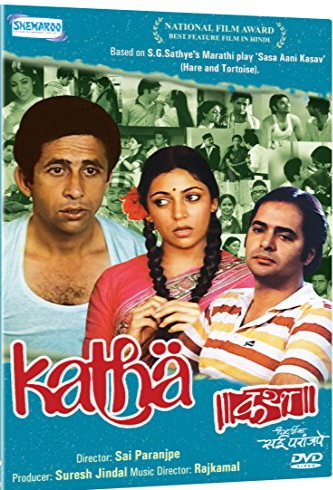
Katha (Story) is a 1983 Indian romantic comedy directed film by Sai Paranjpye are starring Farooq Sheikh, Naseeruddin Shah, and Deepti Naval in the main roles. The film is based on the classic folktale of the hare and the tortoise, providing a modern interpretation. It is based on S. G. Sathye’s Marathi play ‘Sasa Aani Kasav‘ (Hare and Tortoise).
The film is about the daily lives of people living in a Mumbai chawl. The tortoise — Rajaram P. Joshi (Naseeruddin Shah) — is a middle-class clerk living in a chawl (a common lower middle-class apartment complex which has several families living in small rooms with common toilets) in Bombay. He is secretly in love with his neighbour Sandhya Sabnis (Deepti Naval), but is unable to express his love due to his timid nature. Rajaram is a good natured and hardworking man. His neighbours and colleagues take advantage of his simplicity.
One day Rajaram’s childhood friend Vashudev (Farooq Shaikh) – he prefers the hip nickname “Bashu” – the hare — comes visiting as a house guest and makes himself at home in the chawl. Bashu makes a good impression on everybody by his charming, friendly behaviour, his extraordinary good looks and exaggerated stories of success.
Bashu starts wooing Sandhya, and she falls in love with him. He then joins Rajaram’s company Footprint Shoes by impressing the owner Mr. Dhindhoria with untrue stories about his work experience and his newfound love of golf. Dhindhoria has a passion for golf and is easily impressed. Typically, Bashu soon starts flirting with Dhindhoria’s beautiful and young wife Anuradha (Mallika Sarabhai) as well as his daughter Jojo (Winnie Paranjape) by his first marriage, courting both women at the same time.
In the chawl, meanwhile, the Sabnis family decides to get Sandhya married to Bashu much to Rajaram’s shock and disappointment. But on the day of the engagement Bashu disappears. The footloose and fancy free youth does not wish to be tied down by marriage. The engagement is called off. Rajaram then offers to marry the devastated Sandhya, but she hints that she has been very intimate with Bashu and is therefore unworthy of Rajaram. Still, Rajaram shows his love by offering to accept her and finally expresses his long repressed love towards her. They get married. Meanwhile, Bashu ensnares an Arab employer and flies off to the Middle East on his next adventure.
Sai Paranjpye shows her gentle touch in Katha, offering characters who are real, relatable, and engaging. Katha offers adorable humor without outlandishness, real-life believable situations that make the audience laugh because it’s not difficult to project them onto ourselves and our neighbors. The portrayal of life in the chawl is particularly charming and satisfying, and is itself a reason to see the movie for anyone interested in workaday Indian life. The chawl is a tight-knit community is like a small village, a great joint family, in which individuals and families live in small flats centered on a common courtyard and shared water and other utilities. There is a bitter barren woman who yells at children playing in the courtyard; a newlywed couple who rarely emerge from their rooms, a disabled man who asks incessant favors from every visitor; a grandma who cooks yummy snacks for every young visitor she receives; a couple, whose son is a doctor in Canada, who love nothing more than to show off their richly appointed flat and their refrigerator and television.
The principals’ performances are all executed without flaw, especially those of Naseeruddin Shah and Farooq Shaikh. Naseeruddin Shah is at his droopy, sad-sacky best; Rajaram wears his frustration physically as Bashu runs circles around him, projecting a confused and adorable mixture of disdain and admiration for his friend’s antics. And Farooq Shaikh nails Bashu’s puff-chested confidence to perfection. The joke which Paranjpye lets the audience in on – a joke that escapes Bashu – is that Bashu is nothing more than a small-time con, not half the player he thinks is. A marked departure, Sai Paranjpye’s morally uplifting tale gives Sheikh a role he had never played before, bordering on the anti-hero / antagonist. Okay, let’s just agree to call Katha’s Bashu (Sheikh) a ‘loveable rogue.
And so, as in the titular fable that provides the film’s bookends – the story of the tortoise and the hare – Katha ends with the satisfying feeling that the wheel will turn and both Bashu and Rajaram will get what they deserve from the universe. And we, the audience, get a warm, delightful, and utterly charming film, another very, very fine feather in Sai Paranjpye’s cap.
Photos courtesy Google. Excerpts taken from Google.
 Writer Sunita