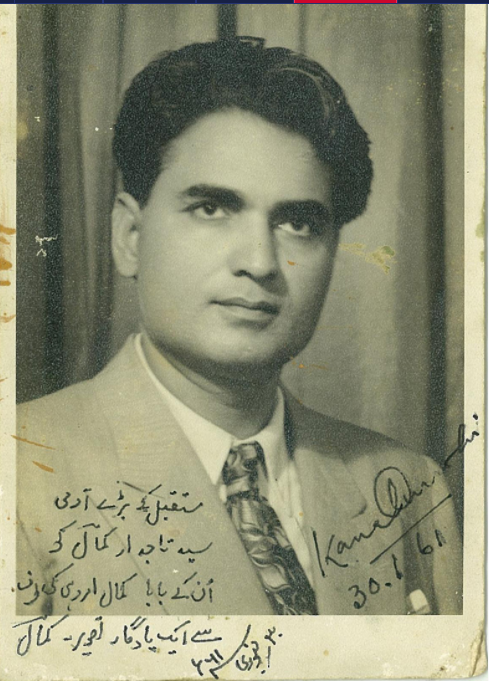
Syed Amir Haider Kamal Naqvi, popularly known as Kamal Amrohi, was an Indian film director and screenwriter. Kamal Amrohi is best known for Pakeezah, the musical classic. He was also an Urdu and Hindi poet. Amrohi’s cinema was commercially successful and elegant, showcasing his great eye for detail. His movies told stories of lovers who were unable to cross the boundaries of social conventions (Pakeezah), tradition or marriage (Daera).
In 1938, he left Amroha to study in Lahore, now part of Pakistan, where singer K. L. Saigal discovered him and took him to Mumbai (Bombay) to work for Sohrab Modi’s Minerva Movietone film company, where he started his career working on films like Jailor (1938), Pukar (1939), Bharosa (1940), A. R. Kardar’s film (Shahjehan 1946).
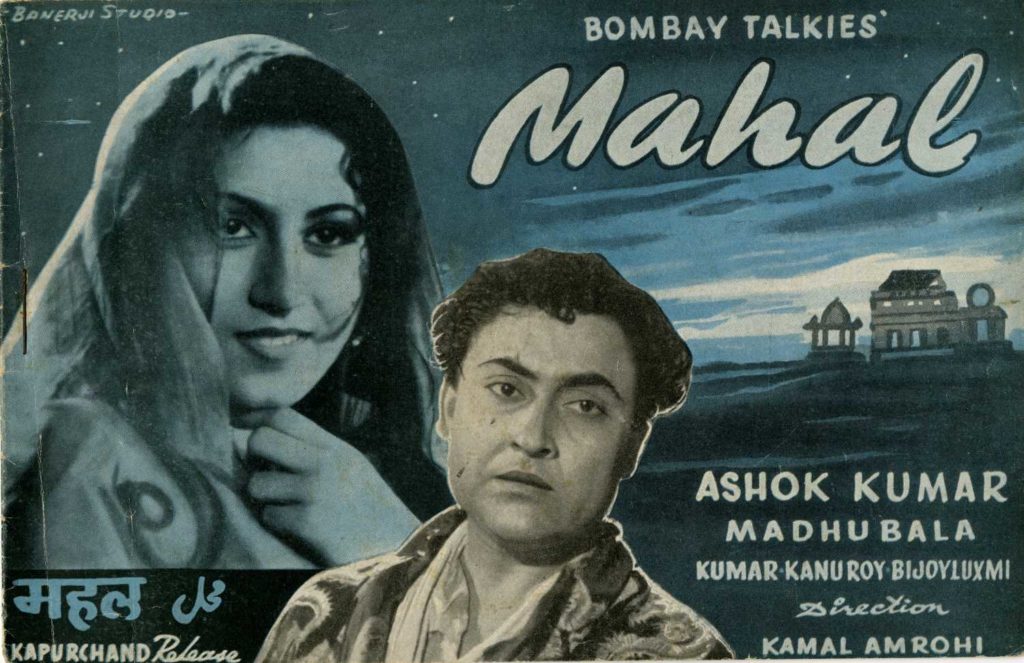
He directed only four films; of these were Mahal (“Mansion”) (1949) for Bombay Talkies, a reincarnation movie that set the film world alight. The film centres on a screenplay written by Amrohi. He was just 30 years old when he pitched the idea to Ashok Kumar. Cited as Bollywood’s first horror film, it revolves around an aristocrat (Ashok Kumar) who moves into an ancient mansion, where he gets visions of a mysterious lady (Madhubala) claiming to be his lover in their previous lives. Amrohi received acclaim for his deft use of chiaroscuro (the treatment of light and shade) as well as its music, including ‘Aayega aanewala’, one of Lata Mangeshkar’s first big hits in Hindi. It emerged as one of the biggest hits of the decade as well as the biggest financial success in Bombay Talkies’ history. The film’s success paved the way for Indian gothic fiction. Mahal has influenced a number of horror films since its release. It was listed in British Film Institute’s list of “10 great romantic horror films” and ScoopWhoop’s “14 Bollywood Horror Movies That You Just Can’t Watch Alone”.
Daaera (Circle) is a 1953 Hindi film written starring Meena Kumari and Nasir Khan. Story of film was a 16-year-old girl who was forced to marry a man much older than her, but fell in love with a younger neighbour boy. Called “far ahead of its time”, Daera bombed at the box office, but it was important for another reason — it was the first collaboration between Amrohi and Meena Kumari.
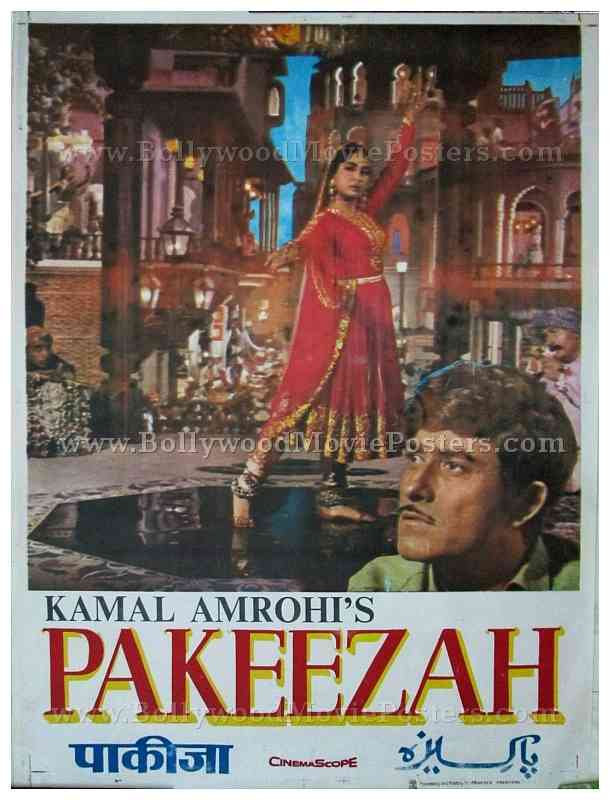
Pakeezah (The Pure One) is a film tells the story of Sahibjaan, a Lucknow – based courtesan or dancer, popularly known as tawaif. While asleep on a train, Sahibjaan receives a note from a stranger praising her beauty. Later, evacuating from a broken boat, she takes shelter in a tent and finds out its owner, a forest ranger named Salim, wrote the letter. Sahibjaan and Salim plan to get married, causing conflicts with Sahibjaan’s professional background.
He also wrote the screenplay, lyrics and produced this film. Amrohi had poured his heart, soul and personal fortune into the film. The film was initially shot in black and white, then re-shot in colour, and then again in CinemaScope. Film has been called one of the extraordinary musical melodramas ever made in India, although flawed but noble. The music by Ghulam Mohammed, of course, is one of the most legendary soundtracks in Indian film history — songs like ‘Chalte chalte’, ‘Thade rahiyo’ and ‘Inhi logon ne’ that remain on people’s lips even 47 years later. Meena Kumari herself, in her public comments to the press, after seeing the movie, said that it was Kamal Amrohi’s tribute to her.
Pakeezah addresses prostitution and belongs to the Muslim social genre, a Bollywood film category exploring Muslim culture in the usual settings of Lucknow, Lahore, and Delhi that became popular in the 1930s. Films of the genre generally follow the romantic stories of members of a Nawab family. In Pakeezah‘s narrative, Nargis and Sahibjaan present as Lucknow-based tawaifs (entertainers) who fall in love with Shahbuddin and Salim, members of nawab families, respectively. Other aspects of Muslim culture, such as dance and costumes, are vital to the plot. Pakeezah follows society’s rejection of prostitution; at the film’s beginning, Shahbuddin arrives at his home with Nargis, whom he is preparing to marry. His father rejects Nargis, shouting, “She’s not my daughter-in-law. She’s your sin.” The film also aims to capture Islamic traditions; in the ending, Sahibjaan is revealed by Shahbuddin to be the daughter of Nargis, whom his family rejected. Salim is also part of the family, being the son of Shahbuddin’s brother. Sahibjaan and Salim s ubsequently marry, which her father requests before his death; this is not exceptional for a Muslim marriage – marriage between paternal cousins legal under Islamic law.
Film analysts have considered the first encounter of Salim and Sahibjaan to be one of the most erotic scenes in the film. Salim and Sahibjaan meet in their respective railway journeys when Sahibjaan is sleeping and Salim enters her compartment and is amazed by her feet, placing a note there saying, “Aapke paon dekhe, bahut haseen hain. Inhein zameen par mat utariyega… maile ho jaayenge” (“I saw your feet. They are really beautiful. Please do not step on the ground… avoid making them dirty”).
Voiceovers done by Amrohi play a significant role in Pakeezah, which several film analysts found to be his finest work. In the film’s opening minutes, voiceover is used to identify Nargis as a courtesan with a “mesmerising voice” and whose tinkling of bells are “a sensation all over”, and is the younger sister of the character Nawabjaan. Sound motifs are used throughout the film; for instance, a train whistle represents Sahibjaan’s hopes of escaping from her brothel and the alap represents her sadness. A number of symbols, such as a bird with clipped wings and a snake in Sahibjaan’s brothel, are used to represent struggles in Kumari’s personal life.
Pakeezah attained cult status and became a milestone in Bollywood, particularly for its depiction of Muslim culture. Pakeezah established Amrohi’s image as a prominent director. According to Raheja, Amrohi narrates “a story imbued with the despair and the euphoria of human desires so deftly that you are caught up in the swirl of the visual maximalism in the fanciful, almost surreal setting. And by the romanticism of the wish-fulfillment end.” Amrohi said the film’s success prompted many producers and actors to express their desire to collaborate with him.
According to the academic Sumitra S. Chakravarthy, Pakeezah is a film in which “high drama and spectacle combine with a fine evocation of the niceties” of Muslim culture and Urdu, the language used by most Indian Muslims.
Pakeezah remained one of the most-talked-about Indian films decades after its release, and many books, including their chapters, and articles have been written about it. Desai wrote the book Pakeezah: An Ode to a Bygone World (2013), providing an inside look at the production, release and thematic analysis. The book attracted positive reviews from critics, who praised his writing and extensive commentary. Biographer Raju Bharatan’s Naushadnama, released that year, also contains a chapter about the film’s musical composition and background score. In 2021, media reported the National Film Archive of India had obtained 18 minutes of film footage that includes a sequence of the original, black-and-white version of “Inhin Logon Ne” with a younger Kumari and different choreography.
The music by Ghulam Mohammed, of course, is one of the most legendary soundtracks in Indian film history — songs like ‘Chalte chalte’, ‘Thade rahiyo’ and ‘Inhi logon ne’ that remain on people’s lips even 47 years later.
The film received nominations for Best Film and Best Director (Amrohi), and won N. B. Kulkarni a trophy for Best Art Direction at Filmfare.
Razia Sultan, is 1983 Indian period biographical last film, written and directed by Kamal Amrohi. The film is based on the life of Razia Sultan (1205–1240), the only female Sultan of Delhi (1236–1240) and her speculated love affair with the Abyssinian slave, Jamal-ud-Din- Yakut. Film is chiefly remembered for its soundtrack. Khwab Ban Kar Koi Aayega is dropped on unsuspecting viewers minutes before the movie’s masterpiece, Ae Dil-E-Nadaan.
He wrote scripts for the movies made by Sohrab Modi, Abdul Rashid Kardar and K. Asif. He was one of the four dialogue writers for the latter’s famous 1960 movie, Mughal-e- Azam, for which he won the Filmfare Award.
As a director, he developed a style that combined a stylised direction with minimalist performances. This style was different from the one with expressive acting that was common in Indian cinema of his period.
He established Kamal Pictures (Mahal Films) in 1953 and Kamalistan Studio in Bombay in 1958 , spread over 15 acre,
Photos courtesy Google. Experts taken from Google.
 Writer Sunita
