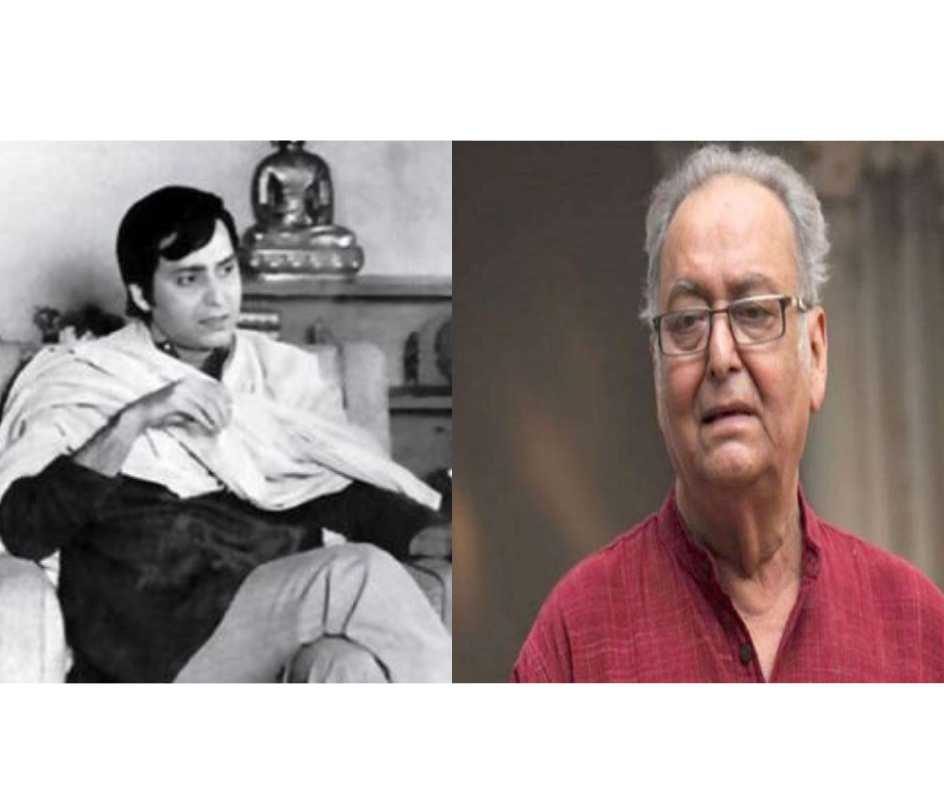
Soumitra Chatterjee was an Indian film actor, play-director, playwright, writer, thespian and poet. He is regarded as one of the greatest and most influential actors in the history of Indian cinema.
He studied for his M. A. in Bengali from the University of Calcutta. While still a student, he learnt acting under noted actor-director of Bengali theatre Ahindra Choudhury. However a turning point came when in the final year of college he saw a play by Sisir Bhaduri, theatre director and the doyen of Bengali theatre. The play not only set a standard for acting for him, but also helped make up his mind to become an actor. He managed to meet Bhaduri, through his friend’s mother, actress Shefalika Putul. Though, he met Bhaduri, towards the end of his career, when his theatre had closed, nevertheless over the next three years, till Bhaduri’s death in 1959, Chatterjee made him a mentor, and learnt the craft of acting through their regular interactions. He even appeared in a small role in one of Bhaduri’s productions.
He started his career working in All India Radio as an announcer. He was there he started pursuing a career in films. Chatterjee had gone on the sets of Ray’s fourth film, Jalsaghar (1958) to watch the shoot. He was unaware that he had already been selected for the title role in the Apu trilogy. That day, while he was leaving the sets, Ray called him over and introduced him to actor Chhabi Biswas as “This is Soumitra Chattopadhyay; he’s playing Apu in my next film Apur Sansar” leaving him much surprised. Despite being selected, as a debutant actor, Chatterjee was nevertheless unsure of his career choice and especially his looks, as he didn’t consider himself photogenic. However, on 9 August 1958, when the first shooting of the film was accepted in a single take, he realized that he had found his vocation. Thus Soumitra’s film debut came in 1959 in Satyajit Ray’s The World of Apu (Apur Sansar). Apu is now in his early twenties, out of college, and hoping to live as a writer. Alongside his professional ambitions, the film charts his romantic awakening, which occurs as the result of a most unlikely turn of events, and his eventual, fraught fatherhood. After Apur Sansar, he also worked with Sharmila Tagore in a number of Ray’s films
Soumitra would go on to collaborate with Ray in fourteen films. Starting with his debut film, Devi (“The Goddess”), Abhijan (The Expedition, 1962), Charulata (1964), Kapurush (1965), Aranyer Din Ratri (Days and Nights in the Forest, 1969), Ashani Sanket (Distant Thunder, 1973), Sonar Kella (The Fortress of Gold, 1974), Joi Baba Felinath (The Elephant God, 1978) as Felida, Hirak Rajar Desha (1980), Ghare Baire (The Home and The World, 1984), Shakha Proshakha (1990) and Ganashaontru (Enemy of the People, 1989).
Abhijan film gives the famous Ray flavour in its composition, flow and dialogues, and use of symbols. The protagonist Narasingh (played by Soumitra Chatterjee) was a direct influence for the character of the cynical cab driver Travis Bicke (played by Robert De Niro) in Martin Scorsese’s Taxi Driver (1976). Soumitra Chatterjee excels as the proud, foul-mouthed, hot-tempered, blue-blooded taxi driver struggling to find his place in a world where honour and dignity stand for nothing. His bruised ego, his constant desire to be respected and his deep-seated insecurities lead him to take a few wrong turns in life, but the warrior within him knows how to find his way back. Chatterjee infuses the character with a never-ending conflict of emotions, a vast range of shades, effortlessly making it his own. Consider, for example, his hatred towards women — which is totally absent in the presence of Neeli, who he sees as an educated woman, one to be respected and revered. Chatterjee pulls off these clashes of emotions with great skill, and makes us root for him.
Ganashaontru film is an adaptation of a play by Henrik Ibsen: An Enemy of the People. It is set in a small town in Bengal. Dr. Ashoke Gupta (Soumitra Chatterjee) is the head of a town hospital. Gupta’s younger brother, Nisith (Dhritiman Chatterjee), is the head of the committees running the hospital and a temple. Both were built by a local Industrialist. The temple is also a big tourist attraction. Dr. Gupta is convinced that the holy water of the temple is contaminated due to faulty pipe-laying. It is causing an epidemic in the town. He warns his brother Nisith. Nisith, the Industrialist and other town officials reject the idea that holy water might be the cause of the epidemic. They refuse to close the temple to carry out the repairs. Dr. Gupta wants to write an article in the newspaper to warn people, but giving-in to the pressure from the powerful people, the editor refuses to publish it. Left with no alternative, Dr. Gupta organises a public meeting that is also sabotaged. And Dr. Gupta is proclaimed an enemy of the people. Soumitra Chatterjee, plays Dr. Gupta’s superb performance.
Soumitra was cast in diverse roles by Ray and some of the stories and screenplays that Ray wrote were said to be written with him in mind. Soumitra featured as Feluda/Pradosh Chandra Mitter, the famous private investigator from Calcutta in Ray’s Feluda series of books, in two films in the 1970s Sonar Kella (1974) and Joi Baba Felunath (1979). These two films were the first film series made for Feluda and are considered as the Feluda original film series. He was the first person who portrayed the iconic Bengali sleuth Feluda. Satyajit Ray made some illustrations of Feluda based on Soumitra’s body figure and look in the 1970s Feluda books.
Soumitra had approached Satyajit Ray to suggest a name for a little magazine founded by Soumitra and Nirmaly a Acharya in 1961. Satyajit Ray had named the magazine Ekkhon (Now).
He also worked with other noted directors of Bengali cinema, such as Mrinal Sen in Akash Kusum (Up in the Clouds, 1965); Tapan Sinha in Kshudhita Pashan (Hungry Stones, 1960), Asit Sen in Swaralipi (1961), Ajoy Kar in Parineeta (1969), and Tarun Mazumdar In Ganadevata (1978). In the romantic film Teen Bhubaner Pare (1969), he shared the screen with actress Tanuja, the film was noted for his “flamboyant” style of acting. He acted in more than 210 films in his career. He also received critical acclaim for his directorial debut Stree Ki Patra (1986) which was based on the Bengali short story Streer Patra by Rabindranath.
Jhinder Bondi (Prisoner of Jhind) is a 1961 film directed by the legendary Tapan Sinha, first time two legendary actor of Bengali cinema Uttam Kumar and Soumitra worked together. Uttam Kumar played duel role in this film. Soumitra is cast, in a villain role in the film.
Entering the 1980s and 1990s, he started working with contemporary directors, like Goutam Ghose, Aparna Sen, Aanjan Das and Rituparno Ghosh, and even acted on television. In 1986, he played the role of a swimming coach, Khitish Singh (Khidda) in film Kony (1986) directed by Saroj Dey, who was part of the film collective Agragami. The film is about a young girl from a slum, who wants to become a swimmer. At the 32nd National Film Awards, the film won the National Film Award for Best Popular Film Providing Wholesome Entertainment. Later in a 2012 interview, he called Kony one of the best films of his career. He even recalled using film’s catch-phrase “Fight-Koni-fight” in hard times, as a chant to himself to lift his “aging spirits”. The phrase had become popular with middle-class Bengalis at the time. He also starred in his biopic Abhijaan directed by Parambrata Chatterjee, an artist himself. The movie was released in April 2022 posthumously as a tribute to Soumitra featuring Jisshu Sengupta who portrayed the younger self of the late artist.
For the first time, Soumitra Chatterjee and Naseeruddin Shah had come together on the silver screen in Mitra’s ‘A Holy Conspiracy,’ adapted from the famous American play ‘Inherit the Wind’. In this film, a teacher is arrested and a case is lodged against him for not mentioning the role of religion while teaching science in a small-town school. It is a courtroom drama where Naseeruddin Shah and Soumitra Chatterjee play the role of lawyers. Film is an engrossing court room battle between science and religion. When science is represented by Naseeruddin Shah and religion by Soumitra Chatterjee, it is expected to be a riveting watch.
After a two-decade long busy career as a leading man of Bengali cinema, he returned to theatre in 1978, with his production Naam Jiban, staged at Biswarupa Theatre in Kolkata. This led to other plays like Rajkumar (1982), Phera (1987), Nilkantha (1988), Ghatak Biday (1990) and Nyaymurti (1996), beside notable plays like Tiktiki (1995), an adaptation of Sleuth and Homapakhi (2006). Besides acting, he has written and directed several plays, translated a few and also branched out to poetry reading in recent decades.
Soumitra was the recipient of multiple honours and awards. Soumitra was the first Indian film personality who was conferred with France’s highest award for artists ‘Commandeur’ of, Ordre des Arts et des Lettres (1999). He was also awarded the Padma Bhushan (2004) and France’s highest civilian award Commandeur de la Légion d’ Honneur (Commander of Legion of Honour) (2017). He received two National Film Awards as an actor and the Sangeet Natak Kademi Award for his work in theatre. In 2012, he received the Dadasaheb Phalke Award, India’s highest award in cinema given by the Government of India for lifetime achievement. In 2013, IBN Live named him as one of “The men who changed the face of the Indian Cinema”
Photos courtesy Google. Experts taken from Google.
 Writer Sunita