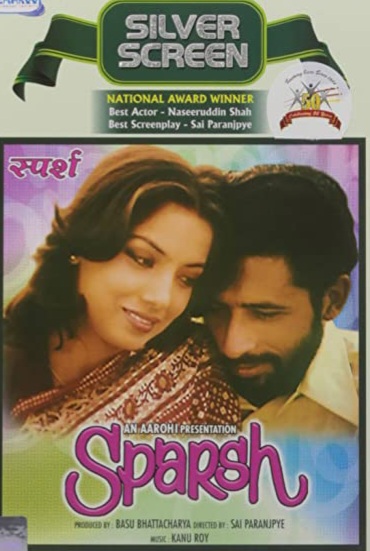
Sparsh (Touch) is a 1980 Hindi feature film written and directed by Sai Paranjpye. This film is about the blind, in particular about the lives and feelings of blind children and the principal of their school. Sparsh refers to the sensation and feeling of touch upon which blind people rely in the absence of sight. The film remains most memorable for the subtle acting of its leads, plus the handling of the issue of relationships with the visually disabled, revealing the emotional and perception divide between the worlds of the “blind” and the “sighted”, epitomized by the characters.
The story opens with Anirudh Parmar (Naseeruddin Shah) as the principal of Navjivan Andhvidyalay, a school for the blind that educates about 200 blind children. Anirudh has a dark and lonely existence for the most part. One day, while on his way to the doctor, he hears a lovely song and ends up mesmerized at the singer’s door instead of the doctor. The voice belongs to Kavita Prasad (Shabana Azmi), a young woman recently widowed after three years of marriage. Kavita, too, prefers a secluded existence. Her childhood friend Manju, is the only friend she has.
Manju throws a small party where Kavita and Anirudh meet again. He recognizes her from her voice. During the conversation, he mentions that the school is looking for volunteers to read, sing, teach handicrafts and spend time with the children. Kavita is reluctant, but she is urged by Manju and her husband Suresh to strongly consider it. Kavita decides to volunteer.
As Kavita spends more time at the school, she begins forming a friendship with Anirudh. The friendship grows stronger over time and they become engaged. But their personalities and feelings are different. Anirudh is of strong character. He firmly believes that the blind need help but not pity or charity. Kavita, recently bereaved, looks to the school (and Anirudh) as a way towards an ideal, one of sacrificial service. Anirudh gets wind of this and assumes Kavita is simply seeking to fill the void in her life with this form of service. He assumes she accepted the proposal, not out of love, but as a sacrifice towards a way out of her dark life. During this time, Anirudh’s fellow blind friend Dubey (Om Puri) laments that his recently deceased wife was not happy in their marriage.
Anirudh is shaken, confused, and disturbed by all this. He breaks off the engagement, but does not mention the reason to Kavita. She accepts his decision. Kavita, now a salaried employee of the school, continues to help the children. The initial coldness between her and Anirudh gives way to friction and eventually, over a series of events at the school, brings up the feelings they were not able to discuss before. The situation spirals downward and one of them must leave the school. The film ends with Anirudh and Kavita being touched by the depth of their feelings for one another and finally seeing a way out.
The film won numerous awards including National Film Award – Best Actor for Naseeruddin Shah, Best Feature Film in Hindi, while Sai Paranjpye got the Best Screenplay. At the Filmfare Awards, it won the top two: that of Best Film and Best Director, plus a Best Dialogue Award for Sai Paranjpye.
Films about relationships between blind people and sighted people – or indeed between any “handicapped” people and “normal” people. Some of its uncomfortable moments feel canned and facile, as when Kavita, at one of her early meetings with Anirudh, refers to his students as “those poor children;” Anirudh bristles, telling Kavita to remove the word “poor” from her vocabulary, as his children do not need her pity.
Accordingly, Sparsh is at its best when it focuses tightly on Kavita and Anirudh as individuals, rather than as iconic representatives of “The Blind” and “The Sighted”. Kavita and Anirudh are fragile people. Anirudh is proud, and that pride makes it hard for him to let Kavita care for him. Kavita, for her part, is eager for a way out of her loneliness but not quite ready to move beyond her husband’s death. They are both navigating strong emotions, but they are also both uncertain and very reserved by nature; that, together with Shabana and Naseeruddin’s understated performance styles, yield a very muted tone, with few outbursts of emotion.
Sparsh is nevertheless quietly sweet and engaging; the characters are warm, sympathetic, likeable. Kavita is a wounded bird; even her smiles are a little sad. This may be what makes the young Shabana and Naseeruddin work so well as a screen couple. His scenes in conversations with Shabana are heart touching elevating blending of romance and sensitivity to magnitude of rare level. Inspite of not the slightest touch of melodrama their love gave vibrations of a lotus in full bloom, posessing poetic grace. Their romance is delicious, sweet and even passionate at moments. And there are some truly beautiful scenes. In one, Kavita shops for a new sari, closing her eyes and using her fingertips to choose one that Anirudh will like. In another, Anirudh makes Kavita blush, describing for her why he finds her beautiful – her fragrance, the sound of her voice, the softness of her touch.
Such a film would inspire people to devote themselves towards social causes. It would also be a lesson that through service the inner self is liberated and pursuit of worldly things leads to narcasm of the soul. No film ever in onse and behaviour of the blind children in the school touch the very core of the soul of an audience. It as simply directorial genius by Sai Paranjpye. The feelings of blind children are reflected at the deepest depth, echoing their very aspirations. The film projects the capability of blind children at maximum magnitude. Humanism was scaled to heavenly proportions.
Photos courtesy Google. Experts taken from Google.
 Writer Sunita