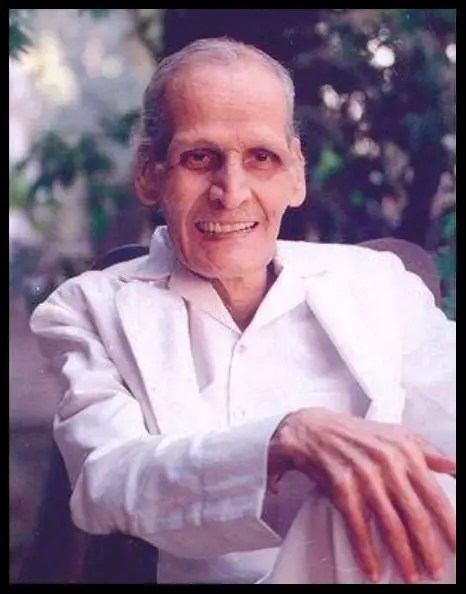
Kavi Pradeep (Ramchandra Narayanji Dwivedi), was an Indian poet and songwriter who is best known for his patriotic song “Aye Mere Watan Ke Loge“ written as a tribute to the soldiers who had died defending the country during the Sino-Indian War.
Pradeepji started writing and reciting poetry at a very early age. “A lot of people wrote in those days and I was encouraged because I was saying something that listeners then appreciated,” he explained. He finished graduation and decided to join a teacher’s course and teach, but destiny had other plans. He was invited to a kavi sammelan in Bombay. Himanshu Rai, the owner of Bombay Talkies, offered Pradeep Rs 200 and made him sign a contract for Kangan. Pradeep shifted to Bombay and wrote four songs for the film, all of which became very popular, and sung three of the songs himself.
Next film was Bandhan (1940), he wrote all the songs which became huge hits. The most notable is “Chal Chal Re Naujawan”, which made waves since the Indian freedom movement was at a crucial juncture.
India’s first golden jubilee hit Kismet (1943) is known for its patriotic song “Aaj Himalay Ki Choti Se Phir Hum Ne Lalkara Hai, Door Hato Ae Duniyawalon Hindustan Hamara Hai” (From the peak of the Himalayas we are warning other countries to stay away from India as it is our country). Kismet was his groundbreaking effort since it came at the time of the Quit India Movement. The country was in strife with all national leaders in prison. The song was supposed to warn the Axis powers, but the Indian public understood the real meaning of the song. Almost synonymous to the song (phir means again in Hindi), the reel would be rewound and played many times to satisfy public demand. Theatres around the country were resounded with “once more” calls once the song ended. The reel had to be rewound and the song was screened again and again. Kismet made box office history for its time by running for 3½ years in one theatre. Though the song managed to pass through heavy censorship of the time. The British soon realised the true meaning of his songs and issued a warrant for his arrest. This forced Kavi Pradeep to go underground to avoid arrest.
He worked on four more movies for Bombay Talkies which included Punar Milan (1940), Jhoola (1941), Naya Sansar (1941), Anjan (1943).
Mashaal (1950) was his next film and it features the extremely popular song “Upar Gagan Vishal” sung by Manna Dey. Kavi Pradeep was at his creative zenith when he wrote for the films Nastik (1954) . He even lent his voice for the evergreen song “Dekh Tere Sansar Ki Halat Kya Ho Gayi Bhagwaan, Kitna Badal Gaya Insaan” (Look at your world, O God. How the man has changed!) from the film Nastik.
Jagriti is considered to be among his best work. Each of the songs is a masterpiece. It includes hit song such as “Aao Bachcho Tumhein Dikhayen Jhanki Hindustan Ki, Is Mitti Se Tilak Karo, Yeh Dharti Hai Balidan Ki” (sung by himself). Song “De Dee Hamein Azadi Bina Khadag Bina Dhal, Sabarmati Ke Sant Tu Ne Kar Diya Kamaal” tribute to Mahatma Gandhi. Song for children “Hum laye hain toofan se kishti nikal ke” is still played throughout th e country on 14 November, Children’s Day. Jagriti was unofficially remade in Pakistan as Bedari (1956), by Rafiq Rizvi, with the Pradeep’s songs also being lifted. The songs had Pakistani nationalist symbols replacing Indian ones and such as Muhammad Ali Jonnah in “Aey Qaid-e-Azam, tera ehsan hai ehsan” a reworking “De Di Humein Azaadi”, and “Aao Bachho Sair Karain Tum Ko Pakistan Ki” copying from “Aao Bachcho Tumhein Dikhayen Jhanki Hindustan Ki”.
His devotional song fom the superhit film Waman Avtar (1955) starring Trilok Kapoor and Nirupa Roy “Tere Dwar khada Bhagwan” is popular till today.
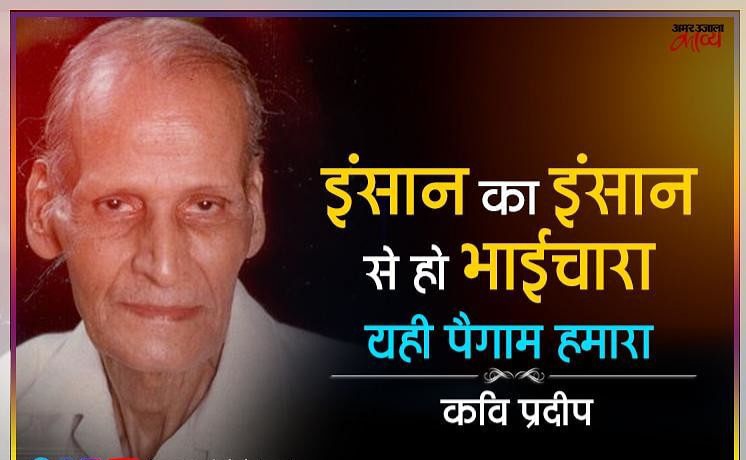
By the 1960s, the popularity of his songs was on the wane and film producers who were looking for western music and fast numbers avoided him. However he managed to prove his detractors wrong with films Talaaq, a Rajendra Kumar starrer and Paigam (1959) starring Dilip Kumar, Raj Kumar and Vyjayantimala. With “Insaan Ka Insaan Se Ho Bhaichara, Yahi Paigam Hamara” being a highlight.
During 1962 Indo-China war days, he heard about Param Vir Major Shaitan Sing Bhati. He was so touched by his sacrifice and bravery that he penned down the lines ” Aye mere vatan ke logon Zara aankh mein bhar lo paani Jo Shaheed hue hai unki Zara yaad karo qurbaani (O! The people of my motherland Shed a few tears For those who martyred Remember their great sacrifice) which went on to become one of the greatest patriotic songs of the country. For writing the song Kavi Pradeep was conferred the honour of “Rashtriya Kavi” (National Poet) by the government of India. On 27 January 1963, Lata Mangeshkar first performed the song in the presence of then President Sarvepalli Radhakrishnan and Prime Minister Jawaharlal Nehru at Delhi’s National Stadium for an event organised by the film industry as a fundraiser for war widows. The performance of the song moved Nehru to tears. “Those who don’t feel inspired by Aye mere watan ke logo don’t deserve to be called a Hindustani”, said Nehru, who was visibly moved by the song. Pradeep was not invited to the first live performance of the song. When Mr Nehru visited Mumbai three months, my father sang it specially for him at a function at R.M. High School here and also presented the original handwritten poem to him.” Despite many offers, Kavi Pradeep pledged the royalties of the song to ‘War Widows Fund’ and on 25 August 2005 Bombay High Court ordered Saregama (HMV) to pay ₹ 1 million as arrears in royalty to the Fund.
From Independence Day to Republic Day, this song still marks every patriotic occasion in India. This song united the masses at a time when India was agonised by its defeat in the war. Pradeep’s words reminded Indians of the sacrifice made by soldiers and reinstated the pride of the country.
S. Mukerji’s Sambandh (1969) was a film that ran on the popularity of songs such as “Chal Akela Chal Akela, Tera Mela Peechhe Chhoota Raahi Chal Akela”, “Jo Diya Tha Tum Ne Ek Din, Mujhe Phir Wohi Pyar De Do, Ek Karz Mangta Hoon, Bachpan Udhar De Do” were written by Pradeep. He c ontinued to show his brilliance in 1975, when the movie Jai Santoshi Maa was released. For a low-budget movie, it matched the collections of another blockbuster Sholay. For months, theatres screening the movie, held the housefull boards high. Ladies would perform poojas when the immortal song “Main To Aarti Utaroon Re Santoshi Mata Ki” was played in the theatres.
In a career span of five decades, Kavi Pradeep wrote about 1,700 songs. HMV, released an album of 13 songs with his lyrics.
His songs were so popular that fans would see his movies repeatedly just to listen to his soulful songs. Kavi Pradeep always believed in writing songs in simple words portraying a meaning fitting into the situation. The popularity of his songs was due to his down-to-earth lyrics and simple language that was well understood by everyone.
In 1987, Pradeep told a journalist, “Nobody can make you patriotic. It’s in your blood. It is how you bring it out to serve the country that makes you different.”
About the kind of songs he wrote, Pradeep once said, “Love is just a part of life. Young men and women have a monopoly where love is concerned. Aren’t there different kinds of love that between a mother and her children, between a father and his children, between a bhakt (devotee) and his deity, between a man and his motherland? I chose to write about all these different kinds of love. The saint-poetess Mirabai wasn’t married to Krishna but she loved him and spent her life singing about him… Perhaps it was the atmosphere in which we lived that evoked patriotic feelings in us, but then, in those days, we had good upbringing, good grooming and command over the language. That is why our work is also good.”
In 1997, he was honoured with India’s highest award in cinema, the “Dada Saheb Phalke Award“, for lifetime achievement.
An award, Kavi Pradeep Samman, has also been constituted in his memory.
Photos courtesy Google. Experts taken from Google.
 Writer Sunita