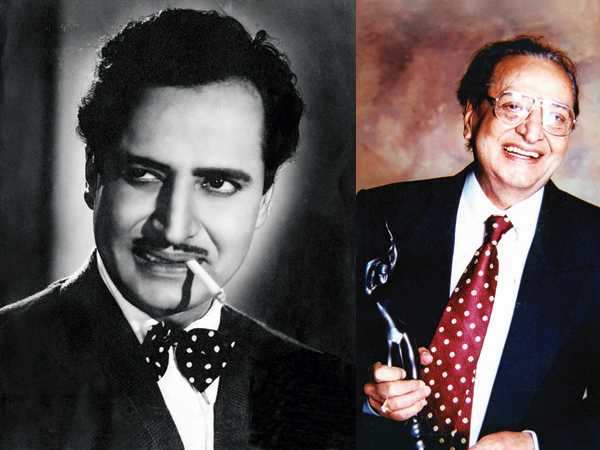
Pran Krishan Sikand, better known by his mononym, Pran, was an Indian actor, known as the greatest villain ever in the history of Indian cinema and character actor in Hindi cinema from the 1940s to the 1990s. He was one of the most highly successful & respected veteran actors in the history of Indian cinema. He was also one among the highest paid actors of his time.
He played hero roles from 1940 to 1947, negative character from 1942 to 1991, and played supporting and character roles from 1967 to 2007. The decades of late 1940s, 1950s, 1960s and early 1970s were the peak periods of Pran’s stint as a negative character actor, especially 1950s & 1960s.
Pran got his first role in Dalsukh M. Pancholi’s Punjabi film Yamli Jat (1940) because of an accidental meeting with writer Wali Mohammad Wali at a shop in Lahore. Directed by Moti B. Gidwani, the film featured Noor Jehan and Durga Khote. This was followed by small roles in the film Chaudhary and Khajanchi, both in 1941. Pancholi cast him again in Khandaan (1942), which was Pran’s first Hindi – language film. It featured him as a romantic hero, opposite Noor Jehan, who had acted with him in Yamla Jat as a child artist. In Khandaan, she was under 15 years old and compensated for the difference in their heights in close-up shots by standing on top of bricks. In the pre-independence era, director Gidwani cast Pran in more film s like Kaise Kahoon (1945) and Khamosh Nigahen (1946).
Pran had acted in 22 films from 1942 to 1946 in Lahore; 18 were released by 1947. Due to India’s Partition in 1947, his career had a brief break. His films from 1944 to 1947 were made in undivided India, but Taraash (1951) and Khanabadosh (1952) (both co-starring Manorama) were released only in Pakistan after Partition. He left Lahore and arrived in Bombay. For a few months, he looked for acting opportunities while doing other jobs. He worked in Delmar Hotel, Marine Drive for eight months, after which he got a chance to act in 1948.
Because of help from writer Saadat Hasan Manto and actor Shyam, he got a role in the Bombay Talkies’ film, Ziddi which starred Dev Anand and Kamini Kaushal and was directed by Shaheed Latif. The movie launched Pran’s career in Bombay. As a villain, Pran’s initial successful films were Ziddi and Bari Behan (1949). Within a week of Ziddi‘s success, he had signed three more films – S M Yusuf’s Grihasti (1948), which became a diamond jubilee hit, Prabhat Films’s Apradhi (1949) and Wali Mohammad’s Putli (1949). By then, Wali Mohammad, who was responsible for Pran’s first role, had come to Bombay and became a producer, setting up an office at Famous Studios, near Mahalaxmi Racecourse. In the 1940s, romantic duets featuring him, like the songs “Tere Naaz Uthane Ko Jee Chahta Hai” from Grihasti, opposite Shardha, and from Khandaan (1942), with Noor Jehan, became popular in the 1940s. The way he expressed his dialogues in films such as Sheesh Mahal (1950), a series of disguises he made in Adalat (1958), and the rapport he shared with vamps like Kuldip Kaur in Jashan (1955) showcased his versatility in the 1950s. He proved his versatility in the 1950s by playing the pirate in Sindbad the Sailor (1952 ) and Daughter of Sindbad (1958).
Incidentally, it proved to be Dev Anand’s big break as a hero. By 1950 he been gradually established as a premier villain in Hindi cinema. Pran’s trademark blowing of smoke rings first appeared in the latter film. He was regularly offered the role of the main villain or of a negative character in films with Dilip Kumar, Dev Anand and Raj Kapoor as the lead hero in the 1950s and 60s. From the 1950s directors like M. V. Raman, Nanabhai Bhatt, Kalidas, Ravindra Dave, I. S. Johar and Bimal Roy repeatedly cast him. Similarly in the 1960s, he was frequently in the directorial ventures of A. Bhim Singh, Shakti Samanta, Bhappi Sonie, K. Amarnath, Nasir Hussain and others. In the 1970s, newer, younger directors and producers cast him in their films even though Pran asked for the highest price among supporting actors from 1968 to 1982.
Pran’s performance as the negative character was appreciated especially in Dilip Kumar starrers such as Azaad (1955), Devdas (1955), Madhumati (1958), Dil Diya Dard Liya (1966), Ram Aur Shyam (1967) and Aadmi (1968); and films with Dev Anand as the lead man such as Ziddi (1948), Munimji (1955), Amar Deep (1958), Jab Pyar Kisi Se Hot Ja Hai (1961); and with Raj Kapoor in Aah (1953), Chori Chori (1956), Jagte Raho (1956), Chhalia (1960), Jis Desh Mein Ganga Behti Hai (1960) and Dil Hi Toh Hai (1963). Films with him as the lead hero, Pilpili Saheb (1954) and then Halaku in 1956, were big hits too. He had roles in several genres, like as a pirate in Sindbad the Sailor (1952) and Daughter of Sindbad (1958); in action-packed thrillers like Azad (1955); historicals like Aan (1952) and Raj Tilak (1958); social themes like Baradari (1955); and light romances like Munimji (1955) and Asha (1957). In the 1960s and early 1970s, despite being in his 40s, he continued to play pivotal roles as a character in the age range of 25 to 30 in films with Shammi Kapoor, Joy Mudherjee, Rajendra Kumar and Dharmendra as the lead heroes. From the early 1950s to the early 1970s, Pran gained particular notoriety due to his frequent roles as a villain. From 1964, with Pooja Ke Phool and Kashmir Ki Kali, he also brought a comical side to his negative characters. While Dilip Kumar and Raj Kapoor’s careers as the young hero started to decline from the late 1960s and Rajendra Kumar and Shammi Kapoor stopped playing the lead by 1973, Pran continued with his roles. His association with Dev Anand, begun in 1948, continued even during the 1970s and the 1980s with Johny Mera Naam (1970), Yeh Gulistan Hamara (1972), Joshila (1973), Warrant (1975) and Des Pardea (1978).
Pran played roles in comedy films starring Kishore Kumar and Mehmood Ali in the lead. His collaborations with Mehmood include Sadhu Aur Shaitaan (1968), Lakhon Me Ek (1971) and with Kishore Kumar include Chham Chhama Chham (1952), Aasha (1957), Bewaqoof (1960), Half Ticket (1962) and Man-Mauji (1962).
Manoj Kumar’s film Upkar (1967) features actor Pran as Malang Chacha, a physically challenged and upright farmer, a character very different from his usual flamboyant villainous roles. The Kalyanji Anandji song “Kasme Waade Pyaar Wafaa” was picturised on him. In this film, Pran played a more sympathetic role. He received his first Filmfare Award for Best Supporting Actor for Upkar. Kumar continued to cast him in pivotal roles in films such as Purab Aur Paschim (1970), Be-Imaan (1972), Sanyasi (1975) and Dus Numbri (1976).
From 1967 onward he also acted in Bengali films, beginning with Ashim Banerjee’s Sonai Dighe, where Joy Mukherjee was the hero.
Pran played the supporting role in several of these, which replaced his image as the villain with that of a character actor. After 1969, he was offered the lead role in films like Nanha Farishta (1969), Jangal Mein Mangal (1972), Dharma (1973), Ek Kunwari Kunwara (1973) and Rahu Ketu (1978).
Pran and Ashok Kumar were very close friends in professional and real life. They acted in 27 films together from 1951 to 1987 starting with Afsana (1951). Their other films include Mr. X (1957), Adhikar (1971), Victoria No. 203 (1972), Chori Mera Kaam (1975) and Raja Aur Rana (1984). Sung by Kishore Kumar, the songs “Hum Bolega To Bologe Ke Bolta Hai” from Kasauti (1974) and “Micheal Daru Peeke dandha kartha Hai” from Majboor (1974), picturised on Pran, were very popular.
From 1969 to 1982, Pran was one of the highest paid actors of Bollywood. He played the lead role in the film Aurat (1967) paired opposite Padmini, with Rajesh Khanna in a supporting role. Pran and Khanna worked in five more films — Maryada (1971), Jaanwar (1983), Soutan (1983), Bewafai (1985) and Durga (1985). In 1973, he recommended Amitabh Bachchan to Prakash Mehra for the character of Vijay in Zanjeer. Pran’s role as Sher Khan, with his red wig and beard and Pathani style was well appreciated. Mehra had to rush to pran’s house to plead with him, saying without him the film would not work as Amitabh as a hero was not a bankable box office proposition. Finally song was shot and Pran gave one of the best performances of his career. “Yari Hai Iman Mera Yaar meri Zindagi” lipped by Pran made a history. Pran acted with Bachchan in about 14 films with notable ones being Majboor (1974), Don (1978), Amar Akbar Anthony (1977), Dostana (1980), Naseeb (1981) and Sharabi (1984).
Pran occasionally accepted antagonistic roles from 1971 to 1992. He appeared as a villain in films like Maryada, Naya Zamana, Jawan Muhabat, Aan Baan, Roop Tera Mastana, Yeh Gulistan Hamara, Gaddar, Rahu Ketu, Andha Kanoon (1983), Duniya (1984), Insaaf Kaun Karega, Durgaa, Bewafai, Hoshiyar, Dharm Adhikari and Azaad Desh Ke Ghulam. Pran had dual roles in Khoon Ka Rishta, Insaaf and Jangal Mein Mangal.
He produced the movie Lakshmanrekha in 1991, the only one he produced in his Bollywood career, and played Kishan Lal Sharma in the movie.
In 1998, at the age of 78, Pran suffered a heart attack, after which he started rejecting film offers due to age-related problems. But in the 1990s, Amitabh Bachchan requested Pran to do roles in his home productions Tere Mere Sapne (1996) and Mrityudata (1997). Pran made an exception by acting in them to help Bachchan through a difficult time in his career. In 1997, his character in Mrityudaata was modified to compensate for Pran’s shaking legs in real life and in Tere Mere Sapne, his shots were taken with him seated. After 2000, he made few guest appearances.
Pran has been honoured with awards for his portrayal of negative characters. He has received three Filmfare Awards in the Best Supporting Actor category for Upkar, Aansoo Ban Gaye Phool and Be-Imaan. However, in 1973 when he was awarded for his role of constable Ram Singh in Be-Imaan, he refused to accept the award stating that the Filmfare Award for Best Music Director should have gone to Ghulam Mohammed for Pakeezah and not to the musical duo Shankar Jaikishan for Be-imaan. He was awarded with three Bengal Film Journalists’ Association Awards for his supporting roles. He was awarded as the “Villain of the Millennium” by Stardust in 2000. For his vast contributions to Indian cinema, Pran has been honoured with Lifetime Achievement awards, including those of Filmfare, Star Screen Awards and Zee Cine Awards.
In 2001, the Government of India conferred the Padma Bhushan on him. In April 2013, he was announced to be the winner of the Dadasaheb Phalke Award, the most prestigious award of the Indian cinema, presented by the Government of India. The award was presented to him at the 60th National Film Awards for his lifetime of work in the film industry. He could not attend the 60th National Film Awards in May 2013 where he was to be presented the Dadasaheb Phalke Award. Instead, Information and Broadcasting minister Manish Tewari presented the award at Pran’s home in Mumbai. Celebrities congratulated him on this occasion with Amitabh Bachchan calling him “a large pillar of the Indian Film Industry” on Twitter. He was named on the list of CNN’s Top 25 Asian actors of all time.
Pran had a six-decade career in Hindi cinema and is one of the most celebrated actors of the industry. Though he played each character with panache, dedication and ease, it was Pran’s negative roles that people swear by even today. The industry had started calling him “Pran Sahab”. His favourite line “Barkhurdaar” became immensely popular. He was the first true personification of “evil” on the Indian screen. The intensity of his portrayal of negative/villainous characters on the screen was effective enough to desist the Indian people from naming their children “Pran” in the 1950s & 60s & subsequently thereafter (when Pran was at the peak of his villainy). In a long and prolific career Pran appeared in over 362 films.
In 2000, Bunny Reuben, a film journalist, authored a biography on Pran, titled “…and Pran”. The name of this book arises from the fact that in majority of Pran’s movies, his name was credited in the last after all the other actors, “….and Pran”. His biography, “…and Pran”, was a tribute to about 250 of his 350 movies that had his name at the end of the credits, usually with the words “…and Pran” and sometimes “…above all, Pran”.
In a 2000 interview with Dr Rajiv Vijayakar, Pran said “As a villain, I was so effective that people were scared of me in real life. When I went to someone’s house in Delhi for tea, his young sister was whisked out of my sight. My friend later phoned me and said his sister had fought with him for bringing a bad man into the house.”
In 2012, he gave his hand print for “Legend’s Walk”, a waterfront promenade in Bandra.
Photos courtesy Google. Experts taken from Google
 Writer Sunita
