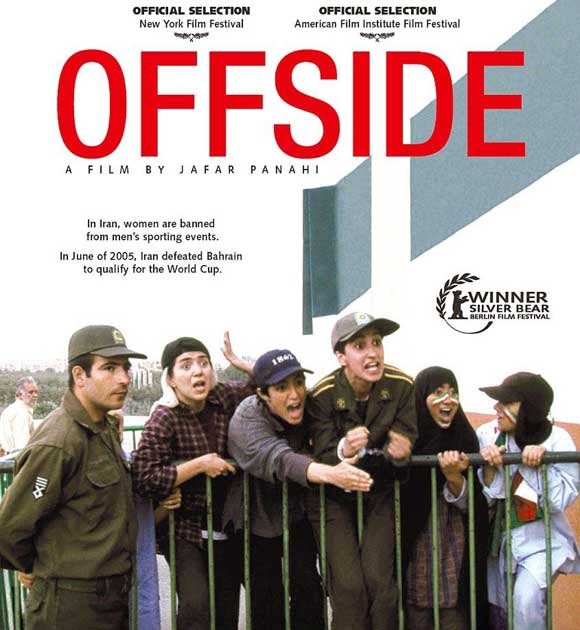
Offside is a 2006 Iranian film directed by Jafar Panahi, Six young female soccer fans who try to sneak into a qualifying match for the a World Cup qualifying match between Iran and Bahrain but Women are prohibited from attending sporting events in Iran. The struggle of women in a country that excludes them from entering stadiums. The film was shot in Iran but its screening was banned there.
Many Iranian girls love soccer as much as their countrymen and sport fans all over the world but, they are prevented by law from attending live soccer matches in their country. Inspired by the day when director’s own daughter was refused entry to a soccer stadium in Iran. Jafar Panahi’s OFFSIDE follows a day in the life of a group of Iranian girls attempting to watch their team’s World Cup qualifying match against Bahrain at the stadium in Tehran.
A middle-aged man riding in a cab is distraught; his teenage daughter has left home without his permission to go to Tehran’s Azadi stadium where Iran is playing Bahrain to qualify for the 2006 World Cup. This young female soccer fan is not alone in her love of the game and willingness to do anything to see it. In a bus filled with boys and men, a pretty girl has disguised herself as a male, her hat pulled down and the national colors painted on her face. Upon arrival at the grounds of Azadi Stadium, she persuades a reluctant ticket tout to sell her a ticket; he only agrees to do so at an inflated price. The girl tries to slip through security, but she is spotted and arrested. After using her cell phone, a young soldier takes her to a holding pen inside the stadium but away from the soccer action. They are tortured by being able to hear the roar of the crowd without being able to see what is happening in the match.
She is put in a holding pen on the stadium roof, five other girls in various disguises are being held there. One is a streetwise woman with feminist leanings. Another has played soccer on a women’s team. A woman dressed in a military uniform shows up with handcuffs. These women share a passion for the game but are not allowed to see it for such flimsy reasons as it not being proper for them to see men in shorts on the field or to hear their fathers, husbands, and brothers cursing in the stands. The women are guarded by several soldiers, all of whom are just doing their national service; one in particular is an Iranian Azeri boy from Tabriz who just wants to return to his farm. The soldiers are bored and do not particularly care whether women should be allowed to attend football matches; however, they guard the women carefully for fear of their “chief”, who could come by at any moment. One solider finally agrees to provide commentary on the game as he sees it through a hole in the wall.
One of the younger girls needs to go to the toilet, but of course there is no women’s toilet in the stadium. A soldier is deputed to escort her to the men’s toilet, which he does by an increasingly farcical process: first disguising her face with a poster of a football star, then throwing a number of angry men out of the toilet and blockading any more from entering. During the chaos, the girl escapes into the stadium, although she returns to the holding pen shortly after as she is worried about the soldier from Tabriz getting into trouble.
Before the game is over a minibus arrives to take them to the Vice Squad headquarters. They are joined by a teenage boy who loves to explode firecrackers. In order to better hear the game, the soldier in authority holds the radio out the bus window where the reception is better. As the bus travels through Tehran, the soldier from Tabriz plays the radio commentary on the match as it concludes. Iran defeats Bahrain 1-0 with a goal from Mohammad Nosrati just after half time and wild celebrations erupt within the bus as the women and the soldiers cheer and sing with joy. The girl whose story began the film is the only one not happy. When asked why, she explains that she is not really interested in football; she wanted to attend the match because a friend of hers was one of seven people killed in a scuffle during the recent Iran–Japan match, and she wanted to see the match in his memory.
The city of Tehran explodes with festivity, and the bus becomes caught in a traffic jam as a spontaneous street party begins. Borrowing seven sparklers from the boy with the fireworks, the women and the soldiers leave the bus and join the party, holding the sparklers above them.
In Iran, like many other countries, football is very important. As you can imagine, the majority of distractions are rather limited. So football is both sport and entertainment. It’s an opportunity for people to shout, let themselves go, expel all the pent-up energy within them. Sometimes, when a match coincides with a demonstration, and Iran wins, the demonstration becomes more intense.
Jafar Panahi is one of the most humanistic filmmakers anywhere in the world. Most of the characters in the film are not named. All of his movies are gems that reveal the qualities that draw us all together despite surface differences as members of the human family. Here he uses the game of soccer as a means to explore how the human rights of women in Iran are violated. But he doesn’t stop with cultural criticism. He also explores how the sport unites people. In the closing scenes of this extraordinary movie, the impatient and worn-out policemen, the angry and exhausted girls, and the adolescent boy suddenly become one with each other and with all the fans in the streets. Panahi is not just presenting the response to Iran’s victory in a game; he is showing us the joy that can bring those in conflict together for a mystical moment of celebration. Such moments give us hope that this weary and war-torn world can one day become one.
The girls disguise themselves as boys to sneak into Azadi Stadium but are caught, arrested, and detained in a makeshift holding pen outside the arena by young soldiers who’d clearly rather be watching the match themselves. Panahi shot much of this surreptitiously on location during the actual World Cup qualifier. One soldier borrows a detainee’s cell phone to call his girlfriend, arousing her jealousy when she phones back and a girl answers. Another soldier escorts one of the girls, a soccer player herself, to the men’s room shortly before halftime but is careful to mask her face with a poster of a soccer player. This builds into a sequence of almost Hitchcockian suspense, seen from the soldier’s point of view: he frantically tries to keep the men’s room clear so the girl can use one of the stalls in peace but loses track of her precise whereabouts in the process.
The cinema of Jafar Panahi is often described as Iranian neo-realism. Regardless of how one chooses to categorize his powerful work, the unprecedented humanitarianism of Panahi’s films cannot be denied. Panahi’s cinema is urban, contemporary and rich with the details of human existence. The film was filmed at an actual stadium during a qualifying match for the Iranian National team. Panahi had two separate outcomes to the film depending on the turnout of the match.
Film is selected at the Tehran film festival, it is easier for it to find a distributor in Iran. Every year, director fill out all the necessary applications for the festival but for the time being films have not been released in Iran.
The film received very positive reviews from critics. The film won the Silver Bear at the Berlin International Film Festival in 2006, and was in the official selection for the 2006 New York and Toronto International Film Festivals.
Photo courtesy Google. Experts taken from Google.
 Writer Sunita