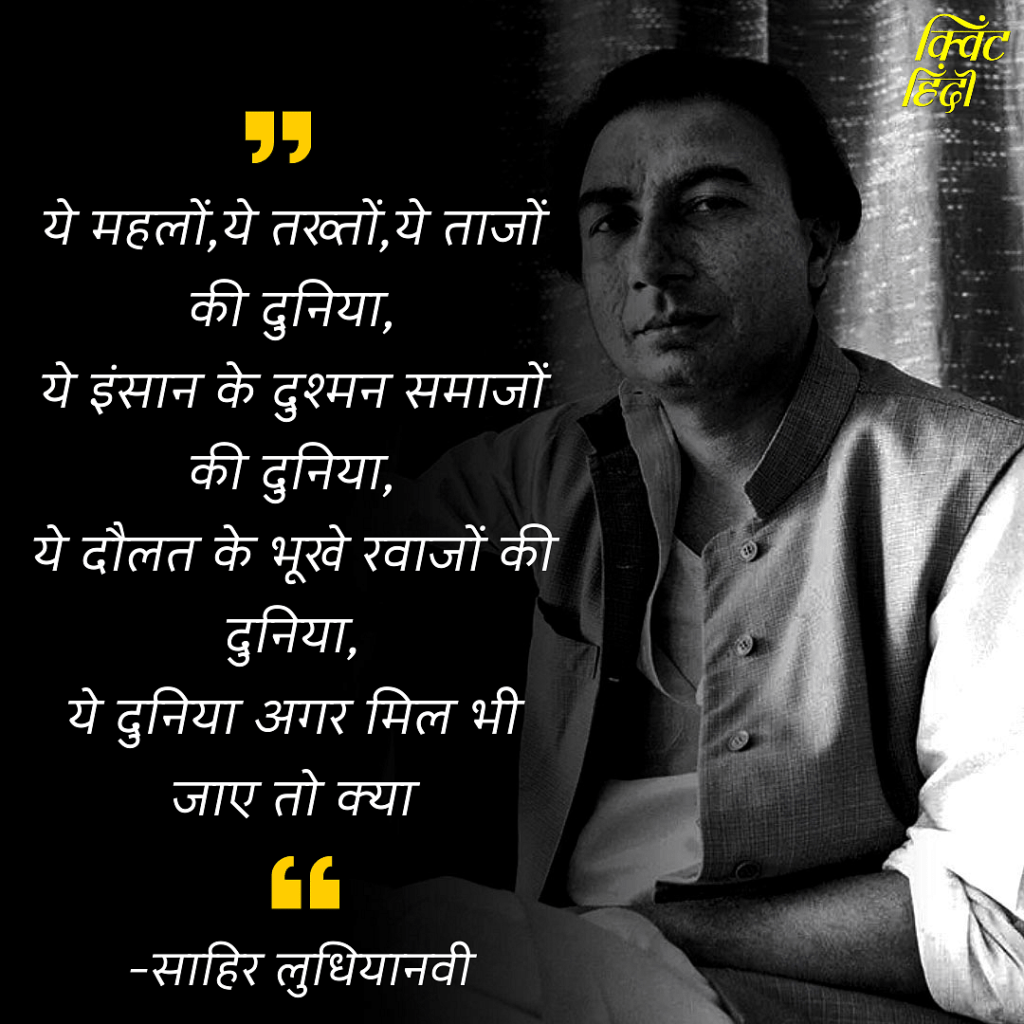
Abdul Hayee, popularly known by his pen name (takhallus) Sahir Ludhianvi, was an Indian poet and film song lyricist who wrote primarily in Urdu in addition to Hindi. He is regarded one of the greatest and revolutionary film lyricist and poet of the 20th century India.
On Sahir Ludhianvi birth anniversary, remembering the poet who was sensitive to the plight of the downtrodden. Sahir had a rare sensibility that could bring together the abstract and the concrete. Sahir was a painter-poet. Replete as his poetry was with themes like despair, agony, human relationships, and existential crises.
Sahir was educated at the Khalsa High School in Ludhiana. He then enrolled at the Government College, Ludhiana. The auditorium there is named after him. As a college student, Sahir was popular for his ghazals and nazms (poetry in Urdu) and empassioned speeches.
An anthology of his poems, Talkhiyan, was published in 1943 but his ambition was to become a film lyricist. So, off he went to Bombay. His work influenced Indian cinema, in particular Hindi language films. Sahir’s work as a lyricist in the film industry gave him financial stability beyond his earnings as a poet. He made his debut with four songs performed in the film Azadi Ki Raah Par (1949). One of the songs was Badal Rahi Hai Zindagi. In 1950, his college friend, Mohan Sehgal, advised him to meet S. D. Burman, who was looking for a writer who could pen a song for his new tune. Burman played the tune to Sahir, who on the spur of the moment, composed the evergreen song ‘Thandi hawayen lehra ke aayen’ for Noor Jahan (1951).
Sahir’s major success was Baazi (1951). Again, the composer was Burman. Sahir was then considered part of Guru Dutt’s team. Pyaasa was inspired by the poetry of Sahir and Guru Dutt wove around it the theme of social injustice and the poignant though unspoken love of the poet and the prostitute, which rises above the prejudices of the class-torn social order. In Pyaasa, Guru Dutt played a poet named Vijay. Acclaimed as the best romantic film of all times, Pyaasa brought to large audiences across the country the poetry of Sahir in all its glory, set to the lilting music of SD Burman. Writing on this film which was to mark the end of the Sahir-Burman magic, Akshay Manwani, the biographer of The People’s Poet, writes: “Sahir Ludhianvi, his lyrical contribution apart, remains central to the theme. The film is replete with references to Sahir and his life even if they happen unwittingly. For example, in the film’s second scene, when the publisher refuses to publish Vijay’s poems saying that poetry should be about beauty and romance instead of hunger and unemployment, the parallel to Sahir’s own brand of poetry is all too familiar.” Jawaharlal Nehru, Prime Minister of India said he was moved by Sahir’s lyrics in Pyaasa. Vijay, as he is passing through a red light area sings, “Ye kuche, ye nilaam ghar dilakashi ke, Ye lutate hue kaaravaa zindagi ke, Kahaan hai, kahaan hai muhafiz khudi ke, Jinhe naaz hai hind par vo kahaan hai”
In 1958, Sahir wrote the lyrics for Ramesh Saigal’s film Phir Subah Hogi, which was based on Fyodor Dostoevsky’s novel Crime and Punishment. The male lead was played by Raj Kapoor. It was presumed that Shankar-Jaikishan would be the composer but Sahir demanded a composer with a more intimate knowledge of the novel. Khayyam composed the film score. The song Woh Subah Kabhi Toh Aayegi with its minimal background music remains popular. Khayyam collaborated with Sahir in many films including Kabhie Kabhie and Trishul.
He made his songs vehicles for dissemination of his social commitments and iconoclastic ideas. In Yash Chopra’s Daag, he came down heavily on the feudalistic and chauvinistic attitudes of society in the song Jab bhee jee chahe nayee duniya basa lete hain log/ Ek chehre pe kayee chehrey laga lete hain log. In Zara Hind ke rehbron ko bulao yeh koochey ye galiyaan yeh manzar dikhao, he highlighted the condition of the downtrodden. In Rehne ko ghar nahin hai sara jahan hamara, he expressioned his disillusionment with Nehru’s socialism. To those who fanned the fires of hatred and communalism during Partition, he counselled sanity, saying Malik ne to insaan ko insaan banaya/ Hum ne use Hindu ya musalmaan banaya. Even his light-hearted numbers like Insaan ka nahin kahin naam-o-nishan.. Yeh hai Bombay meri jaan, were satirical.
Be it a patriotic number like Yeh desh hai veer jawano ka… or a bhajan like Alla tero naam Eshwar tero naam or a captivating qawwali like Na to karvaan ki talash hai na to hamsafar ki talash hai or a lullaby like Tere bachpan ko jawani ki dua deti hoon aur dua de ke parishaan si ho jati hoon — his songs were always suffused with a rare passion. Seldom has the confluence of words and music been so divinely inspired as in Yeh zulf agar khul ke bikhar jay to achha, Chhoo lene do nazuk hoton ko, Kabhi khud pe kabhi halat pe rona aaya, Main zindagi ka saath nibhata chala gaya, Kis ka rasta dekhe ay dil ay saudayee, Dukhee man mere sun mera kehna, Jayen to jayen kahan, Tum na jane kis jahan mein kho gaye, Hum intezaar karenge tera qayamat tak, etc. Over five decades have passed, but his songs remain as fresh as ever. All his songs bear the stamp of his individuality.
Sahir was an emotional and sensitive poet. He wrote from the heart. When Sudha Malhotra — who was newly married at the time — at a party, the immortal lines Chalo ek bar phir se ajnabi ban jayen hum dono flashed across his mind.
S.D. Burman, Khayyam, Madan Mohan, Roshan, Ravi, N. Dutta, Jaidev, etc were some of the leading composers with whom Sahir worked.
Sahir wrote the lyrics for film Naujawan (1951) – Thandi Hawayein Lehrake Aaye”, Taxi Driver (1954) – “Jayen To Jayen Kahan”, Naya Daur – “Aana Hai To Aa” and “Saathi Haath Badhana”, Pyaasa (1957) – “Jane Kya Tune Kahi” and “Yeh Duniya Agar Mil Bhi Jaye Toh Kya Hai”, Sadhna (1958) – “Aurat Ne Janam Diya Mardon Ko”, Dhool Ka Phool (1959) – “Tu Hindu Banega Na Musalman Banega”, Barsaat Ki Raat (1960) – “Yeh Ishq Ishq Hai” and “Na To Karvan Ki Talash Hai”, Hum Dono (1961) – “Allah Tero Naam Ishwar Tero Naam”, and “Main Zindagi Ka Sath Nibhata Chala Gaya”, “Kabhi Khud Pe Kabhi Haalat Pe Rona Aaya”, “Abhi Na Jao Chhodkar Ke Dil Abhi Bhara Nahin”, “Abhi Na Jao Chhodkar Ke Dil Abhi Bhara Nahin”, and “Abhi Na Jao Chhodkar Ke Dil Abhi Bhara Nahin”, Gumrah (1963) – “Chalo Ek Baar Phir Se Ajnabi Ban Jaye Hum Dono”, Dil Hi To Hai (1963) – “Laaga Chunri Mein Daag”, Waqt (1965) – “Aye Meri Zoharjabin” and “Aagey Bhi Jane Na Tu”, Hamraaz (1967) – “Tum Agar Saath Dene Ka Wada Karo”, and “Neele Gagan Ke Tale”, Izzat (1968) – “Ye Dil Tum Bin Kahin Lagata Nahin”, Neelkamal (1968) – “Babul Ki Duaen Leti Ja”, Chitralekha (1964) – “Man Re Tu Kahe Na Dheer Dhare”, and “Sansar Se Bhage Phirte Ho, Bhagwan Ko Tum Kya Paoge”, Kajal (1965) – “Tora Mann Darpan Kehlaye”, Dastaan (1972) – “Na Tu Zameen Ke Liye Na Aasaman Ke Liye”, Daag (1973) – “Mere Dil Mein Aaj Kya Hai”
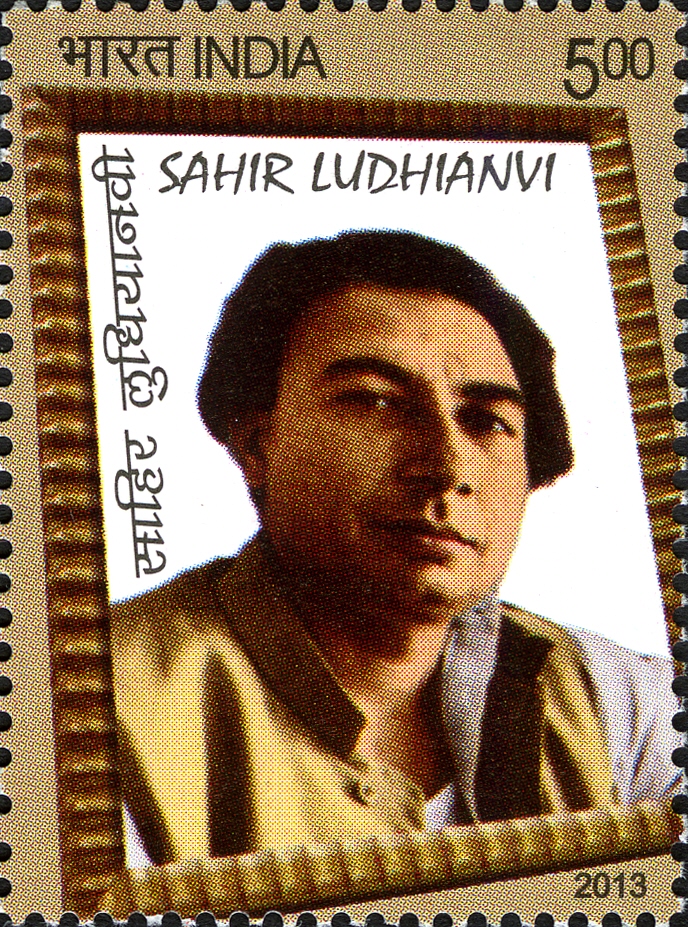
Sahir won a Filmfare Award for Best Lyricist for Taj Mahal (1963). He won a second Filmfare Award for Best Lyricist for his work in Kabhie Kabhie (1976). He was awarded the Padma Shri in 1971. On 8 March 2013, the ninety-second anniversary of Sahir’s birth, a commemorative stamp was issued in his honor.
He was member of All India Students Federation. Sahir Ludhianvi, who has been labeled by objectors as “Anfwan-e-Shabab Ka Shayar” for his poetry, in particular, for stirring the hearts of youngsters and writing literary songs for films, is one of the popular poets and the pride of progressive poetry. The way in which Sahir has given poetic form to their emotions and moods has not been given by any of his contemporary poets. The fact is that by mixing romance and protest, Sahir, with his individuality, gave a new direction to the poetry of the progressive movement. There is a warmth and warmth in his political and protest poems. His choice of words, method of using similes and metaphors is so complete and comprehensive that it is beyond the reach of other poets. Even older poets recognize him as a real poet and his poems meet the standard of criticism. The combination of song, music and lyricism made his ghazals, poems and songs more effective and popular.
Sahir was a controversial figure in that he was artistically temperamental. He insisted that the film score should be composed for his lyrics and not the other way around. He also had a great deal of self-respect. Once a music director had remarked ‘Sahir sahib without Lata’s voice your songs will be ineffective.’ He took a pledge there and then that for two years he would not write songs for films where Lata Mangeshkar would be a playback singer. His films succeeded nonetheless, he promoted Sudha Malhotra’s singing career and she became a popular singer. He also insisted on being paid one rupee more than Lata Mangeshkar and this created a rift between them.
He raised the status of film lyricists to such an extent that song writers’ name started appearing on gramophone records. All India Radio was made to announce the name of the songwriter along with the names of singer and music director. Sahir made it a point to charge a rupee more than the fee of the music director.
Sahir Ludhianvi was slightly different from his contemporaries. A man unable to praise Khuda (God), Husn (beauty) and/or Jaam (wine), his pen was at its best pouring out bitter but sensitive lyrics over the declining values of society, the senselessness of war and politics, and the domination of materialism over love. Whenever he wrote any love songs, they were tinged with sorrow, due to the realization that there were other, starker concepts more important than love. He could be called the underdog’s bard; close to his heart were the soldier gone to fight someone’s war, the woman forced to sell her body, the family living on the street and other victims of society. He roused people from an independence-induced smugness. He would pick on the self-appointed custodian of religion, the self-serving politician, the exploitative capitalist, and the war-mongering super-powers. He wrote Kahat-e-Bangal (The Famine of Bengal) at 25 years of age. Subah-e-Navroz (Dawn of a New Day), mocks the way people celebrate while the poor exist in squalor.
Of his legacy, Sahir writes,”Kal aur aayenge nagmon ki khilti kaliyan chunne wale, Mujhse behtar kahne wale,Tumse behtar sunne wale;Kal koi unko yaad kare,Kyun mujhko yaad kareMashroof zamana mere liye kyunWaqt apna barbaad kare?” (“Tomorrow there will be more who will narrate the love poems. May be someone narrating better than me. May be someone listening better than you. Why should anyone remember me? Why should anyone remember me? Why should the busy age waste its time for me?”)
In a career spanning around 30 years, Sahir wrote 718 songs for 111 films. Sahir said, “I have always strived to bring song writing close to literary poetry and use it to provide political and social perspectives to people.” He believed film songs made poetry accessible even to illiterate film goers. He incorporated many of his poems and ghazals in films. Pyaasa and Kabhie Kabhie became blockbusters because of such poems. His songs explored social evils and the plight of women in man-dominated society. Despite constraints under which a film lyricist has to work, Sahir put across his progressive and secular philosophy.
Sahir has written political poetry, romantic poetry, psychological poetry and revolutionary poetry in which the rebellion of peasants and workers draws our attention. In his Nazms, there is a special vista of his personal experiences and observations. In recognition of his literary services, he was awarded the Padma Shri in 1971. In 1972, the Maharashtra government awarded him the “Justice of Peace” award. In 1973, he was awarded the “Soviet Nehru Award” for his work ‘Aao Koi Khwab Bunen’. He received the Maharashtra State Literary Award. In 1974, the Government of Maharashtra nominated him as a ‘Special Executive Magistrate’. His poems have been translated into various languages of the world.
Exemplifying Sahir’s genius on crafting the musings on human mortality is his iconic song from the film Kabhie Kabhie: ‘Mai pal do pal ka shayar hoon, pal do pal meri kahani hai, pal do pal meri hasti hai, pal do pal meri jawani hai’.
Photos courtesy Google. Experts taken from Google.
 Writer Sunita