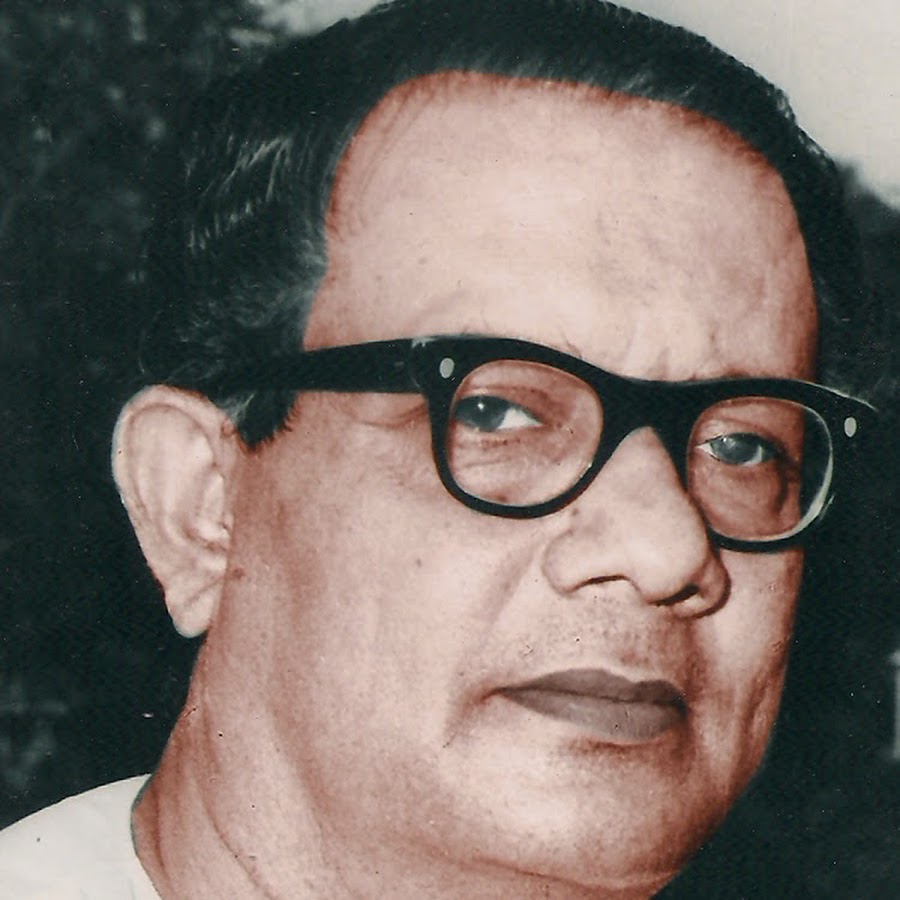
Bimal Mitra (18 March 1912) was an Indian writer in Bengali. Bimal Mitra was equally adept in writing in Bengali as well as in Hindi, and wrote more than one hundred novels and short stories. Many of Bimal Mitra’s novels have been made into successful films. One of his most popular works, Saheb Bibi Golam (January 1953) which was adapted into a hugely popular movie. He also earned a Filmfare nomination for Best Story for the film.
He had served in railways in Bilaspur for long years. He was working in the Chakradharpur Division in the 1940s in the Control Organisation. He resigned from Indian Railway Services in 1950 at the age of 38 to become a full-time writer. One of his novelettes Char Chokher Khela is based on the lives of the Anglo-Indian population of Chakradharpur railway colony.
In his long-spanning career, Bimal Mitra has written more than 100 books and short stories. His novels were sprawling sagas, as was typical of the work of many of his contemporaries, telling sweeping tales of class conflict set against the fast-changing social, political, and economic backdrop of Bengal in the late nineteenth and early-to-middle twentieth centuries.
Saheb Bibi Golam is a 1956 Bengali film adaptation of a Bimal Mitra’s novel that goes by the same name. The storyline is based on the backdrop of the British rule in India and deals with the shocking downfall of Bengal feudalism during that period. This film is one of the best Bengali films that has ever been made and was later saw a Hindi remake titled ‘Sahib Bibi Aur Ghulam’ that proved to be one of the most critically acclaimed Bollywood movies. The story of Chotti Bahu, the younger bride of a feudal family in Calcutta and her fight to win her husband from alcohol and courtesans till she herself becomes an alcoholic, and then her desperate fight to come out of it. Chotti Bahu’s story is closely linked to that of a poor rural boy, Bhootnath, in love with the Jaban, the daughter of a widower Brahamasamaji father. In the background, there is the independence struggle from the British rule and the reformist movement of Hinduism.
Reading “Dayare se Bahar”, was like reading other books of Bimal Mitra, in the sense, the human story grips you and you can’t put it down. The four main actors of this book are Shekhar, the idealist revolutionary who has left his rich father’s home in search of India’s independence; Suruchi, the young girl who loves Shekhar and is carrying his child; Mrinmayi, the mother of Suruchi, who is sick but decides to playact to be pregnant so that her unmarried daughter’s name and honour can remain intact; and finally Sadanand, Suruchi’s intellectual father who is lost in his world of books and ideas. The whole story is played out against the backdrop of second world war. It is the last part of the book “Dayare se Bahar”, that Bimal Mitra described as the “new part of the story that he had discovered later”, that he touches on themes of philosophy and spirituality. The character of Gaurdass and his dialogues with a guilt ridden tormented Suruchi, Bimal Mitra talks about “his own” philosophy of life. Gaurdass, “….Man says, if action is material, it is physical and it is a chain for the spirit. But inside the man, there is a woman, she says, I need work, and need work, thus liberation of soul is in the work – leaving the world is not liberation, darkness is not liberation, inactivity is not liberation. These are all terrible chains. There is one way to cut these chains, through work. Only work liberates the soul and this world is the theatre of our work. How can you leave the world, daughter! If you want liberation than you have to live in this world.”
“Rakh” (Ash) and that earlier, he had finished the story at one point, while today “he knows something more about what happened to the main actors of his story” so this new part has been added.
Another one of his book is “Jana Gana Mana” in which, the young woman Sandhya Ghosh gives her life for India’s independence. In this book, Bimal Mitra explores the use of violence for a cause and concludes, “To keep alive truth, justice and goodness, force needs to be worshipped.”
Explaining the role of literature, he writes, “Human beings expect a lot from literature. They expect joy, thrill and contemporary enjoyment. Even more than all these, they expect to receive some thing from literature. The same expectations are there, also from theatre. In literature and theatre, the expectation of enjoyment is much less compared to that of to receive an understanding.”
In a beautiful short story “Gharanti” (Housewife), he tells about Mrs. Chowdhury, who wants him to write the story of Lavanya and Niranjan. Mrs. Chowdhury is a madam and supplies prostitutes to rich clients. Lavanya is one of her gilrs, who falls in love with Niranjan and gives up on her profession, to join an office. Lavanya and Niranjan need money and a rich client Phulchand is willing to pay for a night with Lavanya.
Stree is a 1972 Bengali film was based on the novel of Bimal Mitra as same title and the era of the plot showing during the Second World War.
Set in the last years of the nineteenth century, the novel tells the story of the sumptuous lifestyle and the decay of a feudal family. It is the story of Pateshwari, aka Chhoto Bou, a woman who wants to experience romance, to be a real wife, to invent for herself and live a new kind of conjugality. The book also tells the story of Calcutta, now Kolkata, and of all the people who lived there.
Asami Hazir is another popular work of Bimal Mitra. The novel is based on the true story of a man who wants to repent for the sins of his father and grandfather. The novel was adapted into a TV series for Doordarshan – Mujrim Hazir.
Photo courtesy Google. Experts taken from Google.
 Writer Sunita