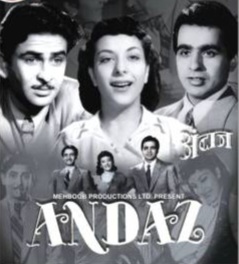
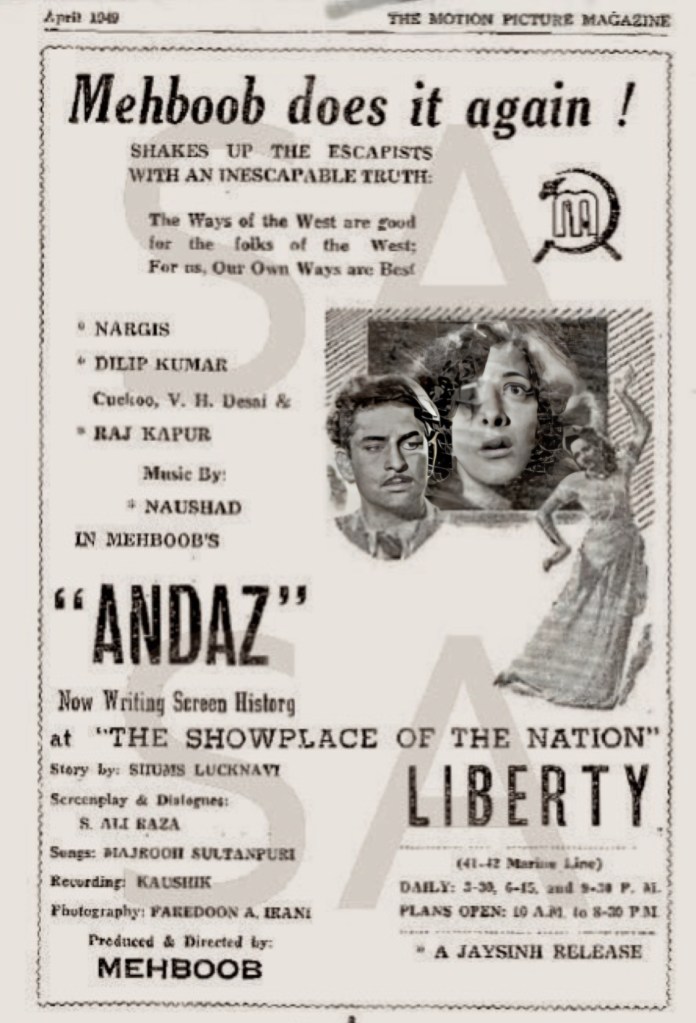
Andaz is 1949 Indian Bollywood (Hindi Language) movie, the creator of which was legendary director Mehboob Khan. There is no doubt it proved to be a watershed film in the careers of Dilip Kumar, Nargis and Raj Kapoor. The story is written by S. Ali Raza & Shums Lucknavi. It was a huge hit at the time of its release and broke all box office records.
Nina (Nargis), the only daughter of indulgent multi-millionaire (Murad), it is at their summer home in Shimla. Nina has all that money can buy, and servants to cater to her every need – to dress her, to serve her tea in bed; her father dotes on her, even though he struggles with her wilfulness. Educated abroad, her life now revolves around horse riding, tea parties and tennis games. One morning, out riding on her own (her father balks at riding every day), she loses control of her horse. A young man saves her from plunging over a cliff along with her horse; he then takes Nina to hospital. Fortunately, she is not hurt much. When her father reaches the hospital, he’s taken aback to see his daughter on extremely friendly terms with a strange young man, whom Nina has nicknamed ‘Mr Ghoda‘. He’s even more disapproving when she invites him home.
The next morning, Dilip puts in an appearance. Nina is more than pleased to see him, and soon, Dilip is singing of his attraction for her. While Nina is engrossed in his song, Dilip is thrilled that she seems to be returning his interest. Dilip is a frequent visitor to Nina’s house, and they, along with Nina’s best friend, Sheela (Cuckoo), spend their time very pleasantly indeed. It is becoming very clear that Sheela is beginning to be attracted to the handsome young man, while Dilip is falling more and more in love with Nina. This time, it’s Nina’s turn to sing, and her song makes Dilip’s heart miss a beat. It appears to him that she’s singing solely for him.
Her father thinks it is time to intervene – he cautions his daughter that society plays by certain rules, rules that are not taught in college. She goes against them, then society will not allow her to survive. Nina is nothing if not headstrong – is her father still bound by the rules of a century. Despite his evident disapproval, her father cannot bear Nina’s sadness, and he permits her to invite Dilip to her birthday party. Her proximity to Dilip doesn’t go unnoticed, and her father’s misgivings continue to grow. Nina is oblivious to the undercurrents, though Sheela, losing her heart to Dilip seems to guess – quite accurately – that Dilip’s interest lies elsewhere.
The next morning sees Nina and her father at odds again – the latter tries to explain to his daughter that her meeting Dilip so openly, her unaffected behaviour towards him can give both him, and society, the wrong impression. Nina is upset. Her father is brutally frank – now that talk affects those closest to him, he’s especially vulnerable. He begs her not to misunderstand him, and Nina, her heart melting at his love and trust, promises that she will never bring dishonour to his name.
Nina and Dilip are at Sheela’s birthday party; Dilip tries to confess his love for Nina, but Sheela’s presence prevents him from saying anything. Later, dancing with Sheela, she tells him frankly that he has no place in Nina’s heart, but lovestruck Dilip doesn’t believe her. The events of the night only cement that feeling – Nina’s father has had a heart attack, and Dilip escorts Nina home.
Her father’s unexpected death leaves Nina bereft. Dilip is a godsend at this vulnerable time, and he takes care of her with such tenderness that when Nina finally breaks down in tears, it is to him that she turns for solace. Not only that, she takes Dilip to Bombay with her, making him both her company’s manager and her co-partner in her father’s business. Dilip is taken aback but once again, hears Nina’s words as proof that she loves him as much as he loves her. He throws himself into running the business, and following Nina’s wishes to the last word. Days pass, and one day, he overhears her singing; he can barely hide his happiness. However, his happiness is destined to be short – lived.
Dilip tries to confide in Neena about his feelings for her but is shocked when her fiancé Rajan (Raj Kapoor) returns from London. Rajan is very welcoming of his presence, and Nina is more than happy to see her beloved and her best friend together. But Dilip is beginning to feel the pangs, and he excuses himself as much as possible. He is conflicted, the more so when Nina confesses that she’d loved Rajan for years. She’d never so much as mentioned him before, but Nina reminds him of all the times she’d referred – obliquely – to her affections already being engaged.
He’s such a close friend that she doesn’t see why he shouldn’t know how she and Rajan had met. She doesn’t realise that her words are twisting the knife deeper into Dilip’s heart. It is clear to him that Nina has been in love with Rajan all this time; it was he who had been mistaken. Dilip has to stand by and watch Nina marry Rajan. He keeps his silence until that night, when his anguished heart breaks all bounds. When Nina stops him from leaving, he is forced to confess he loves her, and that he was mistaken in thinking she loved him as well.
Nina is not so much shocked as afraid, guilty and ashamed, all at once. Her emotions make her hit out at Dilip, who’s leaving so as to not cause her dishonour. However, he refuses to take back his words, and Nina is forced to remember her father’s admonishments. She tries to tell Rajan what had occurred, but her new husband assumes she’s talking about him. Nina, scared that her husband will discover the truth, guilty that she had inadvertently encouraged Dilip’s attentions, ashamed of the attraction that she feels towards him, doesn’t know what to do. Dilip’s words echo in her heart, until she feels she’s being driven insane. In a bid to outrun her demons, she runs away to Shimla, where her husband’s deep, unconditional love offers some solace.
Despite Rajan’s pleas, she refuses to return to Bombay, causing Rajan to wonder why she was so reluctant. Seasons pass, and while the newly weds stay back in Shimla, Dilip continues to work in his capacity as Nina’s manager. He would like to leave, but remains because he’s afraid of what his sudden departure would do to Nina’s reputation. Meanwhile, Nina has given birth to a daughter, and for a while, she is blissfully happy. Months pass, and their daughter is almost a year old. Nina is now troubled by Rajan’s indulgence towards their daughter – he fulfils her every whim – but she cannot bring herself to explain why she is terrified. Rajan has decided that their daughter’s first birthday will be celebrated back in Bombay. He’s had enough of living in Shimla for two years. Nina agrees.
Back in Bombay, Dilip is waiting eagerly for Nina and Rajan to return. He intends to leave her employ as soon as he meets them, and writes a letter to Nina apologising for mistaking her feelings. He also returns the 50% share of the company that Nina had given him earlier – and conceals the letter in the stuffed toy he’s bought as a present for Nina’s daughter’s birthday. His arrival shocks Nina. When the electricity cuts off and causes a blackout in their home, Neena tries to secretly tell Dilip that she does not love him and that he should leave, unaware that she has said all this to Rajan. Rajan accuses Neena of having an affair with Dilip and Dilip decides to clear Rajan’s misunderstanding. He confronts Rajan and tries to convince him that he is wrong about Neena.
Seeing that her tears do not make a dent in Rajan’s anger, Nina impulsively sets out to meet Dilip to beg him to leave. But it’s late at night, and saner counsel prevails – she decides to telephone him instead, and finally decides to write to him. Dilip is packing to leave, but her letter causes him to visit them the next morning. The crack in Rajan’s and Nina’s relationship has widened into a chasm. Dilip’s visit sets the embers blazing, and Rajan is in no mood to listen to his explanations either.
His cruel sarcasm prompts Dilip to be even more forthright, going as far as to tell Rajan that he doesn’t understand his wife, nor her love for him. Goaded beyond endurance, Rajan aims a blow at Dilip with his tennis racquet, grievously injuring him. Nina is petrified; on his continued existence depends her life and happiness. Living, he’s the proof of her innocence; dead, he becomes the mark of her everlasting shame. He confronts Rajan and tries to convince him that he is wrong about Neena. In a fit of rage, Rajan attacks Dilip rendering him unconscious. He leaves home and takes his daughter with him. Neena comes to Dilip’s aid and tells a doctor to save him as he is proof that she has not cheated on Rajan. When Dilip awakens, he is half mad and tries to molest Neena, insisting she really is in love with him. Neena grabs a gun and shoots Dilip, killing him instantly, and is then imprisoned.
Rajan testifies against Neena in court about her affair with Dilip and how she killed him to hide her infidelity. While Neena awaits for the judge’s verdict, Rajan tells his daughter that she is not coming back and tears up the doll that Dilip had given her on her birthday. Inside the doll he finds a letter Dilip had written for Neena, saying that Rajan is the fortunate one who she loves and he has realised this now. Upon reading the letter, Rajan realises he had been wrong about Neena and that Neena loved only him. The judge sentences Neena to life imprisonment and Rajan and his daughter come to see her before she is taken away.
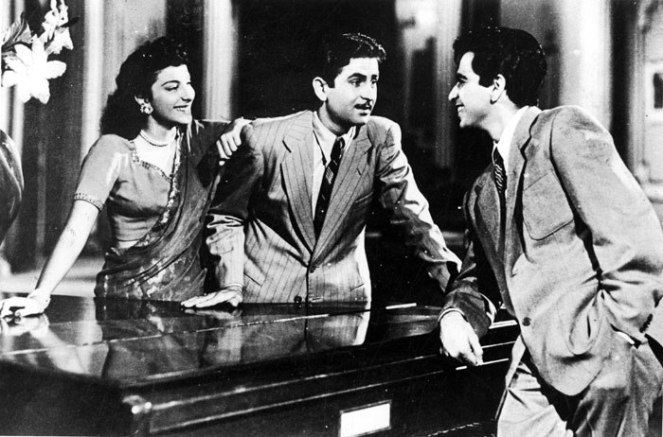
Andaz is also memorable because it was the only time that two legends, Raj Kapoor and Dilip Kumar, came together for a film, with fascinating results. It’s captivating to see three of the brightest names on the Hindi film firmament — Nargis, Raj Kapoor and Dilip Kumar — so young and together onscreen for the first and last time. Any casting permutation combination with this trio is interesting; to get them together is terrific.
The object of Dilip and Raj’s affection in the film is Nargis. Just 20 years old then, English-speaking Nargis perfectly suited the character of the immensely – wealthy, modern Neena who is at home in a world of butlers and mems. She develops a chatty friendship with Dilip and seems oblivious to his raging attraction towards her — even when he croons such pointed songs as ‘Tu kahe agar jeevan bhar main geet sunata jaoon‘.
Thespian Dilip who benefited the most with the success of Andaz. The audience loved his searingly complex and intense portrayal of a man who is in love and struggling to maintain balance as he realises she is engaged to another man. His love and subsequent conflict were beautifully conveyed through four solo songs composed by Naushad, sung by Mukesh and portrayed masterfully by Dilip seated on a piano.
The film could be read as a cautionary note for a newly independent India and the pitfalls of rampant Westernisation. Andaz, often cited as one of India’s first modern films. Director Mehboob Khan’s vision is thankfully deep. The sympathy rests with the woman throughout. Mehboob also adeptly explores the varying aspects of love in this eternal triangle. In one scene, Dilip appears in Neena’s mirror as the manifestation of her subconscious, capturing the ambivalence of her feelings for him.
This landmark film on love, platonic and otherwise, is enhanced by its music and the stars. Dilip Kumar projects a seething intensity. Raj Kapoor and Nargis bring to vivid life the sheer ebullience of young love, especially in Yun toh aapas mein which Mehboob picturised in tight closeups of the two facing each other.
Music maestro Naushad made Mukesh sing for Dilip Kumar, while Mohammed Rafi playbacked for Raj Kapoor. Mukesh (who later went on to become Raj Kapoor’s favourite playback singer), was used here to voice Dilip’s anguish in Tu kahe agar, Jhoom jhoom ke naacho aaj, Toote na dil toote na and Hum aaj kahin dil kho baithe. Raj’s solo song Yun toh aapas mein bigadte hai was vocalised by Rafi, who was later associated more with Dilip Kumar.
A melodramatic tale that is greatly helped by the screen presence of Nargis and Raj Kapoor. These two actors have great chemistry together, and look perfect interacting with one another. It also had a bit of a Orson Welles quality to it with some influences by “Gone with the Wind”, feeling really big and epic. young raj kapoor gives a star performance of genuine, fascinating strangeness – jealous, mercurial, aggressively performative, a little dapper and very sleazy – and nargis, god queen of melodrama, outdoes them all, bringing a complexity and intensity of response to (dumb) scenes that almost short circuits whatever the hell is going on in this film.
Film that depicts a progressive relationship and places a very modern woman at its centre, but then develops cold feet and punishes her for being “immoral”. A fascinating film, because it is so fraught between the old and the new, the traditional and the progressive.
Its gloss was created by the high-key cinematography done by one of India’s greaest Cinematographers Fardeen Irani. Its excellent editing, its direct and forceful story-telling are truly remarkable. The edge – of -seat syspence created by the fateful drama of two ment both in love with the same woman and its culmination in the final, in evitable tragedy make it a unique film.
Photos curtecy Google. Experts taken from Google.
 Writer Sunita