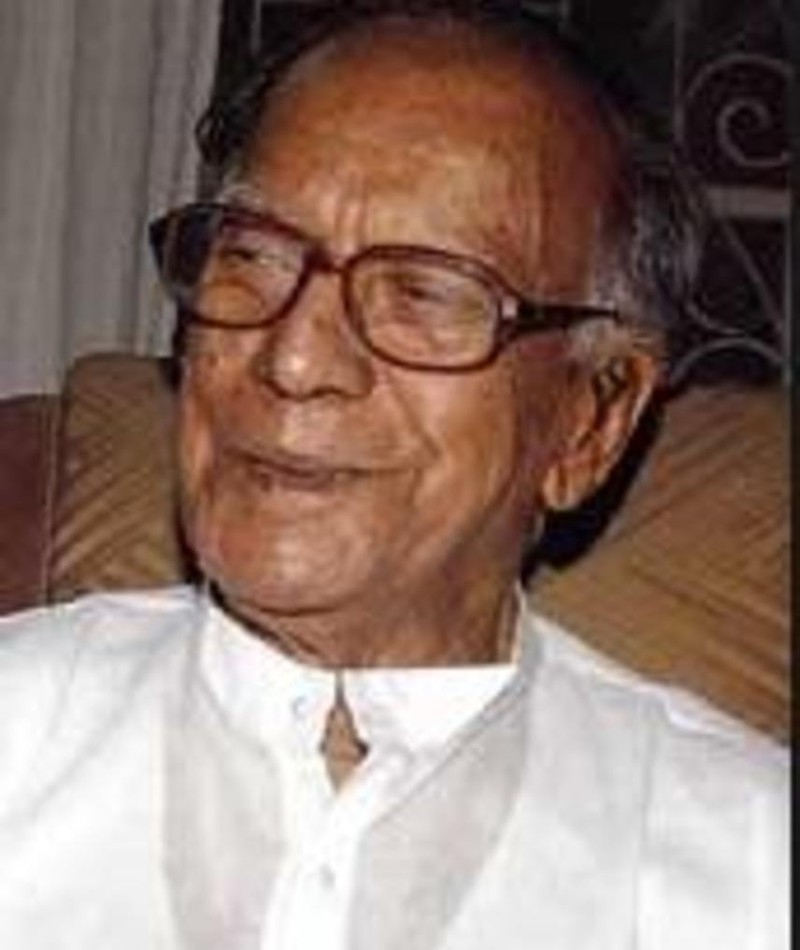
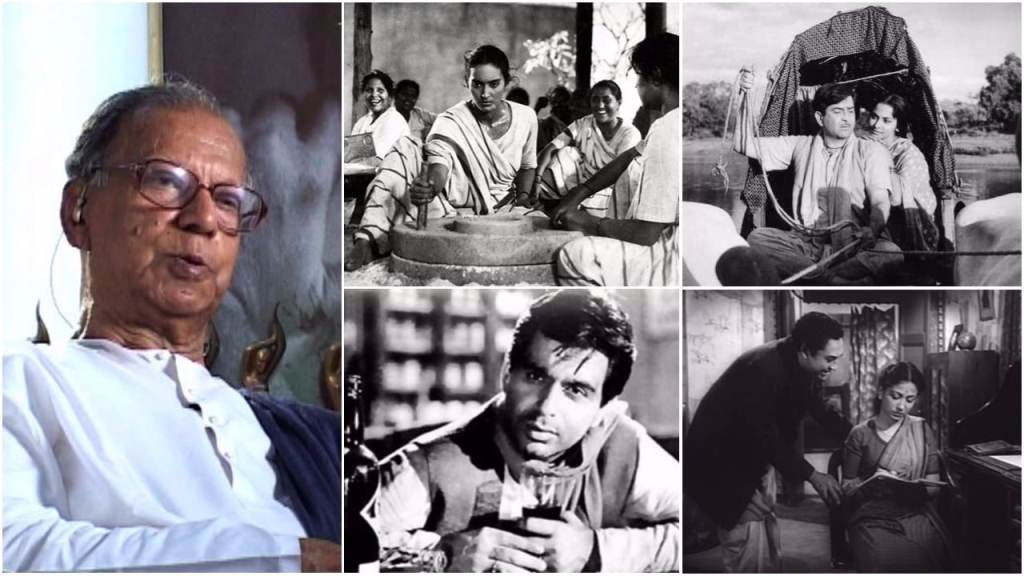
Nabendu Ghosh was was born 27 March 1917, a dancer, novelist, short-story writer, film director, actor and screenwriter. His oeuvre of work includes thirty novels and fifteen collections of short stories, including That Bird Called Happiness: Stories, edited by Ratnottama Sengupta (Speaking Tiger, 2018). Nabendu Ghosh was undoubtedly one of the greatest scriptwriters in Indian Cinema. Through his long career, Ghosh penned about 60 scripts. The humane trait of his writing made him a natural choice for directors like Bimal Roy, Satyen Bose, Guru Dutt, Sushil Majumdar, Hrishikesh Mukherjee, Raj Khosla, Asit Sen, Basu Bhattacharya and Shakti Samanta. He later teamed up with newer directors such as Dulal Guha, Prakash Mehra, Sultan Ahmed, Mohan Saigal and Subhash Ghai. This offers a measure of the range and diversity of his screen writing. Gyan Mukherjee’s Shatranj (1956), Satyen Bose’s Jyot Jale (1968), Mohan Segal’s Raja Jani (1972), Arabinda Sen’s Jaalsaaz (1959) and Ajoy Kar’s Kaya Hiner Kahini (1973) (Bengali) were films based on his original stories. In his career, he directed four movies as well.
At the age of 12 he became a popular actor on stage. The seeds of a career in creative writing were also sown when he was in school. By 1940, he has established himself as a recognized writer of merit in Bengali literature. He soon ranked among the most progressive young writers in Bengali literature. His first novel, Bhagnastoop (The Ruins) was serialized in a Bengali magazine called Prabhati. He got a Masters in English literature in 1939 from Patna then within Bihar Province.
Some of his short stories and novels send shivers down one’s spine. His involvement in the freedom struggle in the 1942 movement cost him his job at the DIG’s office in 1944 for his novel Dak Diye Jai, was set against the Quit India Movement. But the novel also made him famous and he shifted from Patna to Kolkata in 1945.
In his prize speech after receiving the Bankim Puraskar from Buddhadev Bhattacharya, Ghosh traced Bankim Chandra, the author of Vande Mataram, as his first inspiration. “I was so charmed by Durgesh Nandini that I stayed up nights creating a Nabab Nandini.” But his father advised him to learn from those he admired but to write from life around him and stopped him from becoming a copycat. Ghosh did just that and became the voice of the 1940s. He wrote not only on the Quit India Movement, about famine, about the pre-Partition riots and on post-Independence pressures, but as years went by, he broadened his canvas to write around the urbanization of India and against the backdrop of its nuclearization; about corruption of morals in political life and about the souring of love, fantasies of science and the weakening of faith.
Ghosh joined Bimal Roy as his screenplay writer when Roy decided to shift to Bombay in 1950. Under Bimal Roy Productions, Ghosh wrote some of the best scripts ever in the history of Indian cinema. He began as assistant to Roy but got into script writing when Roy suggested he do scripts. His first screenplay was for Maa (1952), directed by Bimal Roy. Ghosh and Roy arrived together with Hrishikesh Mukherjee (as editor) and Asit Sen (as assistant director) to work on the Bombay Talkies film Maa. Soon the other talented technicians from Roy’s Calcutta team joined them including Salil Chowdhury (Music Director), Moni Bhattacharya and Debu Sen (Assistant Directors), Paul Mahendra (Dialogue Director), Kamal Bose and Dilip Ranjan Gupta (Cinematographers) and Biren Naug and Sudhendu Roy (Art Directors). Maa, in which the central role of an old and hapless mother was played by Leela Chitnis, had Shyama and Bharat Bhushan in romantic leads. Paul Mahendra played the role of ungrateful elder son of Maa. Ghosh was the only writer in the team. In other words, each member of this hugely talented and visionary team would move on to chalk out illustrious career paths, creating benchmarks in their respective fields for Indian cinema.
He wrote the story and screenplay of Baap Beti, but still no name in the credits. His name began to appear in the credits for the screenplays of Parineeta (1953), Biraj Bahu (1954), Naukri (1954) and Amanat (1955), the last directed by Roy’s assistant Arabinda Sen. These films were a turning point for this great man who remained unassuming and modest till the end of his days, belying the history he carved for Indian cinema. He wrote the screenplays of Yahudi, Sujata, Devdas, Bandini and the documentary on Swami Vivekananda.
When Roy gave him permission to work with other filmmakers, Ghosh wrote the screenplay for Guru Dutt’s Aar Paar and Hrishikesh Mukherjee’s Majhli Didi and Abhimaan. He wrote the script of Phani Majumdar’s Baadbaan, the first ever film in India to have been produced by a workers’ cooperative. Ghosh wrote the screenplay of Raj Khosla’s directorial debut film Milap, starring Geeta Bali and Dev Anand. Much later, Manoj Kumar’s early film as hero, Kaanch Ki Gudiya, had its screenplay penned by Ghosh.
His subjects were rooted in realism, his language forever sought new expressions in aesthetics and focussed on the tragedy of human pain. Ghosh’s first completed and released directorial film, Trishagni (1988) based on a tale of triangular love and desire set against the backdrop of Buddhist history in the 1st century BC with Pallavi Joshi, Nitish Bharadwaj, Alok Nath and Nana Patekar sharing the acting credits. The film fetched Nabendu Ghosh his first and last National Award. The story and the film juxtapose worldly desires with the exemplary discipline and distilled love between Pippali and Kapilani. “My reverence for Buddha has inspired me to write a Bengali novel derived from the story of Pippali and Kapilani in the Buddhist text Theri Gatha. Some other texts also mention how the newly married couple were drawn towards the Buddha and finally took refuge in him. Pippali later turned on to Maha Kashyap, one of the chief ‘lieutenants’ of Buddha. Bichitra Ek Prem Gatha marks 2550 years of Buddha,” wrote Ghosh for the Osian Cinefan Festival in June 2006, in Delhi, where the film was screened as a tribute to him.
His autobiography, Eka Naukar Jatri was published in March 2008. To commemorate his birth centenary, an English translation of his science fiction novel, Aami o Aami (1999), was released on 25 March 2017. He had worked on the translation with his grandson, Devottam Sengupta. The book is known as Me and I in English.
The late Nutan said, “two of my best roles were penned by Nabendu Ghosh for Sujata (1959) and Bandini (1963). These films by my favourite director Bimal Roy brought out two unknown aspects of womanhood and fired an intensity not seen in any other film of mine. Nabenduda and Bimalda formed one of the greatest script-writer-director combination duos of Indian cinema.” During his 90th birthday celebrations, Amitabh Bachchan said, “I worked in three films scripted by Nabendu Ghosh of which, Abhimaan (1973) and Do Anjaane (1976) could draw out of me the intensity the characters deserved. To this day, Abhimaan remains one of the films that are closest to my heart.”
Right through his work as story and scriptwriter, Ghosh was preparing to take on the directorial wand. He had written a screenplay, tentatively titled Prem Ekti Kobita, in Bengali, based on Subodh Ghosh’s Ramgiri. Ashok Kumar stepped in to produce the film. The casting was complete with Ashok Kumar, Soumitra Chatterjee, Indrani Mukherjee, Tarun Bose and Padma Devi in the cast. “We shot for two days. But then, Ashok Kumar, angered with the production accounts, suddenly withdrew all support. Instead of being frustrated, I became more determined to go ahead with the project.”Ghosh once mentioned in passing.
He then went on to write the script of Basu Bhattacharya’s Teesri Kasam (1966) based on a Phanishwar Nath Renu story. His next attempt at direction came with a film called Daktar Babu based on Phanishwar Nath Renu’s Maila Aanchal. The film shot several reels with an impressive cast of Dharmendra, Jaya Bhaduri, Asit Sen, Nasir Hussain, Kanhaiyalal, Kali Banerjee and Ajitesh Banerjee. But the producer died midway through the film and it never got made.
He made another film for the Children’s Film Society of India called Netraheen Sakshi. It was about a visually challenged boy who could identify men from their voices. Ladkiyaan (1997), produced by the Ministry of Health and Social Welfare, was inspired by the true-life story of three sisters who committed suicide when they heard their father threatening their pregnant mother with dire consequences if she ‘dared’ to deliver a girl again. In 1995, he did a tele-serial called Anmol Ratan for Doordarshan on Ashok Kumar.
Ghosh also took scripting workshops with the film direction students at FTII, Pune from 1967 to the early 1990s. He served on the script committee of the NFDC for some time and had served as member of several juries for the National Film Awards and the Indian Panorama. He headed the film delegation at the Festival of India in Thailand in 1997 with his film Trishagni.
Dev Anand, who played hero in Phani Majumdar’s Baadbaan, based on a script penned by Ghosh says, “I came across Nabenduda during the shooting of the film. He was highly imaginative and original. This was the only film in which I played the role of a fisherman. I was nervous because I was sandwiched between pillars like Ashok Kumar, Meena Kumari and Sheikh Mukhtar. Nabenduda maintained a professional outlook and distance. His scripts made every actor realize that no one is greater than the script.”
Nabendu Ghosh belonged to an age and generation where few film people talked about themselves or their work. The long string of awards that attached to his name over the years stood lightly on his petite shoulders. He has won almost every single literary award bestowed on Bengali litterateurs in the country from the Bankim Puraskar through the Bimal Mitra Puraskar to the Amrita Puraskar. He was lucid and filled with pleasant anecdotes from his life with Bimal Roy and other luminaries till the last day of his life. Alas! They don’t make them like him any more.
Ghosh has left behind an entire heritage of beautiful scripts that will remain in the archival history of Indian cinema for all time to come.
March 27, 2016 marks the birth centenary of Nabendu Ghosh, the legendary script and screenplay writer who quietly worked behind the scenes with some of the best known filmmakers of the country, visually mapping every frame of the film through words before it would go on the floors. In a candid conversation with this writer at her home in South Delhi last year, Ratnottama Sengupta, the daughter of Nabendu Ghosh had revealed the many facets of her illustrious father who raised screenplay writing to the level of a literary art form in Indian cinema. We present an exploration of Nabendu Ghosh’s journey through films to mark his birth centenary.
All these films had their screenplays crafted by one person – the gentle, unassuming Nabendu Ghosh, the legendary script and screenplay writer who quietly worked behind the scenes with some of the best known filmmakers of the country, visually mapping every frame of the film through words before it would go on the floors.
“Even today, people do not know what is screenplay. The stars, director, music composer, singers, lyricist, even cameraperson, choreographer and editor are known but most people are not sure what exactly is the screenplay.” In such a scenario, Nabendu Ghosh is one name that commands high respect from everyone from stars and filmmakers to novelists and litterateurs.
“Scriptwriter Nabendu Ghosh’s perfect characterization enabled any director to shoot the film with ease. He had the rare ability to pen the pulse of a character. His scripts brought to films a literary value that was missing in that period. His Devdas was closest to the novel and the script brought into full play the actor in me. His amazing versatility came forward after Devdas in Yahudi. The ideal scriptwriter-director combination he formed with Bimal Roy are not found today.” said Dilip Kumar.
“He is an amazing scriptwriter. His Teesri Kasam made me look Hiraman and not Raj Kapoor. I should have included him in the RK camp long ago.“ ~ Raj Kapoor, narrated by Subrato Mitra in Screen, 1967
Writes Saibal Chatterjee in Encyclopedia of Hindi Cinema, “Ghosh’s strong literary sensibility imbued such Roy masterworks as Devdas and Sujata with a rare depth of feeling and empathy. Ghosh who turned director himself at the age of 70 with Trishagni, also scripted films such as Guru Dutt’s Aar Paar and Basu Bhattacharya’s Teesri Kasam.
His first directorial venture that never saw completion, was a subject close to his heart. The story Maila Aanchal by Phanishwar Nath ‘Renu’ explored the deep-rooted caste discrimination which was predominant in Bihar. Ghosh was against it very strongly, as he had already written Sujata. This story was about a doctor ‘Dagdar Babu’ who was an orphan and had been raised by a family but even as a doctor when he goes into the villages, the first question he is asked everywhere is ‘what is your caste?’
This close association with Ashok Kumar turned into friendship and mutual respect that prompted Nabendu Ghosh to write ‘Ashok Kumar: His Life and Times’, published by Harper Collins (translated into Marathi). “Dry words can never convey a life,” says Ratnottama daughter of Nabendu Ghosh. “My father believed that this ‘maila aanchal’ of the motherland must be cleansed. He had wanted to make this film since 1963,” says Ratnottama. Producer SH Munshi who was from Gaya, Bihar wanted this film to be made and was insistent that Nabendu Ghosh should direct this film. He had earlier produced Baap Beti, directed by Bimal Roy based on Nabendu Ghosh’s story, which starred Ranjan along with Tabassum and Asha Parekh and Naaz as a child artists.
However, as fate would have it, the movie got stalled twice and after 80 percent of it had been completed, the untimely death of SH Munshi shelved it forever. The film which starred Jaya Bhaduri and Dharmendra is not traceable anymore. The music by RD Burman is also lost. The RD Burman Kosh by Vishwas Nerurkar lists this title as Abha Chitram’s ‘Dagdar Babu’; Director: Nabendu Ghosh; Producer: SH Munshi; Lyricist: Yogesh; with Dharamendra, Jaya Bhaduri, Utpal Dutt, Urmila Bhatt, Kali Banerjee, Amjad Khan
Netraheen Sakshi (1992) was produced by Children’s Film Society of India and Ladkiyan (1997), inspired from the real life incident of three sisters committing suicide to save their parents from the burden of dowry as made for the Ministry of Health and Social Welfare.
Legendary filmmaker Mrinal Sen sums it up thus: “As a writer and a creative individual, Nabendu Ghosh has never believed evil is man’s natural state. Along with his characters he has been confronting, fighting and surviving on tension and hope.”
Photos curtecy Google. Experts taken from Google.
 Writer Sunita