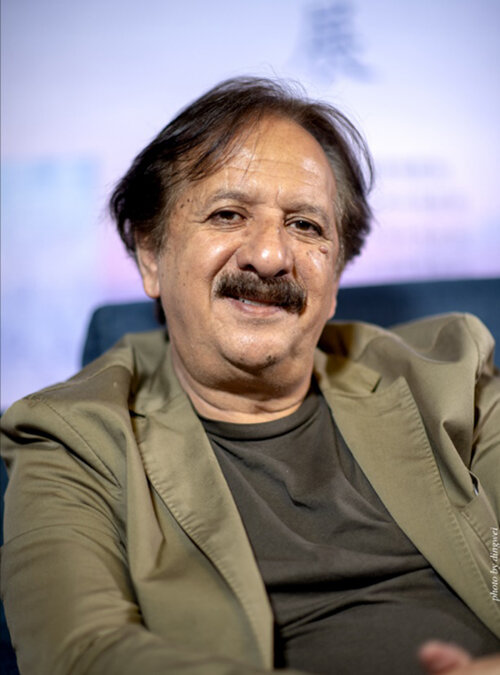
Majid Majidi born 17 April 1959 is an Iranian film director, producer, and screenwriter, who started his film career as an actor. In his films, Majidi has touched on many themes and genres and has won numerous international awards.
Born in an Iranian middle-class family, he grew up in Tehran and at the age of 14 he started acting in amateur theater groups. He then studied at the Institute of Dramatic Arts in Tehran. After the Iranian Revolution in 1979, his interest in cinema brought him to act in various films, most notably Mohsen Makhmalbaf’s Boycott in 1986, where he played a frustraited communist and Ali-Asghar Shadorvan’s Teer baran where he played the role of real life character, Andarzgoo. Later, he started writing and directing short films.
Baduk is a 1992 Iranian film deals with child slavery. The Persian term “baduk” refers to people, often children hired against their will, who carry smuggled merchandise from the border on foot. Jafar and his sister Jamal are separated from their parents after their father is killed in a well cave-in. While walking along the road, the siblings are kidnapped and sold into slavery. Jamal is dressed in fancy silks, destined to be the playmate of a Saudi prince. Jafar is drafted into a band of child baduki, bringing goods across the border between Pakistan and Iran. Jafar escapes his captors, and engages the help of Noredin, a Pakistani baduk he has befriended. Together they work to free Jafar’s sister, Jamal. The movie ends with a doomed act of bravery on the part of Jafar. Baduk premiered in January 1992, and was shown that February at the Tehran Fajr Film Festival. It was screened at the Director’s Fortnight at Cannes in 1992, where it was considered a bold film from the Islamic Republi of Iran. Director Majidi ran into censorship problems after making this film.
The Father is a 1996 Iranian film won a number of awards at film festivals both within Iran and internationally. The word pedar means father in Persian. Fourteen-year-old Mehrollah’s father is killed while a passenger on the motorcycle that Mehrollah is learning to ride. To support his family, Mehrollah takes a job in the city. Upon returning for a visit, he learns from his friend Latif that his mother has remarried to a policeman and moved to a larger house. This deeply angers Mehrollah, who refuses to accept his new step father; he also becomes bitter towards his mother.
Taking up residence in the family’s former home, Mehrollah kidnaps his young sisters, only to have his friend Latif betray their location. Latif acts as the go between for Mehrollah and his estranged family. When Mehrollah is injured, Latif summons his step father, who takes Mehrollah home to recover. As he gets better, he steals his stepfather’s service revolver, and flees to the city with Latif. The step father heads to the city on motorcycle and arrests both of the boys. Placing Latif on a bus, he takes Mehrollah back home on his motorcycle, but on the way the motorcycle breaks down and they become stranded in the desert. Through the extreme hardship that follows, Mehrollah slowly softens, and comes to accept his stepfather.
Majidi has a finger on the pulse of humanity, agony, and relationships. But, his focus on the truth doesn’t waver. Well, it holds true for most of his films. This is Majidi’s second feature film, and one can see the glimpses of themes, style, and approach, for which he became globally renowned eventually.
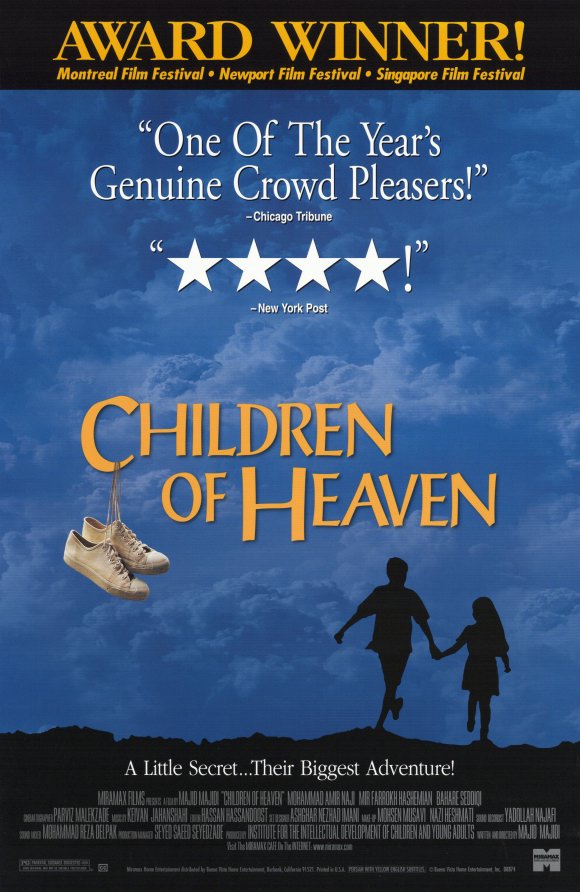
Children of Heaven is a 1997 Iranian family film written and directed by Majidi. It deals with a brother and sister, and their adventures over a lost pair of shoes. It was nominated for the Academy Award for Best Foreign Language Film in 1998.
The film starts with Ali fetching his little sister Zahra’s pink shoes after a cobbler has repaired them. He leaves them unattended to buy some potatoes. While he is pre-occupied, a homeless man picks up the shoes, hidden in a bag, thinking it was garbage and takes them away. Frantic to find them, the young boy, thinking the shoes fell behind the crates, knocks over plates of vegetables and is chased away by the grocer. Ali, is afraid to tell his parents. His sister, named Zahra, wants to know how she is supposed to go to school without shoes. The children feverishly write notes to each other, right under their parent’s noses. Zahra will wear Ali’s sneakers to school every morning, and then run home so that Ali can put them on for his school in the afternoon. But Zahra cannot always run fast enough, and Ali, who is a good student, gets in trouble for being late to class.
One day, Zahra notices her missing pink shoes on another student, Roya’s feet. After class, Zahra secretly follows Roya home. She later brings Ali with her for a confrontation, but from hiding, they discover that Roya’s father is blind, so they decide to leave. When Roya does well in her studies, her father buys her new violet shoes and throws away Zahra’s. Zahra is dismayed when she finds out from her new friend.
Ali’s father, anxious to earn more money, borrows some gardening equipment and heads off with Ali to the rich suburbs of North Tehran to find some gardening work. They try many places without success, though Ali proves to be a great help to his tongue-tied father. Film has a wonderful scene where Ali and his father bicycle from the almost medieval streets and alleys of the old town to the high-rises and luxury homes where the rich people live. The father hopes for work as a gardener, but he is intimidated by the challenge of speaking into the intercoms on the gates of the wealthy. His son jumps in, with offers of pruning, weeding, spraying and trimming. It is a great triumph.
Ali learns of a high-profile children’s 4 kilometer footrace involving many schools; the third prize is one week at a vacation camp and a pair of sneakers. Ali sees this as his chance to earn a new pair of shoes for Zahra. To his bitter disappointment, in a hard-fought dash to the finish, he accidentally places first instead. Ali returns home where Zahra is waiting for him. However, before he can reveal to his sister his disappointment in his placement in the race, she is called away by their mother. In a separate scene, there is a quick shot of the children’s father’s bicycle as he’s riding home, showing a pair of white and a pair of pink shoes among his purchases. In the final shot, Ali is dejected as his sneakers are torn from the race—he is then shown dipping his bare blistered feet in a pool.
“Children of Heaven” is about a home without unhappiness. About a brother and sister who love one another, instead of fighting. About situations any child can identify with. The film was shot in Tehran. It was attempted to keep the filming secret in order to capture a more realistic image of the city.
After the film had become well known worldwide due to the Oscar nomination, it was shown in several European, South American, and Asian countries between 1999 and 2001. It was successfully shown in numerous film festivals and won awards at the Fajr Film Festival, the World Film Festival, the Newport International Film Festival, the Warsaw, and the Singapore International Film Festival. It competed for the Grand Prize at the American Film Institure’s festival of 1997. While watching the film, Singaporean filmmaker Jack Neo and his wife were moved to “holding hands and crying after seeing the love shared by the children”. As soon as we heard about Majid Majidi’s important project, we offered him our full support,” said Harvey Weinstein. “Mr. Majidi has the unique ability to record humanity and tell stories from a child’s perspective. While so many other documentaries like to show people dying, it’s inspiring that he wants to show these people’s ability to live.”
The Color of Paradise (The Color of God) is a 1999 Iranian film, story of Mohammed, a blind Iranian boy and his father, Hashem, who is always oscillating between accepting his son as he is and abandoning him, as he represents a burden for him, after the loss of his wife.
Baran (Rain) is a 2001 film, based on an original script by Majid Majidi. The movie is set during recent times in which there are many Afghan refugees living on the outskirts of Tehran. The intriguing thing about movie like “Baran” is that it gives human faces to these strangers. Baran depicts the alchemical process whereby a perceived enemy can be transformed into a loved one. Latif’s final act of selflessness will take breath away, showing just what the heart can do in a milieu where poverty, loss, and dehumanization reign. Baran won a number of awards both nationally and internationally for the director and writer Majid Majidi. The Best Picture award at the 25th Montreal World Film Festival and received nomination for the European Film Academy Award.
The Willow Tree is an 2005 film, tells the story of Youssef, a man blinded in a fireworks accident, when eight years old. After an operation he regains his vision, changing his life in unexpected ways. A blind man who falls in love with someone other than his wife when he gets the chance to see again. Film won four awards at the 2005 Fajr Film Festival in Tehran.
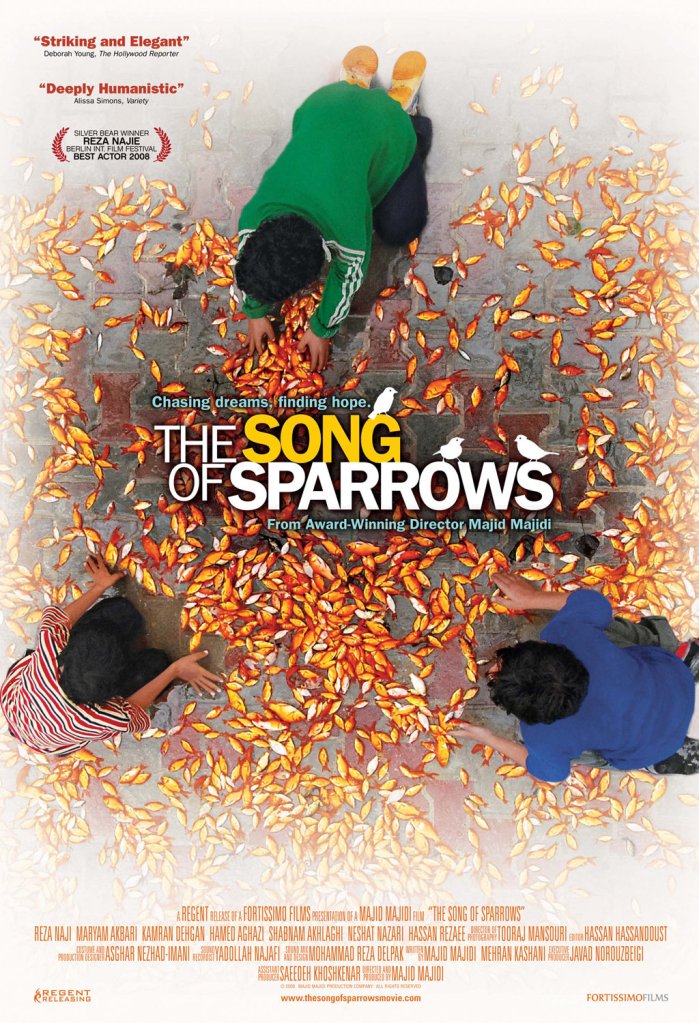
The Song of Sparrows is a 2008 film, tells the story of Karim, a man who works at an ostrich farm until he is fired because one of the ostriches escapes. He finds a new job in Tehran, but he faces new problems in his personal life. This film opened to critical acclaim. After losing a valuable ostrich, Karim (Reza Naji) is fired from his job tending fowl on a small farm. Desperate to repair his daughter’s broken hearing aid, Karim sets out on his motorcycle to find work in the bustling city of Tehran, Iran. Karim accidentally falls into a lucrative new line of work when a distracted businessman mistakes him for a taxi and jumps on the back of his motorcycle. But as the allure of the city takes its hold on Karim, he begins to lose sight of what matters most.
Karim is a kind man and a considerate father but the wear and tear of the city begins to change him. He becomes obsessed with carting things home — a new antenna for the television and a window frame they need but also a lot of junk. When Narges lets a neighbor take a blue door that he brought home, he retrieves it from her. His young son Hussein (Hamed Aghazi) seems to have also developed an acquisitive nature. He and his buddies clean out the sludge from a water tank with the idea of breeding goldfish there and then selling them. The boy is convinced that he can become a millionaire.
While climbing around in his pile of things collected in the city, Karim falls and is badly injured. While bedridden, he realizes how much he depends on the kindness of his wife and neighbors. He gets back in touch with the beauty of the natural world and identifies with a sparrow that is trapped in his house. When he sets it free, know that he is really ready to change.
The director writes in a statement about his intentions with the film: “My aim was to portray contemporary people today vis-à-vis the modern world in order to show how the era of modernization has put human beings in a stranglehold. By this I do not mean that I am opposed to modernity, per se. Modernization should be at the service of humanity, yet people find themselves conquered by it. The result is that with each passing day we are becoming more distant from our own human values. . . . All of our values — including friendship, morality and beauty — become less important day by day. In opposition to this process, my aim was to say that we must return to our human essence or else face a major disaster in the future.”
These films immerse us in the lives of their characters and show us the spiritual dimensions of everyday life and the way we treat others. The Song of Sparrows was Iran’s submission for the 2008 Academy Awards for Best Foreign Language Film. In 2008, film was the opening film of the Visakhapatnam International Film Festival in India.
Muhammad: The Messenger of God is a 2015 Islamic epic film, set in the sixth century, revolves around the childhood of the Islamic prophet Muhammad. The film was selected as the Iranian entry for the Best Foreign Language Film at the 88th Academy Awards.
By the order of Abraha, King of Habasha, one of his army commanders launches an attack on Mecca in order to destroy the Kaaba. He leads a well-equipped force of thousands of soldiers, horses and elephants. As the army approaches Mecca, the elephants respond to divine order by halting and refusing to continue. Millions of small birds then release a hail of stones onto Abraha’s forces and the army is annihilated. A month later, Muhammad is born. The film depicts pre-Islamic Arabia as seen through the eyes of Muhammad from birth to the age of 13.
In the beginning of the film, a message appears that states the film encompasses historical facts as well as free personal impressions about Muhammad. Majidi stated that the objective behind presenting these scenes is to show that the whole existence could feel Muhammad’s presence as well as his mercy. The story ends with Muhammad’s journey to Syria and encounter with Bahira. Addressing the controversies associated with the film, Majidi said, “The film contains no controversies and no differences between the Shia and the Sunni points of view.”
Beyond the Clouds is a 2017 Indian Hindi-language film written and directed by Majidi, under the production banner Zee Studios. . It stars debutante Amir, a street hustler and drug dealer in the city of Mumbai and Tara, the sister of Amir. She works for a dour merchant Akshi (Gautam Ghose). The film story is centred around bonding between the siblings, a take on human relationships in general. The sibling’s bond is put to test when Tara lands in jail for a crime committed by Amir which forms the crux of the film
Sun Children , also known as The Sun, is a 2020 Iranian film co-produced, co-written and directed by Majidi. It was presented in competition at the 77th Venice International Film Festival, where child actor Rouhollah Zamani won the Marcello Mastroianni Award. It was selected as the Iranian entry for the Best International Feature Film at the 93rd Academy Awards, making the shortlist of fifteen films.
12-year-old Ali and , three friends do small jobs and petty crimes to survive and support their families. In a timely turn of events, Ali is entrusted to find a hidden underground treasure. However, in order to gain access to the tunnel where the treasure is buried, Ali and his gang have first to enroll at the near Sun School, a charitable institution that tries to educate street kids and child laborers.
In 2001, during the Afghanistan anti-Taliban war, he produced Barefoot to Herat (2003), an emotional documentary about Afghanistan’s refugee camps that won the Fipresci Award at Thessaloniki International Film Festival. Majjid Majid has also received the Douglas Sirk Award in 2001 and the Amici Vittorio de Sica Award in 2003.
Majid Majidi was one of five international film directors invited by the Beijing Government to create a documentary short film to introduce the city of Beijing, in preparation for the 2008 Summer Olympics which was held in the Chinese capital; the project was titled “Vision Beijing”.
Majidi pulled out of a Danish film festival in protest against the publication in Denmark of cartoons satirizing the Islamic prophet, Muhammad. Majidi stated that he was withdrawing “to protest against insulting any religious belief or icon”. Majidi writes, “I believe in God and live with my beliefs in every single moment of my life. I would like to protest against insulting any religious belief and icon. For this reason, I would like to announce my withdrawal from your festival.
The rise of the New Wave in Iran, and holding its fort for the second wave (post-Islamic Revolution in 1979) was Majid Majidi. His hopeful movies are personal, embedded, and often steer the world from a child’s unalloyed outlook. Children’s innocence will have an impact on adults, and that’s what he always wants to express. Majidi, juxtaposes contemporary themes with the merging lifestyles in Iran. His films demystify the Iranian culture for a global audience. His cinema is shockingly simple. He uses plain processes to summon the most earnest feeling.
Majidi is one of Iran’s most influential directors and his films have a simple and poetic feel to them.
Photos courtesy Google. Experts taken from Google.
 Writer Sunita