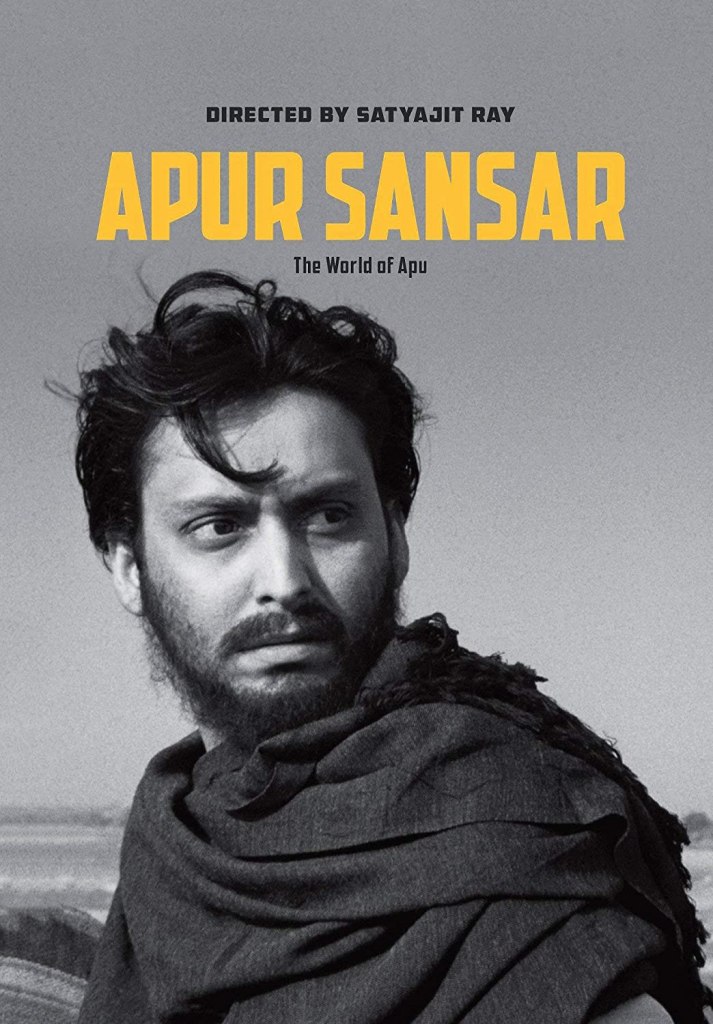
Apur Sansar, also known as The World of Apu, is a 1959 Bengali -language film produced, written and directed by Satyajit Ray. It is based on the second half of Bibhutibhushan Bandopadhyay’s novel Aparajito. The World of Apu is the final part of Ray’s The Apu Trilogy, about the childhood and early adulthood of a young Bengali named Apu in early twentieth century India. The World of Apu stars Soumitra Chatterjee (as Apu) and Sharmila Tagore (as Apu’s wife Aparna).
Apu is now in his early twenties, out of college, and hoping to live as a writer. Apu is now a graduate and without a job. His teacher’s advice to go for higher studies, he is unable to do so because he cannot afford it. He tries to find a job, while barely getting by providing private tutoring. His main passion is writing a novel, partially based on his own life, hoping to get it published some day. He lives in a rented room next to a busy railway yard. He finds himself among a large population of the unemployed youth in the city. To pay his rent, he has to sell his books. One day, he meets his old friend Pulu, who coaxes him to join him on a trip to his village in Khulna to attend the marriage of a cousin named Aparna. On the boat ride to the village Pulu reads Apu’s manuscript and appreciates the work.
On the day of the wedding, , it is revealed that the bridegroom has a serious mental disorder. The bride’s mother cancels the marriage, despite the father’s protests. He and the other villagers believe, according to prevalent Hindu tradition, that the young bride must be wedded off during the previously appointed auspicious hour, otherwise, she will have to remain unmarried all her life. Apu, after initially refusing when requested by a few villagers, ultimately decides to take Pulu’s advice and come to the rescue of the bride by agreeing to marry her. He has not even seen her yet. The marriage takes place and Apu and his young wife return to his Calcutta apartment. He takes up a clerical job, and a loving relationship begins to bloom between them. Soon, a warm and caring relationship develops.
Aparna becomes pregnant, and she goes to her parents’ place for childbirth. She dies during the childbirth. Apu’s world shatters as he receives the news of Aparna’s death. Sunken in grief, he refuses to even see the child whom he holds responsible for his wife’s death. He shuns his worldly responsibilities and becomes a recluse – travelling to different corners of India, while the child is left with his maternal grandparents. Meanwhile, Apu throws away his manuscript for the novel he had been writing over the years. About five years pass, Apu’s friend Pulu, who had been abroad, is shocked to find the child growing wild and not cared for. Pulu goes in search of Apu and advises him one last time to take up his fatherly responsibility. At last, Apu decides to come back to reality and reunite with his son. When he reaches his in-laws’ place, Kajal, having seen him for the first time in his life, at first does not accept him as a father. On seeing Kajal, Apu is overwhelmed by affection. Apu wins over the little boy. The child accepts him as a friend, though not as a father yet. United, they leave for Calcutta to make a new beginning.
In Apur Sansar, Ray introduced two new actors who would become regulars for Ray films, Soumitra Chatterjee played Apu and Sharmila Tagore played his young wife Aparna. By way of experience, Soumitra Chatterjee was a radio announcer and had only played a small role in a Bengali stage production and Sharmila was just a fourteen-year-old with no previous acting experience. As the shooting began, Ray had to shout instructions to Sharmila during the takes. None of this, however, is reflected on the screen. Both tuned out be quick learners and gave memorable performances.
The sequences of Apu and Aparna in Calcutta, are the most striking and cinematic part of the film. In the beginning of the film, seen Apu’s room as a bachelor’s apartment. Now there are two pillows on the bed, curtains on the windows and a plant on the windowsill. Not that Ray has to do much more than let the camera rest on the actors as they take turns fanning each other. Chatterjee and Tagore have an electric chemistry from their first moments together, a tentative wedding night scene that takes place in an elaborately decorated bedroom. She stands still, expectant, on one side of the bed, while Apu paces back and forth on the other, asking across a sea of expensive fabrics and beads, “Can you live with a poor husband?”
Apur Sansar has been lauded all over the world for its fascinating study of love and loss. Two different scenes in the film, both involving Apu, highlight these two emotions in two contrasting manners, and yet both of them are so natural and visually stunning that they might well be considered amongst the best scenes ever written and shot by Ray. The first is a scene from the morning after Apu has brought Aparna home. The night has passed, and unable to show lovemaking between the couple to a largely traditional family audience, Ray shows the romance between Apu and Aparna through a series of shots subtly suggestive of what has passed. As the beautiful Aparna — the vermillion dot on her forehead now slightly smudged — tries to leave the bed, she finds the free end of her sari tied in a knot to Apu’s clothes. As Aparna frees herself, slaps her husband’s back as punishment for such mischief and begins her morning chores, Apu watches her from bed, stumbling upon one of her hairpins under his pillow. His face is filled with the fond remembrance of the previous night, and with a content smile on his face, he opens a packet of cigarettes to find a small handwritten note inside that says — ‘Only one. After meals. You promised.’ Apu smiles again and puts the pack away. With simple actions and situation, the intimacy is established. After seeing the film, Renoir is said to have remarked that intimacy had been suggested without showing even a single embrace.
Later in the film, Aparna is leaving to be at her parents’ place for childbirth. She lights a match to light the cigarette that Apu has put in his mouth. The flame brings a glow to her face. Apu asks, “what is in your eyes?” “Kajal” (mascara / kohl), she replies with a mischief. Lather, the son born to her would also be named “Kajal”. Aparna dies off-screen. Her brother brings the bad news. This is a lyrical and inspired sequence. Apu is working and carrying Aparna’s letter in his pocket. Towards the end of the day, he can no longer wait to read the letter. A touching letter is heard in Aparna’s voice. Apu in interrupted by a fellow clerk.
He takes out the letter again to continue reading on his way home in a crowded tram. A passenger peeps over his shoulders to read, forcing him to put the letter back again. He finishes reading the letter during the walk home by the railway yard. With Aparna’s voice still in his mind, he sees her brother waiting for him. Apu’s smile vanishes; he senses something wrong. As Aparna’s brother conveys the news of her death, Apu looses control. His world is shattered. He slaps the messenger, staggers to his room and collapses on the bed.
It is a long, wonderful and speechless sequence; dealing with Apu’s grief. Satyajit Ray describes in ‘My Years with Apu’ – “The grief-stricken Apu lies in bed for days. … At one point, however, Apu rises from the bed. He hasn’t got over his grief. He stands leaning against the wall. The camera moves to the shaving mirror to show his blank look. Off screen is heard the screech of a train whistle. Apu reacts. The camera moves closer to his face. His eyes have a new look. The screen turns white. There is the sound of a rushing train and smoke rises from the bottom of the screen in what is now established as sky. The camera moves back to show Apu in close up, obviously standing by the railway track. The smoke approaches, then see the engine. Apu, his face still a blank, slowly leans forward, preparing to throw himself before the train. Suddenly, a screech is heard. It is the cry of a pig, which has been run over by the train. Apu’s spell is broken and with it his determination to take his own life.
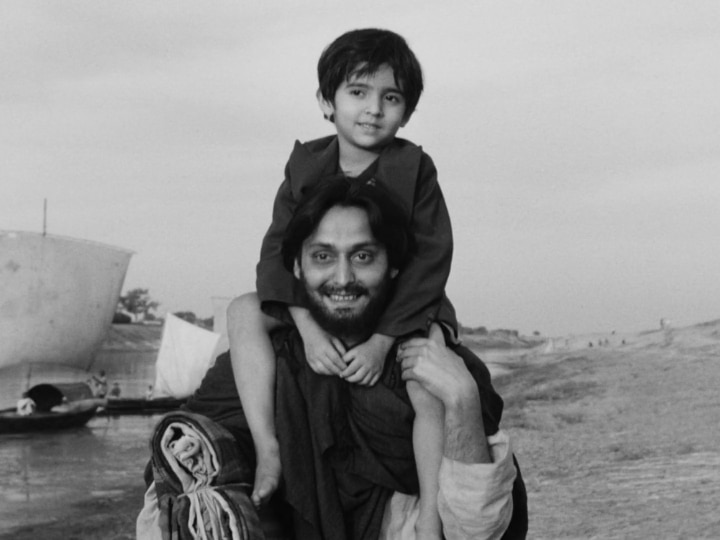
In he final moments of the film, Kajal has rejected Apu. When Apu’s father-in-law is about to strike Kajal with a stick because he has refused to leave with Apu, Apu rescues Kajal instinctively. A hint of trust begins to develop. Apu starts to walk away as he has given up hope of earning Kajal’s love. But Kajal has now decided to trust Apu. He runs away to join Apu as grandfather watches from a distance. Apu sweeps up Kajal in his arms. Both leave for a new life together with Apu carrying Kajal on his shoulders. Apur Sansar was a big box office success both at home and abroad.
It won Satyajit Ray 3 international awards – Best Original and Imaginative Film at the 1960 London Film Fest, Diploma of Merit at 1960 Edinburgh International Film Fest and Best Foreign Film declared by National Board of Review Awards (US). It also received a nomination for Best Film at 1962 BAFTA Awards. It won the National Film Award for Best Feature Film as well as several international awards, including the Sutherland Award for Best Original And Imaginative Film and National Board of Review Award for Best Foreign Languate Film.
The “Apu Trilogy” is a true masterpiece, and The World of Apu is its crown jewel.
Photos courtesy Google. Experts taken from Google.
 Writer Sunita