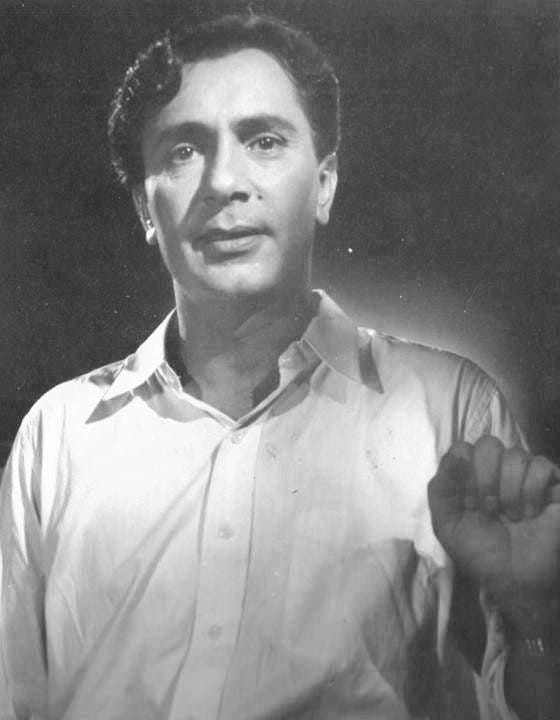

Balraj Sahni born Yudhishthir Sahni; 1 May 1913, was an Indian film and stage actor, who is best known for Dharti Ke Lal (1946), Do Bigha Zameen (1953), Chhoti Bahen (1959), Kabuliwala (1961) and Garam Hawa (1973).
He studied at Government College (Lahore) and completing master’s degree in English Literature. He married Damayanti Sahni. Sahni and his wife left Rawalpindi to join Tagore’s Visva-Bharati University in Shantiniketan as an English and Hindi teacher.
In 1938, Balraj was noticed by Mahatma Gandhi who asked him to join his secretariat. In 1939, Gandhiji recommended him for a job in the BBC in London in the Hindi language broadcast section. He sailed from Bombay and joined his new duties just before things became less certain in Europe and England. When War broke out in 1939, Balraj was telling his Indian listeners in India on the rise of Hitler in Germany and his campaigns.
It was while he was a staff broadcaster in BBC, that he was joined by another woman broadcaster, the daughter of wealthy parents and a bohemian. She had moved out of her parents’ home early in life to roam the world becoming a failed actress, a better pamphleteer and a well-respected film editor. That was Marie Seton. Within BBC, the erudite Balraj caught Marie’s attention, and she invited him to meet her friends. The only thing that interested Balraj was her film connection, and Marie obliged. She introduced to Balraj Sahni the world of Soviet Cinema and the works of the film maker S. Eisenstein. There was also more European cinema, which Balraj saw. The more he saw the cinema of cause, Balraj was hooked in his search to study the works of Marx and Engels. Between 1941 and 1943, he was transformed into a committed communist worker and returned to India in the end of 1943.
Sahni was always interested in acting, and started his acting career with the plays of the Indian People’s Theatre Association (IPTA). Through IPTA, Sahni entered the circle of Leftist thinkers, writers and artists and became an associate of Khwaja Ahmad Abbas, Munshi Prem Chand, Salil Chowdhury, Tripti Mitra, Badal Sircar and others. He acted in plays created by IPTA members, but found he had limited audiences for the messages that were important. IPTA also started making feature films. The first IPTA production, Insaaf, in which Balraj performed. IPTA moved to Calcutta for the next production and made Dharti Ke Lal (Children of the Earth) in 1946. The film was directed by K. A. Abbas and narrated the real story behind the Great Famine of Bengal in which more than one million poor people died of hunger. The film marked the screen debut of Zohara Sehgal and Balraj Sahni his first important on screen role. In 1949, Dharti Ke Lal also became the first Indian film to receive widespread distribution in the Soviet Union (USSR), which led to the country becoming a major overseas market for Indian films. The first Russian-dubbed Indian film, Dharti Ke Lal. It was the first and perhaps the only film produced by IPTA (Indian People’s Theater Association) and remains one of the important Hindi films of that decade. The New York Times called it “…a gritty realistic drama.”
Balraj did not forget the famine. He became more determined to use the medium of cinema to move further into the masses and kept a minimum time devoted to working amidst labour and peasants. During the shooting of the film Dharti ke Lal, Balraj Sahni came to know more leftist artists working in Calcutta. His associates in IPTA were equally involved in theatre and pamphleteering and Balraj eked out a small living from these activities.
Hum Log (We, The People) is a 1951 Hindi social realist film written and directed by Zia Sarhadi. According to Box Office India, among the ten highest-grossing Indian films of 1951. Author Meghnad Desai described it as a “film about the problems faced by a lower middle class family”, noting the acting of Nutan and Sahni, and calling it “a conscious criticism of how ordinary people were oppressed in their daily struggle against forces of power and wealth”. Bunny Reuben praised it as “a strong, bold and outspoken film”. Author and biographer T. J. S. George wrote, “Zia Sarhadi’s Humlog about the frustrations of the middle class was rendered sensitively by an inspired Balraj Sahni and a convincingly consumptive Nutan.”
In 1953, with Bimal Roy’s classic Do Bigha Zamin, that his true strength as an actor was first recognised. The film won the international prize at the Cannes Film Festival. In the film, Sahni played the role of a poor farmer the peasant Shambhu who was forced to migrate to Calcutta (now Kolkata) to become a rickshaw-puller to make enough money to save his land from the clutches of a rich landlord. It is a performance of extraordinary dimensions as Sahni literally becomes Shambhu. In the unforgettable ending of the film, the wretchedness of human defeat is writ large on Sahni’s face as he sees the factory built on his land. It is said that Sahni actually rehearsed for the role by pushing a rickshaw on the streets of Calcutta and interacting with other rickshaw pullers who were convinced he was one of them. Bimal Roy was not sure of taking Sahni for the film because, as mentioned earlier, in real life he was well-educated and westernized, the total antithesis of Shambhu. Balraj Sahni was already a known entity in the film world; but Do Bigha Zameen would catapult him into the first rank of actors. “When, one day, I die,” he has written, “I shall have the satisfaction that I acted in ‘Do Bigha Zameen.’”
There is an interesting account in Bhisham Sahni, Balraj: My Brother (New Delhi: National Book Trust, 1991 [1981]) of how Balraj Sahni trained for this role. He went to the Calcutta rickshaw-pullers’ union and took lessons. Among those he encountered on the roads was a rickshaw puller who, it transpired, was living the very story that was being shot – except that, unlike Shambu who spent three months in Calcutta, this rickshaw puller had been in Calcutta for over 15 years in an attempt to save his two bighas of land. Here is how Balraj described the moment of epiphany: “Then I, as it were, imbibed the soul of this middle-aged rickshaw-puller within me, and stopped thinking about the art of acting. I think the real secret of the unexpected success of my role lay in this. A basic rule of acting had come my way suddenly, not from any book but from life itself” (p. 102).
Garam Coat (The Clerk and the Coat) was a 1955 Hindi film, starred Balraj Sahni and Nirupa Roy. A thin storyline, over-padded with socially realist dialogue, this melodramatic saga scripted by Rajinder Singh Bedi could as well have been titled “The Hundred Rupee Note”. But presuming the repeated reference to a torn winter coat, the title of the original story (written by Bedi himself) and the pre-climax shots about the recovery must have tilted the scales in favour of “Garam Coat”.
Seema (limit, horizon) is a 1955 film starring Balraj Sahni and Nutan. Balraj Sahni plays the perfect sensitive, gentle, natural and restrained as always, he plays the understanding warden trying to make a better life for the women and children at the reform home to perfection. Sahni strikes the perfect balance as someone who could be calm and kind but also be stern when it matters.
Anuradha is a 1960 film story of a noted radio singer and dancer Anuradha Roy (Leela Naidu) falls in love with an idealistic doctor, Dr Nirmal Chowdhary (Balraj Sahni). A film about the common man and the problems that he faces in his day-to-day life. Balraj Sahni’s acting skills are legendary and well-documented and therefore do not need any special mention. He is one of the finest actors in Indian cinema. His restrained performance in Anurdaha is exemplary.
Kabuliwala is a 1961 Hindi film based on the 1892 short story “Kabuliwala”, by the Bengali writer Rabindranath Tagore. Hemen Gupta made it in Hindi employing the impeccable Balraj Sahni. This heart warming story of a Pathan from Kabul, who comes to Calcutta (as it was then called) to earn money and befriends four-year-old Mini from a middle class family since she reminds him of his own daughter back home.
Sahni’s wife Damayanti, who was the heroine of his 1947 film Gudia. He acted opposite heroines such as Padmini, Nutan, Meena Kumari, Vyjayanthimala, and Nargis in films such as Bindya, Seema (1955), Sone Ki Chidiya (1958), Sutta Bazaar (1959), Bhabhi Ki Chudiyaan (1961), Kathputli (1957), Lajwanti (1958) and Ghar Sansaar (1958). His character roles in films such as Neelkamal, Ghar Ghar Ki Kahani, Do Raaste and Ek Phool Do Mali were well received. His character roles with strong performances in films like “Haqeeqat” (1964), “Waqt” (1965), “Do Raaste” (1969), “Ek Phool Do Mali” (1969), and “Mere Humsafar” (1970) further left an indelible mark in the film fraternity and fans alike. The legendary song “Ae Meri Zohra Jabeen” from the film “Waqt”, picturized on Balraj Sahni and Achala Sachdev is still etched deep in peoples’ memories and is loved by the current generation as well.
He also starred in the classic Punjabi film Nanak Dukhiya Sub Sansar (1970) as well as the critically acclaimed Satluj De Kande.
The film Garam Hawa (Hot Winds), directed by M.S. Sathyu, The film was controversial from its inception, as it was the first film to deal with the human consequences resulting from the 1947 partition of India. The role of family patriarch, Salim Mirza was played by Sahni, and this was to be his last important film role, and according to many his finest performance. He responded with an absolutely brilliant performance Balraj, however, could not see the completed film to rate his own performance, as he died the day after he finished dubbing work. The last line he recorded for the film, and hence his last recorded line is Hindustani: “Insaan Kab Tak Akela Jee Sakta Hai?” which can be translated to English as: “How long can a man live alone?” Garm Hawa competed for the Palm d’Or at the Cannes Film Festival
Sahni’s writing career begun with “Shahzaadon Ka Drink” that came out in 1936. This was his first compilation of Hindi fiction. Sahni was a gifted writer; his early writings were in English, though later in life he switched to Punjabi, and became a writer of repute in Punjabi literature. In 1960, after a visit to Pakistan, he wrote Mera Pakistani Safarnama. His book Mera Rusi Safarnama, which he had written after a tour of the erstwhile Soviet Union in 1969, earned him the “Soviet Land Nehru Award”. He contributed many poems and short stories in magazines and also penned his autobiography; Meri Filmi Aatmakatha. Sahni was an extremely well-read and politically conscious person.
He and P K Vasudevan Nair worked on the idea of All India Youth Federation with firebrand Delhi communist, Comrade Guru Radha Kishan to organise the first national conference of AIYF in Delhi. Their wholehearted efforts were visible as more than 250 delegates and observers representing several youth organisations of various states of India attended this session. Balraj Sahni was elected as the first president of All India Youth Federatioon, the youth wing of Communist Party of India. The organisation was a huge success and strong presence of the organisation was noticed by other political groups and the senior communist leaders everywhere. In 1972, he was invited by the student’s union of Jawaharlal Nehru University, a leftist stronghold, to address the annual student’s convocation. His speech is considered a landmark event in the University’s campus politics.
Sahni also dabbled in screenwriting; he wrote the 1951 movie Baazi which starred Dev Anand and was directed by Guru Dutt. He was also a recipient of the Padma Shri Award (1969). Balraj Sahni also wrote in Punjabi and contributed to the Punjabi magazine Preetlari. In the 1950s he inaugurated the Library and Study Centre for the underprivileged in Delhi. “Punjabi Kala Kender”, founded in 1973 at Bombay by Balraj Sahni, gives away the annual Balraj Sahni Award, also given by the “All India Artists Association”.
Sahni has remained a ghostly figure in the history of Indian cinema. This is because he was for most of the time away from the gossip circuit. He hardly gave any personalised interviews and there was no publicist who promoted him to producers. He found work from those who belonged to the theatre movement in the country and from friends who respected his talent.
During the post Sino-Indian war, Balraj found himself in a dissenting position to that of the the CPI on the war. He accepted a role in Haqeeqat (1963-64), which depicted a pro-India position and his leftist colleagues resented his participation. When Jawaharlal Nehru died, Sahni was vocal in his praise for Nehru’s contribution to nation building. Sahni was criticised for this praise within IPTA. Sahni continued to be associated with meaningful cinema from Bombay, but he was not much in demand for commercial films.
To bring his personas to life, Balraj Sahni lived in character. K. Asif gave Balraj the character of a jailer in the film Halchal, so he conferred with jail administration leaders and officials. Balraj Sahni also desired that his character be remembered everywhere. Because of this, they reached Hokie Arthur Jail Road and learned about the prisoners’ living conditions.
Sahni won everyone’s heart and he brought the sufferings and problems of the common man to the film screen very often. He remained a symbol of skillfulness, gentleness, harmony and morality in real life and his acting made many people obsessed with him.
Known to be a true gentleman both on and off camera, Sahni had the rare quality of leaving a lasting impression on people. On the streets of Calcutta, an actor pretending to be a rickshaw puller had other rickshaw puller convinced that he was one of them. This man was popularly known as Balraj Sahni and his talents as an actor cannot be forgotten by those who’ve seen him act. Such were his skills that he used to get into the skin of the characters he played, leaving the name of Balraj Sahni behind. He was a well educated person, a teacher and a writer. But it was his stint as an actor that made him the name he is today. Many present-day personalities from the film world consider him to be the greatest actor ever in the Hindi Film Industry. Making his debut as an actor in 1946, he went on to prove the same in all the films that followed till 1973.
Photo courtesy Google. Experts taken from Google.
 Writer Sunita