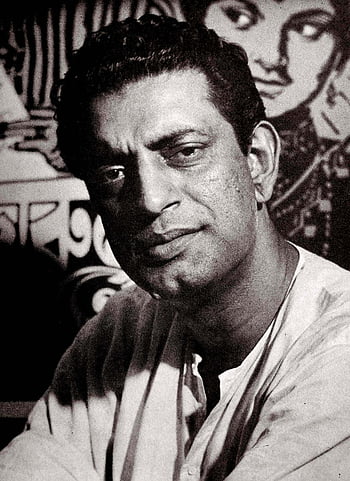
Satyajit Ray born on 2 May 1921 was an Indian Director, Screenwriter, Documentary Filmmaker, Author, Essayist, Lyricist, Magazine Editor, Illustrator, Calligrapher, and Music Composer. Considered one of the greatest auteurs of film-making, Ray is celebrated for works including The Apu Trilogy (1955–1959), The Music Room (1958), The Big City (1963), Charulate (1964) and the Goopy-Bagha trilogy.
In 1943, Ray started working at D. J. Keymer, a British advertising agency, as a junior visualiser. Here he was trained the Indian commercial art under artist Annada Munshi. Although he liked visual design (graphic design) and he was mostly treated well. In 1943, Ray started a second job for the Signet Press, a new publisher started by D. K. Gupta. Gupta asked Ray to create book cover designs for the company and gave him complete artistic freedom. Ray established himself as a commercial illustrator, becoming a leading Indian typographer and book-jacket designer.
Ray designed covers for many books, including Jibanananda Das’s Banalata Sen and Rupase Bangla, Bibhutibhushan Bandyopadhyay’s Chander Pahar, Jim Corbett’s Maneaters of Kumaon, and Jawaharlal Nehru’s Discovery of India. He worked on a children’s version of Pather Panchali, a classic Bengali novel by Bibhutibhushan Bandyopadhyay, renamed Aam Antir Bhepu (The mango-seed whistle). Ray designed the cover and illustrated the book, and was deeply influenced by the work. He used it as the subject of his first film and featured his illustrations as shots in his ground-breaking film.
Ray befriended the American soldiers stationed in Calcutta during World War II, who kept him informed about the latest American films showing in the city. He came to know a RAF employee, Norman Clare, who shared Ray’s passion for films, chess and western classical music. Ray was a regular at Coffee House where several intellectuals frequented. Along with Chidananda Dasgupta (film critic) and others, Ray founded the Calcutta Film Society in 1947. They screened many foreign films, many of which Ray watched and seriously studied, including several American and Russian films. The use of Indian music and dancing in the 1948 Indian film Kalpana (Imagination), directed by the celebrated dancer Uday Shankar, had impact on Ray.
In 1949, French director Jean Renoir came to Calcutta to shoot his film The River. Ray helped him to find locations in the countryside. Ray told Renoir about his idea of filming Pather Panchali, which had long been on his mind, and Renoir encouraged him in the project.
In 1950, D. J. Keymer sent Ray to London to work at the headquarters. During his six months in London, Ray watched 99 films, including Alexander Dovzhenko’s Earth (1930) and Jean Renoir’s The Rules of the Game (1939). However, the film that had the most profound effect on him was the neorealist film Ladri di biciclette (Bicycle Thieves) (1948) by Vittorio De Sica. Ray later said that he walked out of the theatre determined to become a filmmaker.
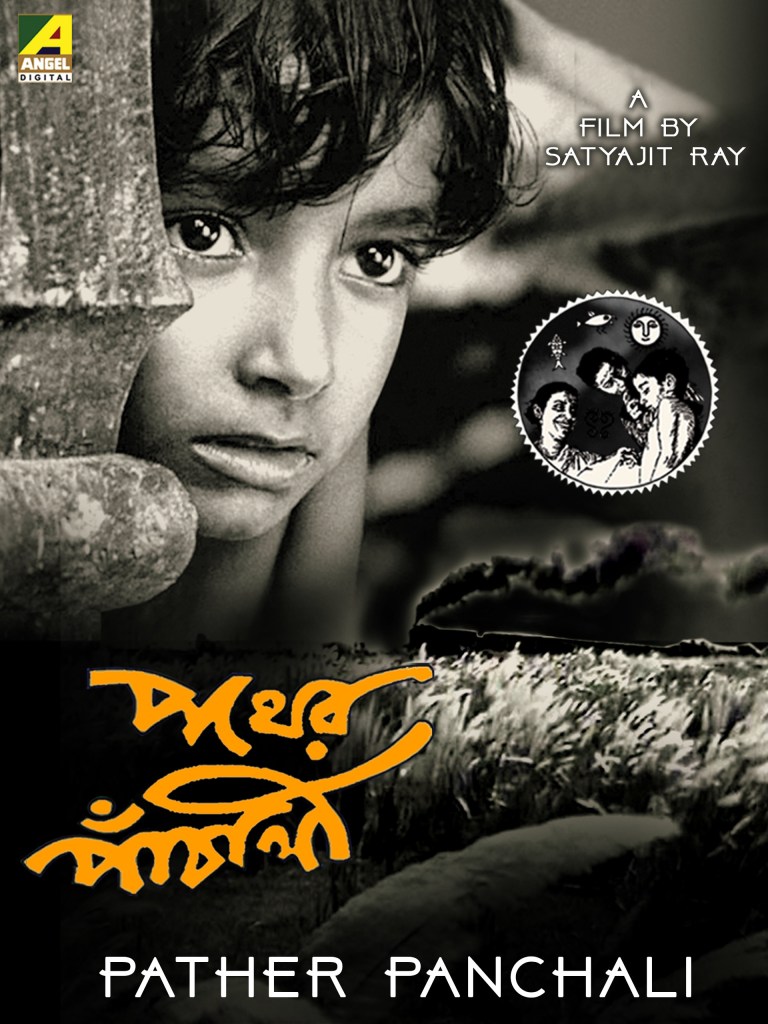
Pather Panchali (Song of the Little Road) is a 1955 first Bengali -language film written and directed by Ray. The first film in The Apu Trilogy. Pather Panchali did not have a script; it was made from Ray’s drawings and notes. A depiction of rural Bengali life in a style inspired by Italian neorealism, this naturalistic but poetic evocation of a number of years in the life of a family introduces us to both little Apu and, just as essentially, the women who will help shape him: his independent older sister, Durga; his harried mother, Sarbajaya, who, with her husband away, must hold the family together; and his kindly and mischievous elderly “auntie,” Indir—vivid, multifaceted characters all. Apu, or Sarbajaya, losing a dear sister or a daughter changes the dynamics of a family that was already hit hard by the pangs of poverty. Small vignettes of an artistic high make the movie timeless. Be it a speechless Apu, brushing his teeth, combing his hair, performing tasks which otherwise his sister often helped in and who is no more! That subtle look of mourning a death transforms into a determined one, when he finds the necklace his sister Durga had earlier denied to have stolen and throws it into a pond before leaving the village with his parents. When father Harihar returns home from the city with puja gifts for the whole family and learns of his daughter’s death, he doesn’t cry loud while consoling his wife. Instead, Ray brings in the high-pitched musical composition of a Tarsehnai in the background. The music was enough to echo the pain of a soul, piercing the hearts of viewers. With resplendent photography informed by its young protagonist’s perpetual sense of discovery, Pather Panchali, which won an award for Best Human Document at Cannes, is an immersive cinematic experience and a film of elemental power.
The Times of India wrote “It is absurd to compare it with any other Indian cinema […] Pather Panchali is pure cinema.” In the United Kingdom, Lindsay Anderson wrote a positive review of the film. The film enjoyed an eight months theatrical run in the United States.
Aparajito (The Unvanquished) is a 1956 film is the second part of The Apu Trilogy. This film depicts the eternal struggle between the ambitions of a young man, Apu, and the mother who loves him. Film won 11 international awards, including the Golden Lion and Critics Award at the Venice Film Festival, becoming the first ever film to win both Upon release, In a retrospective review, Edward Guthmann of the San Francisco Chronicle praised Ray for his ability to capture emotions, and blend music with storytelling to create a “flawless” picture. Veteran film-maker Mrinal Sen said he considers it to be one of the best Indian movies he had ever seen. Bosley Crowther said that “it is done with such rare feeling and skill at pictorial imagery, and with such sympathetic understanding of Indian character on the part of Mr. Ray, that it develops a sort of hypnotism for the serene and tolerant viewer”
Parash Pathar (The Philosopher’s Stone) is a 1958 fantasy comedy film . It was also his first comedy and first magical realist film. The film offered an early glimpse of Ray’s sense of humour, centered on a middle-class clerk who accidentally discovers a stone that can turn other objects into gold. The film was entered into the 1958 Cannes Film Festival, where it competed for the Palmed’Or (Best Film).
Jalsaghar (‘The Music Room’) is a 1958, fourth of Ray’s feature film. Film won the Presidential Award for best film in New Delhi, and played a significant role in establishing Ray’s international reputation as a director. It has since gained near-universal critical acclaim, and has come to be regarded by the cinema community as one of the greatest films of all time. Film won Best Music Award at 1st Moscow International Film Festival. Also got a nomination for Grand Pix for Best Film in the festival.
Jalsaghar depicts the end days of a decadent Zamindar (landlord) in Bengal and his efforts to uphold his family prestige while facing economic adversity. The landlord, Biswambhar Roy, is a just but otherworldly man who loves to spend time listening to music and putting up spectacles rather than managing his properties ravaged by floods and the government’s abolition of the zamindari system after Independence. He is challenged by a commoner who has attained riches through business dealings, in putting up spectacles and organising music fests. This is the tale of a zamindar who has nothing left but respect and sacrifices his family and wealth trying to retain it.
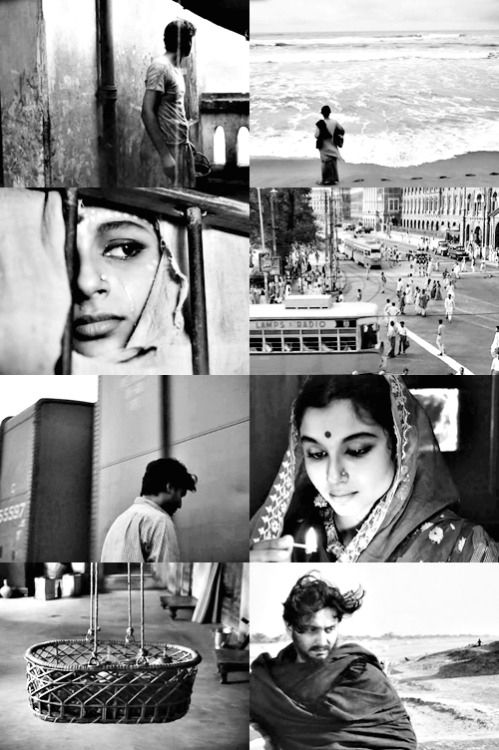
‘Apur Sansar’ (The World of Apu) is the final film in Ray’s ‘The Apu Trilogy’. It won Satyajit Ray 3 international awards – Best Original and Imaginative Film at the 1960 London Film Fest, Diploma of Merit at 1960 Edinburgh International Film Fest and Best Foreign Film declared by National Board of Review Awards (US). It also received a nomination for Best Film at 1962 BAFTA Awards.
The cult classic sees jobless Apu, aspiring to become a writer, marries Aparna and returns to Calcutta. But his wife dies while giving birth to their son and he believes the child responsible for his wife’s death. He then leaves his child to his maternal grandparents and starts his journey as a traveller. An old friend reaches out to a vagabond Apu convincing him to get back to his son. Finally, the father and son reunite.
Devi ( Goddess) is a 1960 film is based on the worship of women and young girls as incarnations of the goddesses Durga or Kali. A young woman is deemed a goddess when her father-in-law, a rich feudal land-lord, has a dream envisioning her as an avatar of Kali. Film won National Film Awards for President’s siver medal for Best Feature Film in Bengali. Cannes Film Festival film nominated Palme d’Or (Golden Palm).
Teen Kanya (Three Girls) is a 1961 anthology film based upon short stories by Rabindranath Tagore. The title means “Three Girls”, and the film’s original Indian release contained three stories. Film is divided into three parts – ‘The Postmaster’, ‘Monihara’, and ‘Samapti’. Originally it had three separate stories; so the title is ‘Teen Kanya’. However, the subtitling wasn’t finished in time for a Tagore anniversary, so the second story ‘Monihara’ wasn’t included in the cassette, retitled ‘Two Daughters’. In the two stories, we see the lives of two girls bound to a world, not of their making, so they face their fate with very limited options. However, the international release of the film contained only two stories, missing the second (“Monihara: The Lost Jewels”).
Rabindranath Tagore is a 1961 Indian documentary film about the life and works of noted Bengali author Rabindranath Tagore. Ray started working on the documentary in early 1958. Shot in black-and-white, the finished film was released during the birth centenary year of Rabindranath Tagore.
Kanchenjungha is a 1962 film is about an upper class Bengali family on vacation in Darjeeling, a popular hill station and resort, near Kanchenjunga. It is a very structured and composed film that uses color and nature to heighten the drama. Ray told his biographer Andrew Robinson: “The idea was to have the film starting with sunlight. Then clouds coming, then mist rising, and then mist disappearing, the cloud disappearing, and then the sun shining on the snow-peaks. There is an independent progression to Nature itself, and the story reflects this.”
As the weather becomes misty – the young daughter and the suitor part at that point, Indranath meets Ashoke, and the elder daughter, Amina and her husband have a bitter moment between them. And then when the sun appears again – Amina’s daughter comes back to her parents and they accept her, the misunderstanding is cleared up, and the younger daughter and Ashoke develop a tentative relationship with a hint of future prospects.
Abhijan (The Expedition) is a 1962 film gives the famous Ray flavour in its composition, flow and dialogues, and use of symbols. The story is all about a reckless taxi driver, Narsingh, who is on a mission to reinvent his troubled life going back to his native place but gets involved in a smuggling and human trafficking racket. Soumitra Chatterjee, as Narsingh the taxi driver, gave one of his best performances touching the viewers’ hearts. This popular character and the Bengali film itself is believed to be the sole inspiration for another world-renowned filmmaker Martin Scorsese. He drew inspiration from Ray’s movie to present his landmark film ‘Taxi Driver’. The 1976 Hollywood movie had Robert De Niro in the lead role and still remembered as one of the fascinating works ever made, just like Satyajit Ray’s ‘Abhijaan’.
Mahanagar (‘The Big City‘) is a 1963 film tells the story of a house-wife from a middle-class, conservative family in Calcutta gets a job as a saleswoman. For financial need, she is driven to find paid work. She has an up hill struggle trying to overcome her own low self-esteem and the traditional notions of a woman’s place in society. She wins the self-confidence and economic independence that set her free and allow her to live fulfilled life, as a woman, a wife and a mother. She is a truly liberated woman. Ray won the Silver Bear for Best Director at the 14th Berlin International Film Festival 1964. The film won the All India Certificate of Merit for the Third Best Feature Film in 1963 at the 11th National Film Awards.
Charulata (‘The Lonely Wife‘) is a 1964 film is considered one of the finest works of Ray. Both the first and the last scenes are critically acclaimed. The first scene, with almost no dialogue, shows Charu’s loneliness and how she looks at the outside world through binoculars. In the last scene when Charu and her husband are about to come closer and hold their hands, the screen freezes. This has been described as a beautiful use of freeze frames in cinema. Film was awarded Best Director by the Berlin Film Festival.
Two: A Film Fable is a 1964 black-and-white film was made under the banner of Esso World Theater at the request of a non-profit American public broadcasting television, PBS. The short film shows an encounter between a child of a rich family and a street child, through the rich kid’s window. The film is made without any dialogue and displays attempts of One-upmanship between kids in their successive display of their toys. The film portrays the childlike rivalry with the help of world of noise and that of music. The film is among less known films of Ray but experts rated the film as one of Ray’s best. It is often regarded as a prelude to another Ray Film.
Kapurush, English title The Coward, is a 1965 film was based on meeting rekindles old memories between a screenwriter and his ex-girlfriend, who is by now married to a well-to-do man.
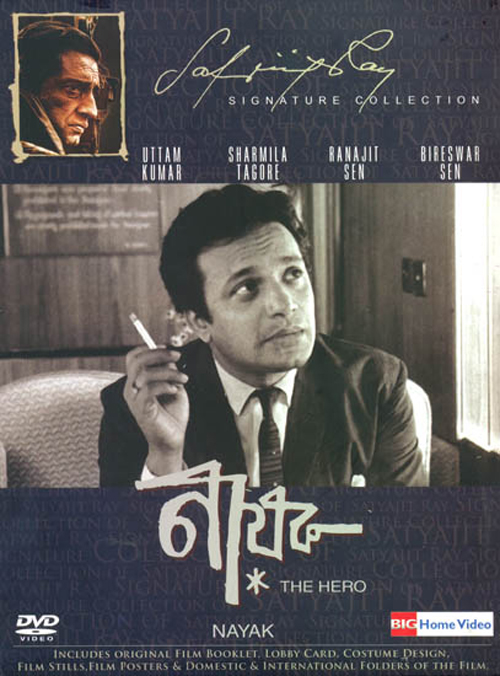
Nayak (also released under the translated title The Hero) is a 1966 film composed, written, and directed by Ray. The story revolves around a matinee idol on a 24-hour train journey from Kolkata to Delhi to receive a national award. However, he ends up revealing his mistakes, insecurities and regrets to a young journalist, who realises that behind all his arrogant facade lies a deeply troubled man as his life’s story is gradually revealed through seven flashbacks and two dreams. In Nayak, Uttam Kumar plays Arindam Mukherjee with such poise and ease that it appears as if he is portraying his own life on the celluloid. Ray gives us a vulnerable hero hiding behind his cocky, larger-than-life façade. And, Kumar, to his credit, never misses a note during his challenging portrayal. He is well complemented by Sharmila Tagore who plays the character of Aditi to a tee. Aditi is the only person Arindam opens up to; the tantalizing conversations between the two characters offer some great food for thought. Ray uses the various interactions between the co-passengers to make us realize that the hypocrisies and follies of a star are not much different from that of an ordinary man. A few other characters in the movie merely provide a morality check.
Goopy Gyne Bagha Byne (Gupi Gain Bagha Bain) is a 1969 fantasy adventure comedy film, with the music and lyrics written by Ray himself. The film was based on the characters Goopy Gyne and Bagha Byne, who made their first appearance in the Sandesh magazine in 1915, with illustrations by Ray’s grandfather Upendrakishore Ray Chowdhury. It is about the journey of Goopy the singer, and Bagha the drummer, endowed with three gifts by the King of Ghosts, to stop an impending war between two neighbouring kingdoms. He also composed the songs and music for the film. The movie released to great critical and commercial reception, which held the record for longest continuous run of a Bengali-language movie in Bengal, as it ran for 51 straight weeks. It won the Best Feature Film and Best Direction awards at the 16th National Film Awards, and went on to win many other international awards as well. Critical reception was highly positive. Raja Sen called it to be the most innovative film to have ever come out of India. Phil Hall said that the film “comes as a delightful surprise – Ray, it appears, not only possessed a great sense of humor but also enjoyed a stunning talent for musical cinema”.
Aranyer Din Ratri (Days and Nights in the Forest) is adventure film released in 1970. Four urban young men going to the forests for a vacation. They try to leave their daily lives behind, but one of them encounters women, and it becomes a deep study of the Indian middle class. First shown at the New York Film Festival in 1970, critic Pauline Kael wrote “Satyajit Ray’s films can give rise to a more complex feeling of happiness in me than the work of any other director […] No artist has done more than Ray to make us reevaluate the commonplace”. Writing for the BBC in 2002, Jamie Russell complimented the script, pacing and mixture of emotions. According to one critic, Robin Wood, “a single sequence [of the film] … would offer material for a short essay”. The film was nominated for the Golden Bear for Best Film at the 20th Berlin International Film Festival.
Pratidwandi (The Adversary, Siddharta and the City) is a 1970 film is the first part of the Calcutta trilogy. Pratidwandi tells the story of Siddharta, an educated middle-class man caught up in the turmoil of social unrest. Corruption and unemployment are rampant, and Siddhartha cannot align himself with either his revolutionary activist brother or his career-oriented sister. The film is known for experimenting with techniques such as photo-negative flashbacks. The first scene which shows the death of Siddhartha’s father. However, the last scene is symbolic of the end of Siddhartha’s aspirations of finding a job in Calcutta. The film won three Indian National Film Awards; including the National Film Award for Best Direction in 1971 and a nomination for the Gold Hugo Award, at the Chicago International Film Festival, 1971.
Seemabaddha (English title: Company Limited) is a 1971 social film was the second entry in Ray’s Calcutta trilogy. The films deal with the rapid modernization of Calcutta, rising corporate culture and greed. The film won the FIPRESCI Award at the 33rd Venice International Film Festival, and the National Film Award for Best Feature Film in 1971.
Sikkim is a 1971 Indian documentary was commissioned by the Chogyal (King) of Sikkim at a time when he felt the sovereignty of Sikkim was under threat from both China and India. The film was banned by the government of India, when Sikkim merged with India in 1975. In 2000, the copyright of the film was transferred to the Art and Culture Trust of Sikkim. The ban was finally lifted by the Ministry of External Affairs (MEA) in September 2010.
The Inner Eye is a 1972 short documentary film on Benode Behari Mukherjee, a blind artist and a teacher from Visva-Bharati University, a university founded by Rabindranath Tagore at Santiniketan. Mukherjee is known as the most informed Indian artist of his generation and a legend of modern Asian Art. Born with severe eye problem, being myopic on one eye and blind in the other, Mukherjee lost his sight completely after an unsuccessful cataract operation. However, he continued his work as an artist. The twenty minutes documentary features the life and works of Mukherjee in the form of paintings and photographs, starring himself. The documentary covers his journey from childhood till his blindness along with much of his works and features his words, “Blindness is a new feeling, a new experience, a new state of being”. The documentary was awarded as Best Information Film (Documentary) at 20th National Film Awards in 1972.
Distant Thunder (Ashani Sanket) is a 1973 film was filmed in colour. The film is set in a village in the Indian province of Bengal during World War II, and examines the effect of the Great Famine of 1943 on the villages of Bengal through the eyes of a young Brahmin doctor-teacher, Gangacharan, and his wife, Angana. As food shortages reach catastrophic proportions, Gangacharan attempts to preserve his privileged situation while his generous wife Ananga conversely tries to help and support the community. Ray shows the human scale of a cataclysmic event that killed more than 3 million people. The film unfolds at a leisurely pace that reflects the rhythms of village life, but gradually shows the breakdown of traditional village norms under the pressure of hunger and starvation.
Ray has chosen to photograph the film in rich, warm colors, the effect of which is not to soften the focus of the film but to sharpen it. The course of terrible events seems that much more vivid in landscapes of relentless beauty. 1973 Berlin International Film Festivel film won Golden Bear for Best Film and 21st National Film Awards film won Best Feature Film in Bengali, Best Music Direction, and Best Cinematography.
Sonar Kella is a 1971 film is based, a young boy becomes a target for crooks, after he claims to remember his past life and mentions precious jewels in a golden fortress.
Jana Aranya is a 1976 film is the last among Ray’s Calcutta trilogy series. College graduate Somnath is having a rough time finding a job. In desperation, he sets up shop as a middleman, buying goods at low prices and reselling them to businesses at a profit. Everything’s going along fine until Somnath is asked to supply one of his clients with a highly unusual item: a prostitute. If he succeeds, he’ll land a huge order. After scouring the brothels of Calcutta, India, he finds the right girl. Unfortunately, she’s his best friend’s sister.
Bala is a 1976 documentary film, based a Bharatanatyam dancer, Balasaraswat, fondly known as “Bala”. The film was jointly produced by National Centre for the Performing Arts and Government of Tamil Nadu. The thirty-three-minute documentary features the life and some of the works by Balasaraswati in the form of narration and dance, starring herself. At the age of fourteen, Ray had seen a performance of Balasaraswati in Kolkata, then known as “Calcutta”, in 1935, when she was seventeen years old.
Shatranj Ke Khilari, also subtitled and later internationally released with the translated title The Chess Players, is a 1977 Hindi feature film, based on Munshi Premchand’s short story of the same name. The film shows in parallel the historical drama of the Indian princely state of Awadh (whose capital is Lucknow) and its Nawab, Wajid Ali Shah who is overthrown by the British, alongside the story of two noblemen who are obsessed with shatranj, i.e., chess. Wazed Ali Shah was the ruler of one of the last independent kingdoms of India. The British, intent on controlling this rich country, had sent General Outram on a secret mission to clear the way for an annexation. While pressure was mounting amidst intrigue and political maneuvers, Ali Shah composes poems and listens to music, secluded in his palace. The court was of no help, as exemplified by nobles Mir and Mirza, who, ignoring the situation of their country and all of their duties towards their families, spend their days playing endless parties of chess. The Washington Post critic Gary Arnold gave it a positive review; “Ray possesses what many overindulged Hollywood filmmakers often lack: a view of history”. According to Martin Scorsese, “This film deals with a moment of incredible change in Indian history and is told from a comical view that is a hallmark of Ray’s work. Watching it again, I realize this is what it must really feel like to live through a moment of historic change. It feels this big and tragic at the same time.”
Joi Baba Felunath (‘The Elephant God‘) is a 1979 Indian mystery, an adaption of the eponymous Felida novel. This is the detective Feluda set in the holy city of Benares, where he (along with his cousin, Topshe and friend, Lalmohan Ganguly) goes for a holiday. But the theft of a priceless deity of Lord Ganesh (the Elephant God) from a local household forces him to start investigation. Feluda comes in direct confrontation with Maganlal Meghraj, a ruthless trader. Maganlal makes the mild-mannered Lalmohan a knife-thrower’s target and threatens Felu to stop investigation. But there are several other suspects as an innocent artisan is brutally murdered, a shady ‘holy man’ holds court on the banks of the Ganges and an adventure-loving little boy (and his grand-father), brought up on crime thrillers. The climax is a shoot-out on the Ganges, followed by the unraveling of the mystery.
Hirak Rajar Deshe (‘In the country of the Diamond-King‘) is film, the second installment of Goopy Gyne Bagha Byne series. In the film, the musicians Goopy and Bagha (who received magical powers in the first film) travel to the kingdom of the Diamond King, to find a sinister plot at work – subjects are being brainwashed by rewriting their thoughts with rhyming slogans. All the songs were composed and penned by Satyajit Ray. Most of the songs were sung by Anup Ghoshal except one (“Kotoi Rongo Dekhi Duniay”) sung by Amar Pal. The soundtrack won two National Film Awards. Satyajit Ray won the award for the Best Music Direction.
Pikoo is a 1980 short film for a French television channel, France 3. The film is based on a short story named Pikoor Diary (Pikoo’s Diary), written by Ray for one of his books, Pikoor Diary O Onyanyo (Pikoo’s Diary and Other Stories). The film showcases a day in the life of a six-year-old child, Pikoo, in the backdrop of his mother’s extramarital affair. Satyajit Ray was approached by the freelance producer Henri Fraise to make a film. Ray said in his biography that, when Henri Fraise approached him to make a film, he briefed Ray by saying “[…] you can place your camera at your window and shoot the house next-door—we will accept that.” In an interview in Cineasta, Ray stated that Pikoo is “a very complex film”.
Sadgati (Deliverance) is a 1981 Hindi television film, based on a short story of same name by Munshi Premchand. Ray called this drama of a poor Dalit “a deeply angry film […] not the anger of an exploding bomb but of a bow stretched taut and quivering.” Untouchable shoemender Dukhi comes to the Brahmin’s and asks him to arrange his daughter’s engagement. The Brahmin belongs to a higher caste. He wants Dukhi to work for him (and for free) before agreeing… A plea against the indian system of castes.
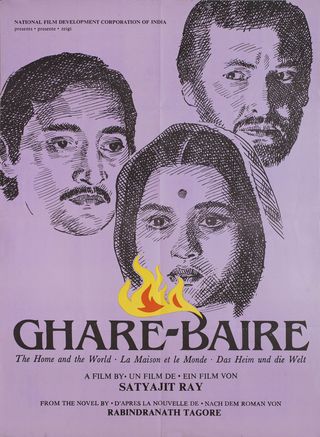
Ghare Baire (The Home and the World) is a 1984 romantic film, based on Rabindranath Tagore’s novel of the same name. The film has a complex portrayal of several themes including nationalism, women emancipation, spiritual and materialistic take on life, tradition versus modernism, and others. When the movie opens, a woman is recalling the events that molded her perspective on the world. Years ago, her husband, a wealthy Western-educated landowner, challenged tradition by providing her with schooling, and inviting her out of the seclusion in which married women were kept, to the consternation of more conservative relatives. Meeting her husband’s visiting friend from college, a leader of an economic rebellion against the British, she takes up his political cause, despite her husbands warnings. As the story progresses, the relationship between the woman and the visitor becomes more than platonic, and the political battles, pitting rich against poor and Hindu against Muslim, turn out not to be quite as simple as she had first thought. The film was in competition for the Palme d’Or at the 1984 Cannes Film Festival. At the 32nd National Film Awards, it won the National Film Award for Best Feature Film in Bengali.
Sukumar Ray is a 1987 short documentary film made by Ray on his father, Sukumar Ray. It was released during the birth centenary year of Sukumar Ray, who was born on 30 October 1887. The thirty minutes documentary features the life and some of the works by Sukumar Ray in the form of paintings, photographs and readings. This is the last documentary made by Satyajit Ray as a tribute to his father. The documentary used Sukumar Ray’s photographs and paintings than video recording as the film was considerably a new medium in India when Sukumar Ray died in 1923.
Ganashatru (‘Enemy of the People’) is a 1990 film is an adaptation of Henrik Ibsen’s 1882 play An Enemy of the People, and was released under that title in the UK. Ray adapts the play to an Indian setting: a flourishing township in which a temple attracts devotees as well as tourists.
Dr. Ashoke Gupta (Soumitra Chatterjee) is the head of a town hospital. Gupta’s younger brother, Nisith, is the head of the committees running the hospital and a temple. Both were built by a local Industrialist. The temple is also a big tourist attraction. Dr. Gupta is convinced that the holy water of the temple is contaminated due to faulty pipe-laying. It is causing an epidemic in the town. He warns his brother Nisith. Nisith, the Industrialist and other town officials reject the idea that holy water might be the cause of the epidemic. They refuse to close the temple to carry out the repairs. Dr. Gupta wants to write an article in the newspaper to warn people, but giving-in to the pressure from the powerful people, the editor refuses to publish it. Left with no alternative, Dr. Gupta organises a public meeting that is also sabotaged. And Dr. Gupta is proclaimed an enemy of the people. The film was screened out of competition at the 1989 Cannes Film Festival.
Shakha Proshakha (Branches of the Tree) is a 1990 film deals with four generations of a well-to-do Bengali family, with a focus on the third generation. It depicts an old man, who has lived a life of honesty, and learns of the corruption of three of his sons. The final scene shows the father finding solace only in the companionship of his fourth son, who is uncorrupted but mentally ill due to a head injury sustained while he was studying in England.
Agantuk is a 1991 film, notable for being Ray’s last film, it was based on one of his own short stories, Atithi. A well-off family is paid an unexpected, and rather unwanted, visit by a man claiming to be the woman’s long-lost uncle. The initial suspicion with which they greet the man slowly dissolves as he regales them with stories of his travels, tales that are at odds with their conventional middle-class perspective on the world.
The story of Agantuk is a very simple one. Anila Bose – a young, educated lady in south Kolkata — receives a letter one day, written by a man who claims to be her long-lost uncle. The stranger claims to have roamed around the globe for the last 35 years, and has invited himself over to her home as he is passing through India. While Anila’s son Babloo is excited about the arrival of ‘a man who may or may not be Dadu’, her husband Sudhindra Bose is cautiously skeptical of the stranger’s motives. During his stay at the Bose’s residence, the stranger, who introduces himself as Manomohan Mitra, comes across as a man of simple tastes, good humour and gentle manners. And yet, the seeds of doubt are not entire dispelled from the minds of Anila and her husband. Agantuk is a philosophical film. Agantuk is a provocative, intellectual movie, and by the time it’s over, Ray’s complex characters have won the viewer’s respect.
The motion-picture director also established a parallel career in Bengal as a writer and an illustrator, chiefly for young people. He revived the children’s magazine Sandesh magazine which his grandfather had founded. Ray had been saving money for some years to make this possible. A duality in the name (Sandesh means both “news” in Bengali and also a sweet popular dessert) set the tone of the magazine (both educational and entertaining). Ray designed four typefaces for roman script named Ray Roman, Ray Bizarre, Daphnis, and Holiday script, apart from numerous Bengali ones for the Sandesh magazine. Ray Roman and Ray Bizarre won an international competition in 1971.
His short stories were published as collections of 12 stories, in which the overall title played with the word twelve (for example Aker pitthe dui, or literally “Two on top of one”). Ray’s interest in puzzles and puns is reflected in his stories. Ray’s short stories give full rein to his interest in the macabre, in suspense and other aspects that he avoided in film, making for an interesting psychological study. Most of his writings have been translated into English. Most of his screenplays have been published in Bengali in the literary journal Eksan. Ray wrote an autobiography about his childhood years, Jakhan Choto Chilam (1982), translated to English as Childhood Days: A Memoir by his wife Bijoya Ray. In 1994, Ray published his memoir, My Years with Apu, about his experiences of making The Apu Trilogy.
He also wrote essays on film, published as the collections: Our Films, Their Films (1976), Bishoy Chalachchitra (1976), and Ekei Bole Shooting (1979). During the mid-1990s, Ray’s film essays and an anthology of short stories were also published in English in the West. Our Films, Their Films is an anthology of film criticism by Ray. The book contains articles and personal journal excerpts. The book is presented in two sections: Ray first discusses Indian film, His book Bishoy Chalachchitra was published in translation in 2006 as Speaking of Films. It contains a compact description of his philosophy of different aspects of the cinemas.[
In certain circles of Calcutta, Ray continued to be known as an eminent graphic designer, well into his film career. Ray illustrated all his books and designed covers for them, as well as creating all publicity material for his films, for example, Ray’s artistic playing with the Bengali graphemes was also revealed in the cine posters and cine promo-brochures’ covers. He also designed covers of several books by other authors. His calligraphic technique reflects the deep impact of (a) the artistic pattern of European musical staff notation in the graphemic syntagms and (b) alpana (“ritual painting” mainly practised by Bengali women at the time of religious festivals (the term denotes ‘to coat with’). Generally categorised as “Folk”-Art cf. in Ray’s graphemes representations.
Thus, so-called division between classical and folk art is blurred in Ray’s representation of Bengali graphemes. The three-tier X-height of Bengali graphemes was presented in a manner of musical map and the contours, curves in between horizontal and vertical meeting-point, follow the patterns of alpana. It is also noticed that the metamorphosis of graphemes (this might be designated as “Archewriting”) as a living object/subject in Ray’s positive manipulation of Bengali graphemes.
As a graphic designer, Ray designed most of his film posters, combining folk art and calligraphy to create themes ranging from mysterious, surreal to comical; an exhibition for his posters was held at British Film Institute in 2013. He would master every style of visual art, and could mimic any painter, as evidenced in his book and magazine covers, posters, literary illustrations and advertisement campaigns.
Ray had been subconsciously paying a tribute to Jean Renoir throughout his career, who influenced him the most. He also acknowledged Vittorio De Sica, whom he thought represented Italian Neoralism best, and taught him the cramming of cinematic details into a single shot, and using amateur actors and actresses. Although Ray stated to have had very little influence from Sergei Eisenstein, films such as Pather Panchali, Aparajito, Charulata and Sadgati contains scenes which show striking uses of montage. He also had sketches of Eisenstein.
Ray considered script-writing to be an integral part of direction. Initially he refused to make a film in any language other than Bengali. In his two non-Bengali feature films, he wrote the script in English; translators adapted it into Hindustani under Ray’s supervision.
The director cast actors from diverse backgrounds, from well-known stars to people who had never seen a film (as in Aparajito). Robin Wood and others have lauded him as the best director of children, recalling memorable performances in the roles of Apu and Durga (Pather Panchali), Ratan (Postmaster) and Mukul (Sonar Kella). Depending on the actor’s skill and experience, Ray varied the intensity of his direction, from virtually nothing with actors such as Utpal Dutt, to using the actor as a puppet (Subir Banerjee as young Apu or Sharmila Tagore as Aparna).
Actors who had worked for Ray trusted him, but said that he could also treat incompetence with total contempt. With admiration of his cinematic style and craft, director Roger Manvell said, “In the restrained style he has adopted, Ray has become a master of technique. He takes his timing from the nature of the people and their environment; his camera is the intent, unobtrusive observer of reactions; his editing the discreet, economical transition from one value to the next.” Ray credited life to be the best kind of inspiration for cinema; he said, “For a popular medium, the best kind of inspiration should derive from life and have its roots in it. No amount of technical polish can make up for artificiality of the theme and the dishonesty of treatment.”
Ray’s work has been described as full of humanism and universality, and of a deceptive simplicity with deep underlying complexity. The Japanese director Akira Kurosawa said, “Not to have seen the cinema of Ray means existing in the world without seeing the sun or the moon.” Kurosawa defended him by saying that Ray’s films were not slow; “His work can be described as flowing composedly, like a big river”. The writer V. S. Naipaul compared a scene in Shatranj Ki Khiladi (The Chess Players) to a Shakespearean play; he wrote, “only three hundred words are spoken but goodness! – terrific things happen.”
Vincent Canby once wrote about Ray’s films “no matter what the particular story, no matter what the social-political circumstances of the characters, the cinema of Satyajit Ray (the Apu trilogy, The Music Room, Distant Thunder and The Chess Players, among others) is so exquisitely realized that an entire world is evoked from comparatively limited details.” On a trip to India, Christopher Nolan expressed his admiration for Ray’s Pather Panchali. Nolan said, “I have had the pleasure of watching Pather Panchali recently, which I hadn’t seen before. I think it is one of the best films ever made. It is an extraordinary piece of work.”
Iranian filmmaker Majid Majidi has expressed deep admiration for Ray. Majidi said, “I have learned a lot about India based on the works of remarkable Indian director Satyajit Ray so it was my dream to make a film in his land. His view point is very valuable to me and I love whatever he has done, so one of the main reasons behind making this film is my admiration for Satyajit Ray and his work”.
Salman Rushdie’s Haroun and the Sea of Stories contains fish characters named Goopy and Bagha, a tribute to Ray’s fantasy film. In 1993, University of California, Santa Cruz established the Satyajit Ray Film and Study collection, and in 1995, the Government of India set up Satyajit Ray Film and Television Institute for studies related to film. In 2007, the BBC declared that two Feluda stories would be made into radio programs. During the London Film Festival, a regular “Satyajit Ray Award” is given to a first-time feature director whose film best captures “the artistry, compassion and humanity of Ray’s vision”.
A number of Documentary films have been produced about Ray in India, prominent ones include: Creative Artists of India – Satyajit Ray (1964) by Bhagwan Das Garga and Satyajit Ray (1982) by Shyam Benegal – both backed by the Government of India’s Films Division, The Music of Satyajit Ray (1984) by Utpalendu Chakrabarty with funding from the National Film Development Corporation of India, Ray: Life and Work of Satyajit Ray (1999) by Goutam Ghose. In 2016, during the shooting of the film Double Feluda, Satyajit’s son, Sandip, filmed his father’s famous libraryil.
On 23 February 2021 on the year of Satyajit Ray’s birth centenary, the Union Information and Broadcasting Minister Prakash Javadekar announced that the central government would institute an award in the name of Satyajit Ray. The award is to be on a par with the Dadasaheb Phalke Award.
The Academy Film Archive has preserved many of Ray’s films films as part of its Satyajit Ray Collection. In 52nd International Film Festival of India, on the occasion of his birth centenary, the Directorate of Film Festivals will pay tribute to him through a ‘Special Retrospective’.Award in recognition of legacy. In recognition of the auteur’s legacy, Lifetime Achievement Award was named as ‘Satyajit Ray Lifetime Achievement Award’ from 2021, to be given at the festival.
Ray received many awards, including 36 National Film Awards by the Government of India, and awards at international film festivals. At the 11th Moscow International Film Festival in 1979, he was awarded with the Honorable Prize for the contribution to cinema. At the Berlin International Film Festivalm, he was one of only four filmmakers to win the Silver Bear for Best Director more than once and holds the record for the most Golden Bear nominations, with seven. At the Venice Film Festival, where he had previously won a Golden Lion for Aparajito (1956), he was awarded the Golden Lion Honorary Award in 1982. That same year, he received an honorary “Hommage à Satyajit Ray” award at the 1982 Cannes Film Festival. Ray is the second film personality after Charlie Chaplin to have been awarded an honorary doctorate by Oxford University.
He was awarded the Dadasaheb Phalke Award in 1985, and the Legion of Honor by the President of France in 1987. The Government of India awarded him the Padma Bhushan 1965 and the highest civilian honour, Bharat Ratna, shortly before his death. The Academy of Motion Picture Arts and Sciences awarded Ray an Honorary Award in 1992 for Lifetime Achievement. In 1992, he was posthumously awarded the Akira Kurosawa Award for Lifetime Achievement in Directing at the San Francisco Francisco International Film Festival.
Participants in a 2004 BBC poll placed him No. 13 on the “Greatest Bengali of all time”. In 1992, the Sight & Sound Critics’ Top Ten Poll ranked Ray at No. 7 in its list of “Top 10 Directors” of all time, making him the highest-ranking Asian filmmaker in the poll. In 2022, the Sydney Film Festival showcased 10 films by Ray as homage and the BFI Southbank screened a complete retrospective in July.
On the occasion of the birth centenary of Ray, the International Film Festival of India in recognition of the auteur’s legacy, rechristened in 2021 its annual Lifetime Achievement award to “Satyajit Ray Lifetime Achievement Award”.
Ray is a cultural icon in India and in Bengali communities worldwide. Together with Madhabi Mukherjee, Ray was the first Indian film figure to be featured on a foreign stamp (Dominica).
His films have received worldwide critical acclaim and won him several awards, honours and recognition — both in India and elsewhere. Ray often used to say that he did not like making grand films, and that he would rather tell the story of the ordinary man, the man on the street. Like his films, his short stories too mirrored this preference of his – most of them describing the lives of ordinary men – all of whom were, without exception, very lonely. Ray valued work more than anything else. He would work 12 hours a day, and go to bed at two o’clock in the morning. He also enjoyed collecting antiques, manuscripts, rare gramophone records, paintings and rare books. As a director, Ray was noted for his humanism, his versatility, and his detailed control over his films and their music. He was one of the greatest filmmakers of the 20th century.
Photos courtesy Google. Experts taken from Google.
 Writer Sunita

.jpg)