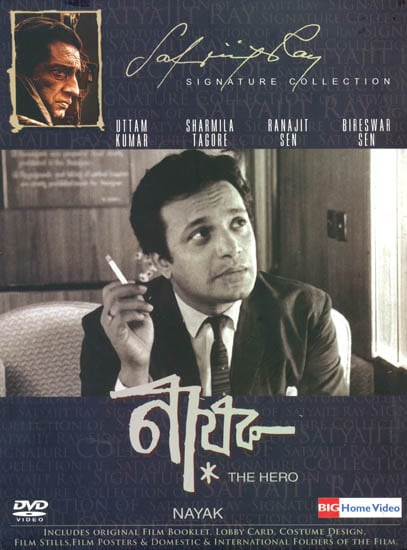
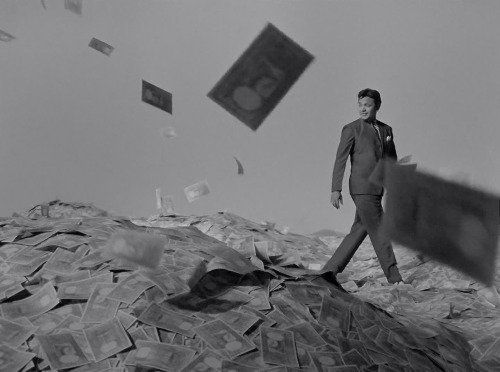
Nayak (also released under the translated title The Hero) is a 1966 film composed, written, and directed by Satyajit Ray. The story revolves around a matinee idol on a 24-hour train journey from Kolkata to Delhi to receive a national award. However, he ends up revealing his mistakes, insecurities and regrets to a young journalist, who realises that behind all his arrogant facade lies a deeply troubled man as his life’s story is gradually revealed through seven flashbacks and two dreams.
Arindam Mukherjee is the indomitable superstar in the Bengali film industry and has been riding high on the popularity charts. He is invited to Delhi to receive a prestigious award, and not being able to secure a flight seat, he boards a train instead, planning to ‘sleep it off’ till he reaches his destination. Travelling along with him in the same train are myriad characters from various walks of life, each with his or her own story. In the restaurant car, he meets Aditi Sengupta, a young journalist who edits a modern women’s magazine, Adhunika.
In a bid to increase the sales of her magazine, she requests Arindam for an interview, and the bored star agrees in good humour. Unwilling to answer her questions honestly at first, he begins to frustrate the novice journalist. But soon enough, owing to a sub-conscious need to speak to someone, Arindam begins to wander down the dark lanes and by lanes of his memories — both good and bad — and begins to describe various incidents in his life. As Aditi tries to get to the man behind the star layer by layer, she begins to discover a haunting truth — that despite all the fandom, popularity and immense success, Arindam Mukherjee is an inherently lonely man who needs a friend, more than anything else. His insecurities, his guilt, his grief, his hatred towards himself — everything is laid bare, as he inadvertently opens his heart to the woman.
Toward the end of the train journey, Arindam is drunk and feels a need to confide his wrongdoings. He asks the conductor to fetch Aditi. He begins to reveal the reason behind the altercation he was a part of, but Aditi stops him, as she has already guessed. It was an affair he’d had with one of his co-actors, Promila. Afraid that he might commit suicide, Aditi makes sure he returns to his cubicle, before going back to her own. As the star re-lives and examines his life with Aditi, a bond develops between them. Aditi realizes that in spite of his fame and success, Arindam is a lonely man, in need of empathy. Out of respect for him, she chooses to suppress the story and tears up the notes she has written. She lets the hero preserve his public image.
On the other hand, Aditi, who has got the ‘scoop’ of her life, realises that she has scratched the surface too deep, and that Arindam Mukherjee is no different than anyone else riding on that train. It is in this realisation that her hatred towards the superstar ceases to exist. As the train pulls into Delhi station, she decides not to publish the interview, leaving the hero surrounded by his fans, and disappears from his life forever.
In Nayak, Uttam Kumar plays Arindam Mukherjee with such poise and ease that it appears as if he is portraying his own life on the celluloid. Ray gives us a vulnerable hero hiding behind his cocky, larger-than-life façade. Kumar, to his credit, never misses a note during his challenging portrayal. He is well complemented by Sharmila Tagore who plays the character of Aditi to a tee. Aditi is the only person Arindam opens up to; the tantalizing conversations between the two characters offer some great food for thought. Ray uses the various interactions between the co-passengers to make us realize that the hypocrisies and follies of a star are not much different from that of an ordinary man. A few other characters in the movie merely provide a morality check.
Nayak a film on the life of an insanely popular matinee idol, a brash, haughty young superstar riding the waves of popularity and enjoying. A film that is so rich, so deep and yet, told in such simple language that perhaps it would not be a mistake to claim that it featured among the best works of Ray’s illustrious career.
Ray wrote the screenplay of the film at Darjeeling in May, where he went during off-season from filming. Even then he had Uttam Kumar in his mind for the lead, but not as an actor, rather a “phenomenon”. When Ray finished this script he hearing to Tapan Sinha and said ”I would choice to Uttam for this role”. Then Sinha replied This is perfect choice. No other can play than Uttam to this role. In a letter by Ray in 1966, he wrote: I wanted a relationship to develop between the Matinee Idol and a girl on the train. Romance was out – the time being so short – but I wanted something with an interesting development. The transition from apathy mixed with a certain dislike, to sympathetic understanding, seemed a promising one. So I made Aditi a slightly snooty sophisticate who questions and resists the easy charm, good looks, sangfroid, etc etc. of the Idol, until she discovers there’s an area where he is helpless, lonely, and in need of guidance. From the point where he begins to unburden himself, Aditi can ignore his façade because she’s had a glimpse of what lies beneath. At first he is ‘material’ for her for a journalistic probe, until the process of unbarring reaches a point where she realizes it would be unethical to exploit it. Sympathy and desire to help is the next step. The bond between the two is tenuous, but real. Intellectually clearly above him, her goodness consists in providing him with the small area of contact that exists between them…
This was the first time when the two icons of Bengali Cinema Satyajit Ray and Uttam Kumar worked together. Uttam Kumar once said that it was one of the best films of his career.
Ray wrote after Uttam’s death ‘I hardly recall any discussion with Uttam on a serious analytical level on the character he was playing. And yet he constantly surprised and delighted me with unexpected little details of action and behaviour which came from him and not from me, which were always in character and always enhanced a scene. They were so spontaneous that it seemed he produced these out of his sleeve. If there was any cogitation involved, he never spoke about it.’ He also said that in this film he might have made some mistakes but Uttam never made any, every shot was confirmed in one take.
Sometime in May 1966, Satyajit Ray called Uttam Kumar. “Uttam, Nayak premieres tomorrow at Indira Cinema. I hope you will be there,” Ray reportedly said. “But Manikda, the press and public will be in attendance. Do you think I should go? There will be pandemonium,” he replied. “Uttam, don’t forget it’s a Satyajit Ray film. Please be there,” Ray commanded. The next day, the news of Kumar’s appearance at the cinema house spread and all hell broke loose. By late afternoon, roads leading to Bhowanipore had to be barricaded. Kumar’s car – by most accounts a Chevrolet Impala – was piloted through the by-lanes. The theatre was shaking under the weight of uproarious chanting, ‘Guru, guru’, with demands to see the star. The hall manager rushed to Ray. “Sir, if we don’t bring him up on stage there will be a serious law-and-order issue.” Minutes later, the lights came on and Kumar was seen standing on the platform in front of the screen. He raised his hand. The crowd fell silent, as if by the waving of a magic wand. “I request you to please be silent and watch the film. Don’t forget it is a Satyajit Ray film.”
The film is one of only three feature films in Ray’s body of work that are not adaptations, and are original screenplays written by Ray himself. Told in free style, punctuated with the occasional humour and smart wit, running back and forth thanks to flashbacks and dream sequences, and taking its time to denude the protagonist of his external garb of casual indifference, Nayak is perhaps the best example of one of Satyajit Ray’s many cinematic skills — his mastery over the narrative. It is not easy to handle multiple storylines intersecting with each other. But Ray does it with admirable flair, and with such simplicity that not one transition looks jarring. What’s even more astonishing and awe-inspiring is that each of the passengers traveling in the train somehow seem to be connected with the protagonist, in the fact that the voids in their lives are not unlike the one in the life of the superstar. And it is in that sense, that Arindam Mukherjee is reduced to just another passenger in the train, journeying through life, from one point to another.
The film boasts of some terrific performances — in fact, there are far too many of them to talk about all of them within the scope of this article. But there are two that unarguably deserve special mention. Sharmila Tagore plays Aditi with grace, elegance and intelligence, exuding a calm confidence that catches the star’s attention, because he is normally used to see the obliged faces of fans and sycophants crowding around him. When she comes out of her shell and reaches out to the man behind the superstar, her concern is genuine — and that it does not depend on box office figures or the success of securing an autograph. She reaches out to Arindam Mukherjee as a woman would reach out to a man who needs someone to talk to. There is a scene in the film in which she chides Arindam Mukherjee in a stern voice, and for a fleeting moment, her bare her heart to the man, for a change. When the train is about to reach its final destination, Aditi walks up to Arindam Mukherjee to say goodbye, and tears up the sheets of paper in which she had recorded her interview with the hero. When Arindam Mukherjee asks her why did she do that, and if she knew the interview by heart, she replies by saying — ‘I’ll…keep it in my heart.’
Bengal’s greatest superstar Kumar plays Bengal’s greatest superstar in Satyajit Ray’s Nayak. Kumar, at the height of his popularity then, played a matinee idol whose insecurities and guilt were to be stripped bare in the film. Kumar shows that he is not considered the star of the millennium without reason. In a long career of fantastic performances, his performance in Nayak is, by far, his best. He smiles and cries, he is frightened and begs for his life, he is vindictive and ruthless, he is a king and a wretch, ambitious in the beginning and hopeless when he has achieved it all, he is a romantic at heart in one scene, he is repentant and frustrated in another — all within the span of one film.
Nayak is easily one of Satyajit Ray’s most incisive and detailed studies of human nature. A careful watching of the film, and a little reflection would make us realise that perhaps the most inconsequential characters of the film are the ones who are truly happy, which could, in turn, probably make us wonder.
After being digitally restored in Academy Film Archive ”Nayak” was released in 2014 Berlin Film Festivals. The film got success again.
Berlin Internation Film Festival, 1966 film won Speical Jury Award, Critics’ Prize (UNICRIT Award) and nomination for Golden Bear for Best Film. Film won BFJA for Best Director – Satyajit Ray and Best Actor Award – Uttam Kumar in 1967.
The Hero is a graceful meditation on art, fame, and regret from one of world cinema’s most keenly perceptive filmmakers.
Photos courtesy Google. Experts taken from Google.
 Writer Sunita