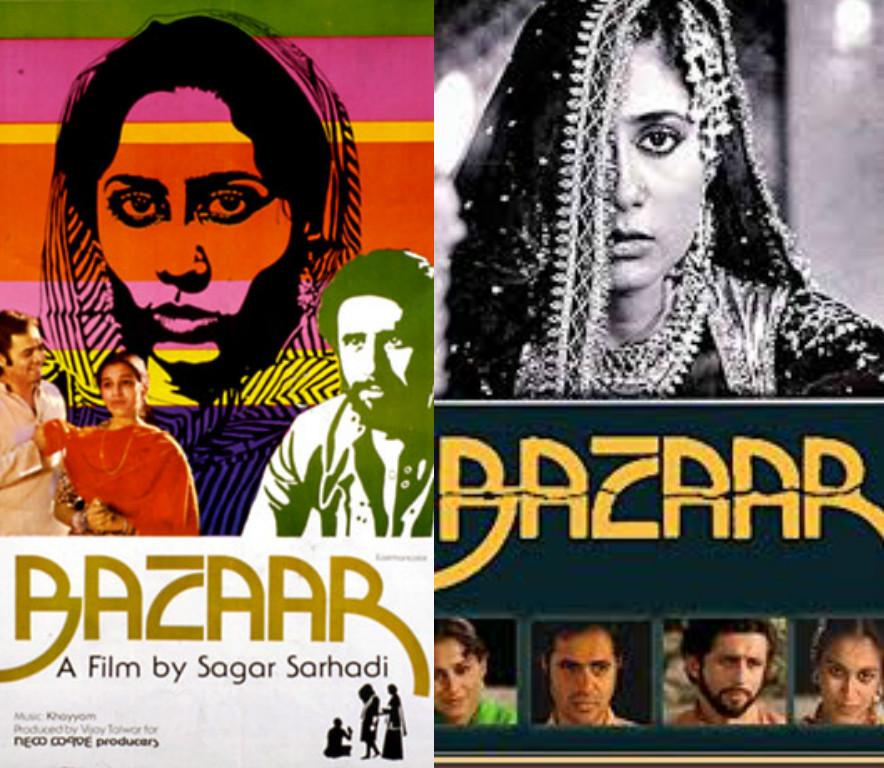
Bazaar (Market) is a 1982, film directed by Sagar Sarhadi was inspired by newspaper headlines concerning transactional marriages involving underprivileged Muslim girls in India and elderly men in the Gulf (reportedly the 1991 Ameena case). Film starring Naseeruddin Shah, Farooq Shaikh, Smita Patil and Supriya Pathak. The film set in Hyderabad, India.
Like its name implies Bazaar is a film about the market-place. An Urdu playwright-turned-ideologue and a writer-turned-producer, Sarhadi has always had strong links with Hyderabad, the bastion of Urdu literature. His first feature film Bazaar is about the decadence and moral corruption which has overtaken this nawabi but impoverished city forcing khandani parents to virtually sell their daughters to the highest bidder. Partly a passionate love play and partly a study in despair and futility, the movie effectively details the marital hardsell which is fast becoming a way of life for Hyderabad’s Muslim population.
The movie opens with Najma (Smita Patil) decking herself up in a flat in Mumbai. She soon entertains a guest, Akhtar Hussain, who turns out to be her love interest. He talks of an argument at his house with his father who had asked him to marry the daughter of an affluent cement factory owner. Akhtar claims that he refused the offer and had told his father that he will marry the woman of his choice. At being asked by Najma about when they would get married, Akhtar reveals that in order to marry against the wishes of the family it is necessary that he start earning his own living. He further assures the crestfallen Najma that one Shakir Khan, a middle-aged man working in the gulf area, who would soon be coming to their place, would help him with the money to set up some business. Najma is apprehensive of Shakir Khan’s stay with her but Akhtar says that there is no other way as after all, the flat has been provided for by Shakir Khan himself. As the evening proceeds, it is revealed that Najma has received many letters from her home for the past six years however, she never reads them as she still hasn’t forgiven her family for forcing her into selling herself in order to earn some money for the family. She had been willing to engage in some other work but her mother had insisted that the pride of the Nawaabs that they had once been would be tarnished if she becomes a working woman and so it would be better to sell the body instead as it is only for a night and can be accomplished secretly.
The next day Najma is visited by Salim, a renowned poet, who has been in love with her for the past six years; however, she hasn’t accepted his love. The two share a friendly relationship and are very comfortable with each other. Salim once again reiterates that he often thinks about her and that though he couldn’t marry her 6 years ago, he is quite capable of doing so today. Salim tells her that she is living a life of lies as Akhtar only visits her to spend the night and has no intention of marrying her.
Najma and Akhtar receive Shakir Khan at the airport. The next morning Shakir questions Najma on the whereabouts of Akhtar, hinting at the promiscuous nature of their relationship and eyeing Najma the whole time. Najma reaffirms her love for Akhtar at which Shakir says that he always wanted to see her settled and would be happy to help Akhtar in his endeavours. He further expresses his intention to marry a woman like her which leaves her a bit taken aback.
Shakir Khan asks Najma to throw a kind of party in the evening where he separately tells Akhtar of his wish to marry a woman as he misses the comfort of home and family. A flashback shows Shakir Khan having his own wife and children; however, it is apparent that he was abusive and so not welcome in his house. He wants Najma to find him a bride from her home city of Hyderabad. When Akhtar tells Najma of this she finds it revolting, however she agrees to find a beautiful bride for Shakir at the prospect of this deed helping her and Akhtar to set up their life as a couple.
The scene changes to Hyderabad where Sarju and Shabnam fall in love with each-other. Sarju asks Nasreen, who secretly loves Sarju, to help set up a meeting with Shabnam who happens to be her friend. Nasreen is heartbroken but in the face of reality she decides to keep her feelings to herself as both Sarju and Shabnam were much in love. Meanwhile, Najma buys the jewellery and other articles that will be necessary for the wedding, and the wedding party, including the common friend, Salim, departs for Hyderabad. While they travel in the train, a flashback reveals how Salim used to visit Najma at her home in Hyderabad and express his feelings but Najma refused him time and again saying that she is that golden bird for her family whose secret is unknown to him. She says that she cannot marry him and that it would be better that he forget her. She promises to acknowledge him as a friend should their paths ever cross again.
Back in Hyderabad, Shabnam’s mother has to let go of a good match for her eldest daughter as she cannot afford to fulfill the demands of the groom’s side. Hajjan Bi, the matchmaker, chides Shabnam’s mother as in this way they would never find a match; however, she leaves promising to tell her if a good match comes her way. Meanwhile, Najma, now in Hyderabad, sets out in search of a bride. She ends up at a place where the poor are literally showcasing their daughters, hoping to get their young girls, some of whom have barely reached puberty, married in order to receive some amount of money in return. Najma is horrified by this and questions her role in this whole wedding plan. Nonetheless, she decides to visit her family in Hyderabad and finds her mother get all sentimental to see her again. She also meets Sarju, her childhood friend whom she considers her younger brother. He tells her that he has found a girl he wishes to marry. Najma feels very happy and promises to help him get married and that too quite grandly. As she leaves, she comes across Nasreen and asks her if she has come to meet Sarju, to which she replies in the affirmative. Najma ends up thinking that Nasreen is the girl Sarju was talking about.
At a small gathering, consisting of the wedding party from Mumbai, Sarju, Nasreen and Shabnam, Shabnam sings a beautiful song at which Shakir Khan seems quite impressed. He later expresses his wish to marry Shabnam which shocks Najma as Shabnam is quite young and not yet 16. However, Akhtar persuades her to set up the wedding as even if she refuses to, the poor parents will be more than happy to get one of their daughters married to such a rich man. The bride’s family accepts the offer but sets up their own demands asking for 5000 rupees for the family (to be used for the elder daughter’s marriage) and 101 rupees as bakshish for the matchmaker, Hajjan Bi. With the wedding being set up, Salim is horrified at the whole thing and in a drunken state expresses his anger at how the girls are being sold off to the rich because of poverty. He equates the setting up of the wedding to the system where humans are auctioned. When Sarju gets to know of the wedding, he confronts Shabnam’s parents asking them how they could do so knowing that he and Shabnam love each other and that he was working hard to earn a living with the intention of marrying her. He points out that they have auctioned her happiness and swears that he will either not let this wedding take place or destroy himself. On the other hand, Najma is not able to deal with the whole situation and constantly questions her role in it. Salim tells her that marriage is but a socially acceptable way of selling and buying humans and that she too has been a victim of a similar market. He tells her that as long as she is dependent on a man she will be just a toy, only when she stands on her own feet will she become her own person, with her separate identity. At that point, Sarju comes over to Najma and tells her that she had set up the love of his life with Shakir Khan. Najma feels terrible and tries to get the wedding cancelled but to no avail. She breaks down and apologizes for messing it up. Sarju takes matters into his own hands and pleads Shakir Khan to break off the wedding, relating all his troubles, but only gets thrashed by him in return with Akhtar and some of the others from the wedding party as mute spectators.
Shabnam is revolted by the relationship her family had set up but has no choice. She pleads not to get married but all her pleas fall on deaf ears. She goes to the mazaar and unties the thread which she had once tied with the wish to have Sarju as her husband. She points out that she had asked for life when she had tied this thread of wish at the mazaar but now only takes back the dead body of all her wishes. Sarju meets Shabnam for the last time with the help of Nasreen and the two feel sorrowful at the turn of events. Shabnam marries Shakir Khan. Salim decides to go back to Mumbai while Najma plans to stay put. She rejects Akhtar, who was quite elated as now it meant that Shakir Khan would surely help him set up a good life. Najma points out that if he could commit such a thing for money then he could perhaps also sell her off one day for his benefit. Akhtar breaks down and says that he will be destroyed without her, to which she replies that he has already destroyed himself by being a pawn in Shakir Khan’s endeavours. On the wedding night, Shakir Khan finds his new bride dead on the bridal bed. Shabnam had committed suicide by poisoning herself. Sarju is heartbroken at the news. Najma feels guilty and catches the train to Mumbai through which Salim was leaving. She faces Salim and relates the news of Shabnam’s death at the end of which she owns up to being a part of this unfairness, this crime.
The city’s vast rocky expanses and exquisite mosques are used to advantage and Sarhadi builds up the Hyderabadi atmosphere brilliantly. Purdah nashin homes with bamboo curtains to separate the men from the girls, colourful bangle-sellers and the little details that go to make life in the city’s middle class quarters are brought out by Sarhadi’s sensitive eye. Most of all the degenerate almost debauched, life-style of Shakar Ali Khan and his cortege is established through brilliant sequences in which the group sits around mapping out its strategy. The art director has done his job with great proficiency. The poverty stricken areas of (old) Hyderabad have come alive on the screen. The streets, the roads, the houses; everything is damn realistic.
Writer-director Saagar Sarhadi has made a brilliant movie with a modest production value. The movie is not to be watched by eyes and ears (the songs being immortal ones and the dialogs being the heart-piercing ones) but by the soul. The real life of such poor (Muslim) girls whom none cares for once they are sold out and ‘delivered’. They are not self-sufficient. They are not independent. Their helplessness gets easily sold out to those who may not be worthy of becoming their husbands but who are wealthy enough to buy that helplessness from their guardians. The girls are just commodities whose selling consideration is also not theirs, it goes into the hands of their guardians. Film is actually the market of their poverty; their helplessness, to be accurate.
Baazaar is a realistic movie which realize the cruel reality prevailing in our country. There has not been any political or social will shown over the years to abolish this market. The deals have been going on. Even the tears of the girls (a majority of them are minor by age) dry up but the stony hearts of the buyers and the sellers do not exude. Everything of this soul-crushing phenomena has been portrayed with utmost realism in this movie through a touching love story of Sarju and Shabnam which is destined to go the tragic way. The sentimental love story with the horrifying reality has been blended well with the Shaayari (Urdu poetry) and the melodious music, giving the movie a unique form and rendering it a cult status.
Baazaar highlights the irony of so-called religious customs and the significance given to the so-called giving of tongue (solemn promise made, not to be broken) which are nothing but the subterfuge for ensuring that the deal for giving the girl ultimately materializes and no eleventh hour development is able to stop it.
A magnificent soundtrack by Khayyam is immortal, consisting of classic Ghazals and Nazms. The tracks include Bhupinder Singh’s unforgettable Karoge Yaad Toh, Jagjit Kaur’s haunting Dekh Lo Aaj Humko, and the beautiful Phir Chhidi Raat, sung by Talat Aziz and Lata Mangeshkar. But Dikhai Diye Yun is a remarkable feat – both in terms of composition and direction. Surrounded by friends and family, Shabnam is singing at a party hosted by Najma. The song is about love. And every person on the screen is experiencing a form of intense devotion or blinding desire. The song takes on a different meaning for whoever who is listening and watching. Shabnam is singing to Sarju, as he looks at her smitten. The song resonates with Salim and Najma as they think about lost love, while Akhtar looks on, aware but unruffled by their history. Nasreen cannot take her eyes off Sarju, and as he smiles back at her, Najma assumes that this is the woman he wants to marry. Lost in their personal love stories, nobody but Salim notices as Shakir lasciviously eyes Shabnam. Salim watches, troubled, as a wordless deal is struck with Akhtar for the hand and virginity of the clueless woman. The whole cast is present in the song, and imminent disaster is conveyed through silent gazes and impeccable acting. In a matter of four minutes, the love ballad becomes a heartbreaking elegy.
Towering performances have been delivered by the great artists of Indian cinema viz. Nasiruddin Shah, Smita Patil and Farooq Sheikh. These are the actors who have redefined the art of acting and Baazaar is a showcase of their abilities. However the heart-conqueror is Supriya Paathak who won the Filmfare award for the best supporting actress for her role of Shabnam in this movie.
A dialog from the final meeting of Sarju and Shabnam in the movie (just before the song – Dekh Lo Aaj Humko Jee Bhar Ke). Sarju says, ‘Agar Hum Gharib Na Hote To Humko Koi Bhi Juda Nahin Kar Sakta Tha Na ?’ (None could have separated us had we not been poor). And Shabnam replies, Haan, Tab Hamko Koi Bhi Juda Nahin Kar Sakta Tha’ (Yes, then none could have separated us).
Photos courtesy Google. Experts taken from Google.
 Writer Sunita