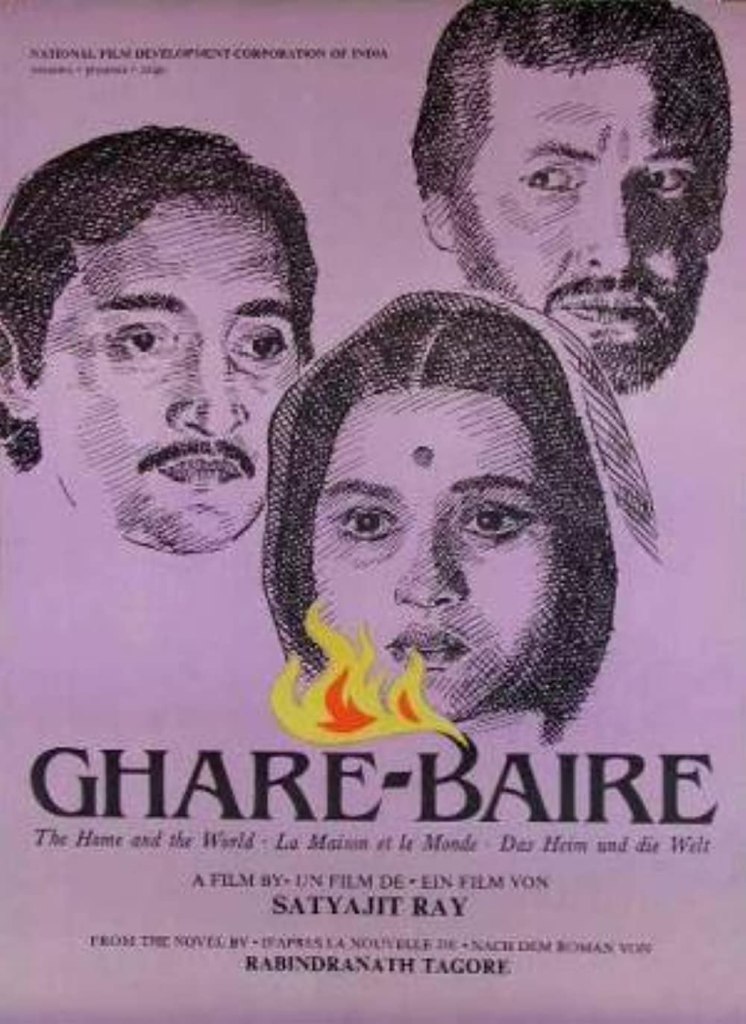
Ghare Baire (The Home and the World) is a 1984 Bengali -language romantic film directed and written by Satyajit Ray. Film based on Rabindranath Tagore’s novil of the same name, starring Soumitra Chatterjee, Victor Banerjee, Jennifer Kendal and Swatilekha Chatterjee. The film has a complex portrayal of several themes including nationalism, women emancipation, spiritual and materialistic take on life, tradition versus modernism, and others.
The story is set in 1907 Bengal, India. The period of British rule in India. Following the ‘divide-and-rule’ policy, Lord Curzon has decided to partition Bengal; one for Hindus and another for Muslims. The people launch a nationalist movement – Swadeshi, appealing for a boycott of foreign-made goods. The movement is symbolised by public burning of foreign-made goods, mainly the British textiles.
A landlord-king Nikhilesh was in Sukhsayar, the first in his family to receive a Western education and he has modern views. He married Bimala. He appointed Miss Gilby to teach his wife Bimala Piano and English songs. He lives happily with his wife Bimala and his widowed sister-in-law until the appearance of his friend, a revolutionist and a strong supporter of the Swadeshi movement, Sandip. Sandip comes to convince Nikhilesh and the villagers to renounce foreign goods in exchange for the Swadeshi ones.
Sandip, a passionate and active man, is a contradiction to the peace-loving and somewhat passive Nikhilesh. Nikhilesh introduces him to his wife Bimala. However, Sandip feels infatuated with Bimala. He insists she meets him daily and decided to stay in Nikhilesh’s bungalow. He easily attracts innocent and unsuspecting Bimala. Meanwhile, Miss Gilby is hit by a student who was associated with the Swadeshi movement when she was returning from the Church. Because of this, she decides to leave Sukhsayar. Although Nikhilesh figures out what is happening between Sandip and Bimala through his sister-in-law and close associates, he is mature and grants Bimala the freedom to grow and explore what she wants in life, as their marriage was arranged when she was a girl. Further, Nikhilesh tells Bimala that he would like her to have a life not only inside the home but outside of it as well. Sandip convinces Bimala to support the Swadeshi movement and urges her to convince Nikhilesh too about the movement who is against the Swadeshi movement because it is not affordable for the poor. According to Nikhilesh, poor people can’t afford the movement because foreign goods are cheap and have better quality than the Swadeshi ones and they would suffer if foreign goods are banned. Thus, he doesn’t ban foreign goods in Sukhsayar. Although Sandip doesn’t concede defeat and starts to make some sinister plan when local poor Muslim tenants also refused to stop buying and selling foreign goods. He creates groups that would often snatch foreign items from the local Muslim traders and bribe the local administrator to sink the boats carrying the foreign goods in Sukhsayar. This results in the growing hatred between Hindus and Muslims. Muslim preachers from other areas started to take benefit of these problems between Hindus and Muslims of Sukhsayar and started to preach hatred to poor Muslim peasants against Hindus.
Sandip demands money from Bimala for the Swadeshi cause. Unsuspecting Bimala gives her the required money but found later that he had demanded more money than required. She also found that he is creating problems in Sukhsayar. Bimala ultimately realizes that it is indeed her husband Nikhilesh who actually loves her rather than Sandip. She regrets her actions in front of Nikhilesh who forgives her. In Sukhsayar, riots broke out between Muslims and Hindus. Nikhilesh decides to go himself and stop the riots between the two groups. Meanwhile, Sandip leaves Sukhsayar by train as soon as he hears about the riots.
Ray in his screenplay has masterfully woven the question of dichotomy and the hypocrisy of nationalism through the main characters. He has made sure that Bimala remains to be the central character of the narrative. Ray was so passionate about this film that he completed it even after suffering two heart attacks during the filming.
Ray has focused more on the conversations between the characters than narrating it through the cinematic language. By using symbolism, he carefully builds the image of a Bhadramahila (respectable woman) in Bimala. Bimala, trying out new blouses stitched in the western style. She is taking classes of western music and mannerisms from an English woman. On the other hand, she is cooking and serving her husband. She is also expected to follow the traditional values attached to being a married Hindu woman. In one scene, Nikhil asks Bimala to sing a Bangla song and she obediently complies. All that Bimala lives for is to fulfil her husband’s desires.
Ray depicts the complexity of the dichotomy between the home and the world through Bimala’s responses to the changes taking place in her life. Though educated and obedient, Bimala is not allowed to cross the passage connecting the antarmahal (inner courtyard of the house) to the outer or drawing room. Even in her conversations with Nikhil, she is not willing to cross the boundaries, although he insists. Eventually, she crosses the passage accompanied by her husband, but the move is criticised heavily by society. When she meets Sandip, she is swept away by his passion.
In Ghare-Baire, another supporting yet important character is Bimala’s sister-in-law “Bara Rani“. She is a widow and has no privileges unlike Bimala. She considers Bimala a lucky woman. She also disapproves of the freedom that Bimala receives form her husband, thereby subtly portraying how women internalise misogyny and the patriarchal norms set by the society.
The portrayal of clothing and mannerisms by Ray brilliantly depicts how the nationalist movement redresses the independence of women from a certain class and caste. Widows and lower caste women remain completely ignored by the nationalist movement. Another female character in the film is a British woman named Miss Gilby. She teaches western music and mannerisms to Bimala. Ray has not given much screen space to this character but she happens to be Bimala’s connection to the outer world apart from her husband. This character subtly represents the notion that was hammered in the minds of upper class Indians that British women were learned and more civilized than Indian women which is why Bimala was being taught to become westernised woman, and therefore become more civilised.
Abroad however, the response was mostly positive. The film premiered at Cannes, where it was well received. Vincent Canby wrote in the New York Times: “As with the works of any great director, The Home and the World defies easy categorization. In close-up, it’s a love story, but it’s one so fully defined that, as in a long-shot, it also succeeds in dramatizing the events seen on the far horizon – including the political differences between Gandhi, who led the nationalist movement, and Tagore, who, like Nikhil, stood for civilized compromise.” About the performances, he wrote: “The film is acted with immense grace by its three leading actors.” Roger Ebert noted that the real story of the film takes place within Bimala’s heart and mind. He added: “It is a contemplative movie — quiet, slow, a series of conversations punctuated by sudden bursts of activity.”
Ghare-Baire was nominated for the Palme d’Or at the 1984 Cannes Film Festival. At the 32nd National Film Awards, it won the National Film Award for Best Feature Film in Bengali, Best suporting Actress (Victor Banerjee) and Best Costume Designer.
Photos courtesy Google. Experts taken from Google.
 Writer Sunita